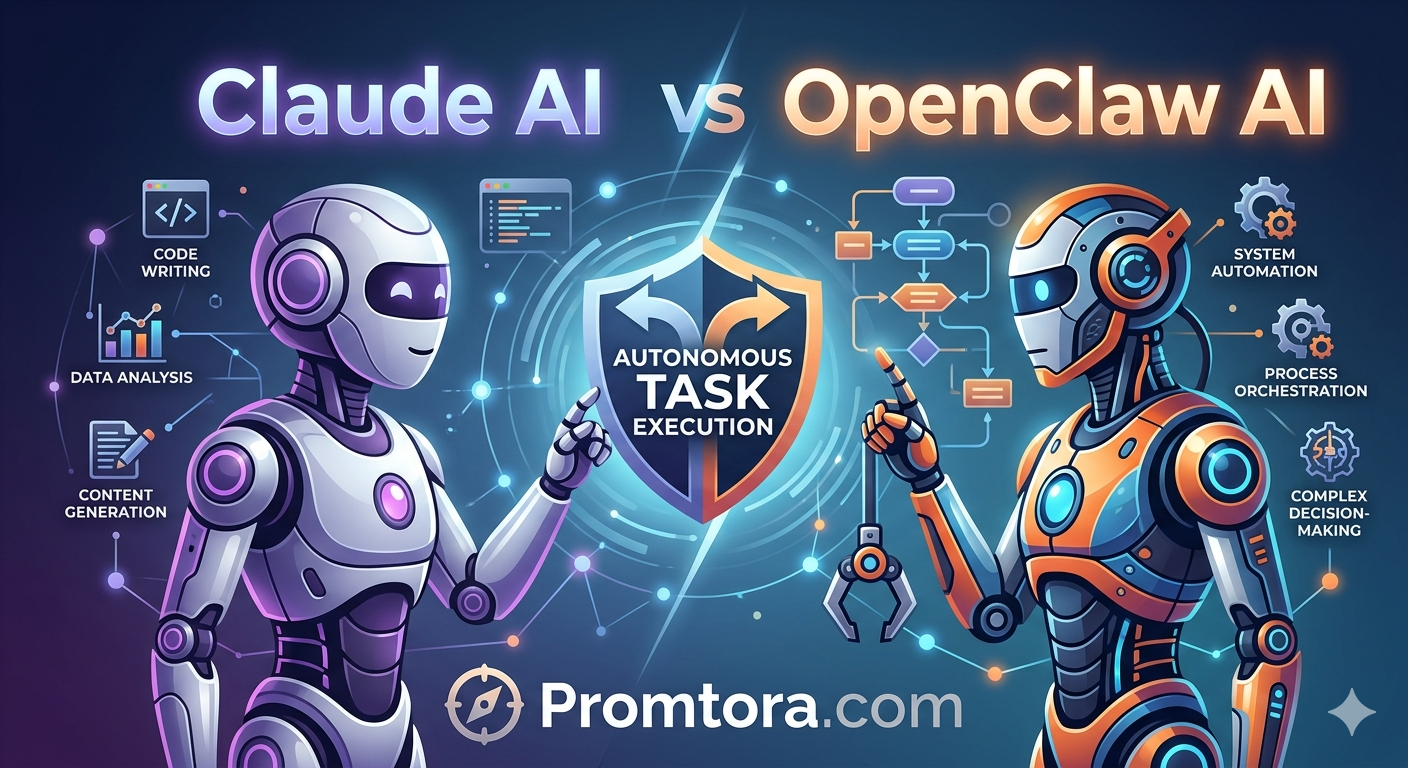
Claude AI vs OpenClaw AI for Autonomous Task Execution
The rise of AI in 2026 has shifted from simple chatbots to fully autonomous agents that can execute real-world tasks. Two names that often come up in this space are Claude AI and OpenClaw.
At first glance, they may seem like direct competitors—but in reality, they are fundamentally different technologies designed for different roles in automation.
In this article, you’ll learn:
- The core differences between Claude AI and OpenClaw
- How each handles autonomous task execution
- Real-world use cases
- Strengths, weaknesses, and limitations
- Which one is better depending on your goals
Understanding the Core Difference (Very Important)
Before comparing them, you need to understand this:
👉 Claude AI = Intelligence (the brain)
👉 OpenClaw = Execution system (the body)
This is not just a metaphor—it’s how modern AI systems are structured.
- Claude is a large language model (LLM) that thinks, writes, and reasons
- OpenClaw is an agent framework that can take action and automate tasks
According to recent comparisons, comparing them directly is like comparing an engine to a car .
What Is Claude AI?
Claude AI is a conversational AI model developed by Anthropic.
What Claude Does Well
- Writes long-form content
- Analyzes data
- Answers questions
- Helps with coding
- Follows complex instructions
👉 It is one of the best tools for thinking and reasoning tasks.
Limitations of Claude for Automation
Claude AI typically works in a:
Prompt → Response cycle
That means:
- It waits for your input
- It responds
- It stops
👉 It does NOT:
- Run continuously
- Execute tasks on its own
- Control external systems (without integrations)
In short:
Claude helps you decide what to do—but doesn’t do it for you.
What Is OpenClaw AI?
OpenClaw is an open-source AI agent platform designed for autonomous task execution.
What Makes OpenClaw Different
- Runs continuously (24/7)
- Executes real-world actions
- Integrates with apps (Slack, WhatsApp, email, etc.)
- Uses “skills” to perform tasks
- Can automate multi-step workflows
👉 It doesn’t just respond—it acts.
How OpenClaw Works
The process looks like this:
- Receive instruction
- Load memory and context
- Use an AI model (like Claude) to reason
- Decide what action to take
- Execute the action
- Save results
👉 This full cycle enables true automation, not just assistance .
Key Differences: Claude AI vs OpenClaw
1. Autonomous Task Execution
- Claude AI:
- Needs manual prompts
- Cannot act independently
- OpenClaw:
- Executes tasks automatically
- Handles multi-step workflows
👉 OpenClaw clearly wins here.
2. Continuous Operation
- Claude:
- Works only when you interact with it
- OpenClaw:
- Runs 24/7
- Can schedule tasks
👉 OpenClaw is designed for background automation.
3. Real-World Action Capability
- Claude:
- Generates ideas and instructions
- OpenClaw:
- Sends emails
- Runs scripts
- Manages files
- Automates workflows
👉 OpenClaw turns AI into a digital worker.
4. Integration & Ecosystem
- Claude:
- Limited integrations
- Mostly API or chat interface
- OpenClaw:
- Integrates with messaging apps, APIs, and tools
- Uses modular “skills” system
👉 OpenClaw is far more flexible.
5. Deployment & Control
- Claude:
- Cloud-based
- Less control over infrastructure
- OpenClaw:
- Self-hosted
- Full control over data and environment
👉 OpenClaw is better for privacy-focused users.
6. Ease of Use
- Claude:
- Very easy to use
- Beginner-friendly
- OpenClaw:
- Requires technical setup
- Steeper learning curve
👉 Claude is better for beginners.
Real-World Use Cases Comparison
Scenario 1: Writing a Blog Post
- Claude:
- Writes the article instantly
- OpenClaw:
- Generates topic
- Writes draft
- Uploads to CMS
- Schedules publishing
👉 OpenClaw automates the entire pipeline.
Scenario 2: Customer Support
- Claude:
- Suggests replies
- OpenClaw:
- Responds to customers automatically
- Handles conversations
Scenario 3: Daily Business Reports
- Claude:
- Creates report when asked
- OpenClaw:
- Collects data
- Generates report
- Sends it automatically
👉 This is where autonomous agents shine.
Strengths and Weaknesses
Claude AI Strengths
- Advanced reasoning
- High-quality writing
- Easy to use
- Reliable outputs
Claude AI Weaknesses
- No true autonomy
- No background execution
- Limited real-world actions
OpenClaw Strengths
- Fully autonomous workflows
- Real-world task execution
- Continuous operation
- Highly customizable
OpenClaw Weaknesses
- Complex setup
- Security risks if misconfigured
- Requires technical knowledge
Security studies highlight that autonomous agents like OpenClaw can introduce serious vulnerabilities if not properly managed .
Can Claude Become Autonomous?
Yes—but only with extra tools.
To make Claude autonomous, you need:
- Schedulers (cron jobs)
- APIs
- External automation frameworks
👉 Essentially, you would be building something similar to OpenClaw.
VIEW ALSO: ChatGPT vs Copy.ai: Which Is Better?
Why Smart Users Combine Both
The most powerful setup is:
👉 Claude AI (brain) + OpenClaw (execution)
This combination allows:
- High-quality reasoning
- Autonomous execution
- Real-time automation
Many systems already use Claude as the reasoning engine inside OpenClaw .
Which One Is Better for Autonomous Task Execution?
If your goal is:
1. Writing, thinking, or analyzing
👉 Choose Claude AI
2. Automating workflows and tasks
👉 Choose OpenClaw
3. Building a full AI automation system
👉 Use BOTH together
Future of AI: From Assistants to Agents
AI is evolving from:
- Chatbots → Assistants → Autonomous agents
OpenClaw represents the shift toward:
AI that doesn’t just think—but actually works for you
Meanwhile, Claude represents:
AI that helps you think better
Final Verdict
When it comes to autonomous task execution, the winner is clear:
👉 OpenClaw AI is far more powerful for automation
However:
👉 Claude AI is still essential for intelligence and decision-making
The real future is not choosing one over the other—but combining both.
FAQs
1. Is OpenClaw better than Claude AI?
Not exactly—they serve different purposes.
2. Can Claude AI automate tasks?
Only with external tools.
3. What makes OpenClaw unique?
Its ability to execute tasks autonomously.
4. Does OpenClaw use Claude AI?
Yes, it can use Claude as its reasoning engine.
5. Is OpenClaw beginner-friendly?
No, it requires technical knowledge.
6. Can OpenClaw run 24/7?
Yes, it operates continuously.
7. Is Claude AI free?
It has free and paid plans.
8. Is OpenClaw secure?
It can be risky if misconfigured.
9. Which is better for businesses?
OpenClaw for automation, Claude for strategy.
10. What is the future of AI tools?
Autonomous agents that combine intelligence and execution.