Countries With the Highest Youth Unemployment in Southeast Asia: An In-Depth Analysis (2025–2026)
This long-form analysis examines the latest available data (primarily 2025 modelled ILO/World Bank estimates and 2025–2026 national statistics), ranks the countries by youth unemployment, explores the structural drivers, reviews country-specific situations, discusses policy responses, and considers the implications of artificial intelligence, demographic change and skills mismatch for the region’s youth dividend.
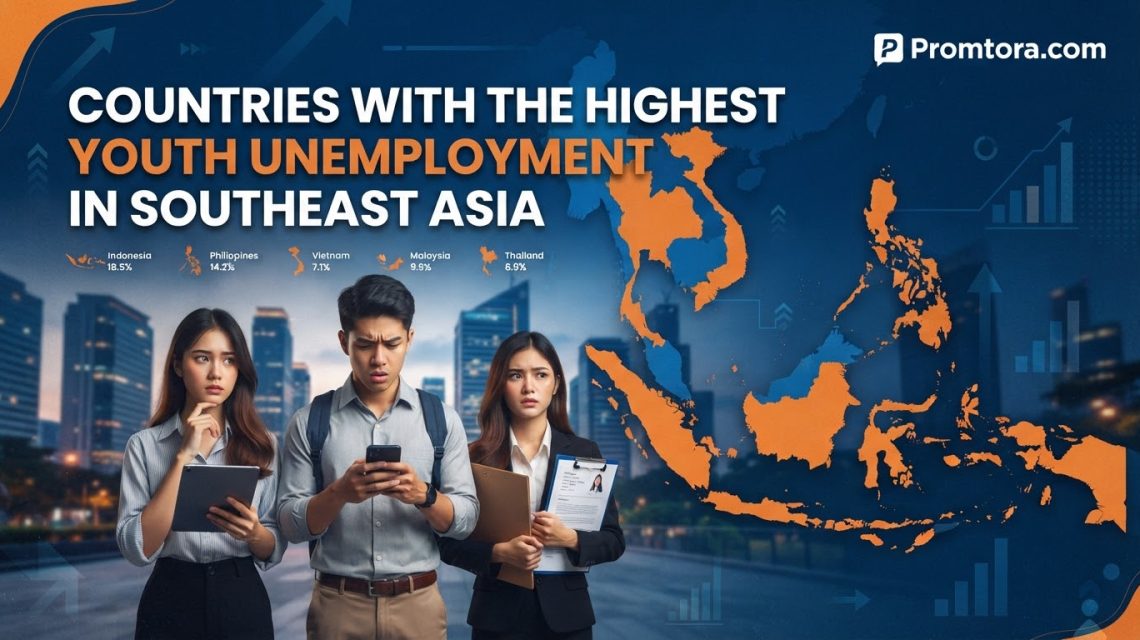
1. Ranking of Youth Unemployment Rates in Southeast Asia (Ages 15–24)
The following ranking is based primarily on harmonised ILO modelled estimates for 2025, cross-checked with national statistical releases and secondary analyses published in 2025–2026. National figures sometimes differ because of survey methodology, reference periods and definitions of unemployment and labour-force participation.
| Rank | Country | Youth Unemployment Rate (approx.) | Key Additional Indicators |
|---|---|---|---|
| 1 | Brunei Darussalam | 18.2% | Highest in ASEAN; heavy dependence on public-sector and oil/gas employment |
| 2 | Indonesia | 13.0% (modelled); national figures often 16–17.5% | Very large absolute numbers; high NEET (\~20–21%); large informal sector |
| 3 | Malaysia | 11.9–12% | Youth rate \~10% in recent monthly data; significant graduate underemployment |
| 4 | Myanmar | \~9.8% | Political and economic instability constraining formal job creation |
| 5 | Philippines | \~7.0% (modelled); recent national youth spikes higher | High underemployment; rising overall unemployment in 2026 reports |
| 6 | Singapore | \~6.8% | Low overall unemployment but competitive high-skill market for new entrants |
| 7 | Vietnam | \~6.2% (modelled); recent quarterly figures \~9% | \~1.6 million NEET youth (11.2% of 15–24 group) in late 2026 |
| 8 | Thailand | \~4.5–6.9% | Among the lower rates; recent uptick in youth unemployment reported |
| 9 | Laos | \~2.4% | Low modelled rate; limited formal sector |
| 10 | Cambodia | \~0.7% | Very low modelled rate; high informality requires cautious interpretation |
Sources: ILO/World Bank modelled estimates 2025; national statistical offices (BPS Indonesia, DOSM Malaysia, PSA Philippines, Vietnam NSO, etc.); secondary compilations from TheGlobalEconomy.com, Nations Inquiry and regional analyses 2025–2026.
2. Regional Overview and ILO Findings
According to the ILO’s Global Employment Trends for Youth 2026, the South-Eastern Asia and the Pacific subregion recorded a youth unemployment rate of approximately 9.5% in 2025. This remains below the global average of 12.4%, yet both the youth unemployment rate and the NEET rate increased between 2023 and 2025. The number of unemployed young people in the subregion stood at around 4.8 million in 2025 and is projected to ease only modestly to 4.7 million in 2026–2027. The regional NEET rate is expected to rise slightly from 16.3% toward 16.5%.
Young people in the subregion face a youth-to-adult unemployment ratio that is among the highest globally—often five to seven times the adult rate in parts of the region. Tertiary-educated youth frequently record higher unemployment rates than those with only secondary or basic education, a pattern consistent with credential inflation and skills mismatch.
VIEW ALSO : Top 10 richest Country in Southeast Asia
Key regional warning signs: Rising NEET rates, erosion of middle-skilled entry-level jobs, growing exposure of young workers to generative AI in clerical and administrative occupations, and persistent underemployment even where open unemployment appears moderate.
3. Country-by-Country In-Depth Analysis
3.1 Brunei Darussalam – Highest Youth Unemployment
Brunei consistently ranks first in youth unemployment within ASEAN. The economy’s heavy reliance on oil and gas and a large public sector limits private-sector job creation. Thousands of graduates enter the labour market each year, many from fields that do not match available vacancies. Informal employment is significant, and the preference for stable government jobs further concentrates demand on a narrow set of positions. Policy discussions have focused on economic diversification, support for MSMEs, and better alignment of education with emerging sectors such as renewable energy and digital services, yet progress remains gradual.
3.2 Indonesia – Large Absolute Numbers and High NEET
Indonesia combines a high youth unemployment rate with the region’s largest youth population. Modelled estimates place the rate near 13%, while national data have shown figures of 16–17.5% in recent periods. More than one million university graduates are unemployed, even as the country faces a projected shortage of millions of digital specialists by 2030. Only about half of graduates work in fields related to their studies. The NEET rate is among the highest in ASEAN (estimates around 20–21%). Female youth are disproportionately represented among NEETs. The large informal sector absorbs many young workers into low-productivity, unprotected jobs. Government responses include the Pre-Employment Card (Kartu Prakerja), national internship programmes, and efforts to expand TVET and digital skills training.
3.3 Malaysia – Graduate Underemployment and Persistent Youth Gap
Malaysia’s overall unemployment has remained near 3%, yet youth unemployment (15–24) has stayed around 10–12%. Skill-related underemployment among degree and diploma holders is substantial, with more than one-third of employed graduates reported as underemployed in some 2025–2026 data. Employers report shortages in digital, technical and soft skills. Initiatives such as TVET expansion, the K-Youth programme and micro-credential efforts aim to improve employability, while the Gig Workers Act 2025 seeks to provide greater protection for young people in platform work.
3.4 Myanmar
Myanmar’s elevated youth unemployment reflects broader political and economic disruption. Formal job creation has been constrained, education-to-work transitions disrupted, and many young people face limited opportunities outside informal or precarious activities.
3.5 Philippines
The Philippines records moderate modelled youth unemployment but faces high underemployment and recent rises in overall and youth unemployment in national data. Many young people work fewer hours than desired or in jobs that do not match their qualifications. Large numbers of graduates enter the labour force each year while productive formal job creation lags. Migration remains an important outlet for many young Filipinos. Policy efforts include internship matching programmes supported by development partners and continued emphasis on skills development.
3.6 Singapore
Singapore maintains relatively low overall and youth unemployment by regional standards, yet the high-skill, competitive nature of the labour market makes entry challenging for some graduates. Young residents increasingly secure permanent rather than casual roles, but competition remains intense. SkillsFuture and continuous learning frameworks support lifelong upskilling. A notable share of young Singaporeans express interest in working overseas.
3.7 Vietnam
Vietnam presents a striking paradox: overall unemployment near 2%, yet youth unemployment and NEET rates that remain elevated. In the third quarter of 2026 approximately 1.6 million young people aged 15–24 were classified as NEET (about 11.2% of the age group). Employers report difficulty filling vacancies, including in manufacturing and technical roles, while many young people lack the practical experience or specific skills demanded. AI and automation are reducing some entry-level opportunities. Young women show higher NEET rates than young men. Policy discussions emphasise stronger school-to-work linkages, practical training and support for youth enterprise creation.
3.8 Thailand, Laos and Cambodia
Thailand generally records lower youth unemployment, although recent monthly data have shown increases toward 6–7%. Structural issues include an ageing workforce, digital-literacy gaps among older workers, and concentration of youth in certain non-STEM fields. Laos and Cambodia show the lowest modelled rates; high levels of informal and agricultural employment mean that low open unemployment does not necessarily indicate abundant quality opportunities for young people.
VIEW ALSO : Top 50 careers in demand in South Africa
4. Structural Drivers of Youth Unemployment
4.1 Skills Mismatch and Credential Inflation
Across ASEAN, the expansion of tertiary education has outpaced the growth of graduate-level jobs. Many graduates work in roles unrelated to their field of study. Employers consistently report shortages of digital, analytical, problem-solving and soft skills even while large numbers of young people remain unemployed or underemployed. Horizontal mismatch (wrong field) and vertical mismatch (over-qualification) are widespread.
4.2 Informal Employment and Job Quality
In Indonesia, Vietnam, the Philippines and elsewhere, a large share of young workers enter the informal sector—agriculture, street vending, ride-hailing, food delivery and micro-enterprises—where social protection, career progression and productivity are limited. Open unemployment statistics therefore understate the challenge of decent work.
4.3 Technology, Automation and AI
Generative AI and automation are already affecting entry-level and middle-skilled occupations that traditionally absorbed young workers (clerical, administrative, some creative and service roles). The ILO estimates that a meaningful share of jobs held by young people in the region have significant AI exposure. While large-scale displacement has not yet materialised, the technology is raising the bar for first-job readiness and reducing some traditional stepping-stone positions.
4.4 Demographic Pressure and First-Job Barriers
Large youth cohorts in Indonesia, the Philippines and Vietnam increase competition for available formal jobs. Employers often prefer candidates with experience, creating a classic “no experience, no job; no job, no experience” trap. Weak apprenticeship systems and limited structured work-based learning exacerbate the problem.
4.5 Economic Structure and Growth Pattern
Growth in several countries has been capital- and technology-intensive rather than labour-intensive. Resource-dependent economies (Brunei) and highly competitive high-skill hubs (Singapore) create narrower pathways for less experienced workers. Manufacturing investments have not always generated proportional employment gains.
VIEW ALSO : Southeast Asian Countries Ranked by GDP Per Capita
5. Gender and Education Dimensions
Young women are over-represented among NEETs in several countries, including Indonesia and Vietnam. Tertiary-educated youth often face higher unemployment rates than those with lower educational attainment—a reversal of the historical pattern and a clear signal of mismatch between the education system and labour-market demand. Rural–urban and regional disparities further complicate outcomes.
6. Policy Responses and Emerging Approaches
Governments and regional bodies are pursuing multiple strategies:
- Expansion and reform of Technical and Vocational Education and Training (TVET)
- National internship and apprenticeship programmes (Indonesia’s National Internship Program, Philippine matching initiatives, Malaysia’s K-Youth)
- Micro-credentials and digital learning platforms (SkillsFuture in Singapore, Kartu Prakerja in Indonesia)
- Labour-market information systems to improve signalling between education providers and employers
- Support for youth entrepreneurship and MSMEs
- Regulatory frameworks for gig and platform work
- Efforts to link university funding or performance metrics to graduate employment outcomes
Effectiveness varies. Evaluations of some large-scale programmes have noted regional disparities, weak job-matching quality and limited conversion into sustained employment. Deeper collaboration between industry and education providers, stronger work-based learning, and real-time labour-market intelligence are repeatedly identified as priorities.
7. Outlook and Recommendations
The ILO projects a modest decline in the South-Eastern Asia and Pacific youth unemployment rate toward 9% by 2027, but NEET rates are expected to remain elevated or edge higher. Without stronger action on skills alignment, job quality and first-job pathways, the region risks under-utilising its demographic dividend.
Priority actions include:
- Closer integration of industry needs into curricula and assessment
- Scaled, high-quality apprenticeships and structured first-job programmes
- Investment in digital, green and foundational skills that remain relevant amid technological change
- Support for formalisation and productivity upgrading in the informal sector
- Gender-responsive measures to reduce female NEET rates
- Continuous monitoring of AI’s impact on entry-level occupations and proactive reskilling
- Regional knowledge sharing on what works in school-to-work transition
Youth unemployment in Southeast Asia is not solely a cyclical problem; it is structural. Addressing it requires coordinated action across education, labour-market policy, industrial strategy and social protection. The countries with the highest rates—Brunei, Indonesia and Malaysia—face particularly urgent challenges, but no country in the region is immune to the twin pressures of skills mismatch and technological change.
References
- International Labour Organization. Global Employment Trends for Youth 2026: Back to the Future. https://www.ilo.org/publications/major-publications/global-employment-trends-youth-2026
- TheGlobalEconomy.com. Youth unemployment rankings for ASEAN countries (2025 data). https://www.theglobaleconomy.com/rankings/Youth_unemployment/ASEAN/
- World Bank / ILO modelled estimates compiled via Nations Inquiry. Youth Unemployment Rate 2025. https://nationsinquiry.com/datasets/youth-unemployment/2025
- East Asia Forum. “ASEAN’s growth narrative rings hollow for underemployed youth” (October 2026). https://eastasiaforum.org/2026/10/02/aseans-growth-narrative-rings-hollow-for-underemployed-youth/
- HR Asia / ILO reporting on South-Eastern Asia and the Pacific youth labour market trends 2025–2026.
- National statistical sources: BPS Indonesia, DOSM Malaysia, PSA Philippines, Vietnam National Statistics Office, and related 2025–2026 labour force reports.
- ERIA and Asia Education Review analyses on skills crisis, micro-credentials and graduate employment in ASEAN (2025–2026).
- Country-specific reporting on Vietnam NEET figures, Malaysian underemployment, Indonesian digital talent gaps, and Thai youth unemployment trends (2025–2026).
- Additional secondary sources on AI exposure of youth jobs, informal employment, and school-to-work transition policies across the region.
Note: This article synthesises the most recent publicly available data and analyses as of late 2026. Readers should consult the latest national statistical releases and ILO updates for the most current figures, as labour-market conditions can change rapidly.