Top 10 Richest Countries in Southeast Asia
When people ask which Southeast Asian country is the richest, the answer depends on what they mean by “rich.” Total economic size favours Indonesia by a wide margin. Average income per person tells a very different story. On that measure — GDP per capita — Singapore sits in a league of its own, followed by oil-rich Brunei and then Malaysia. The gap between the top and the bottom of the region remains one of the widest of any major regional bloc.
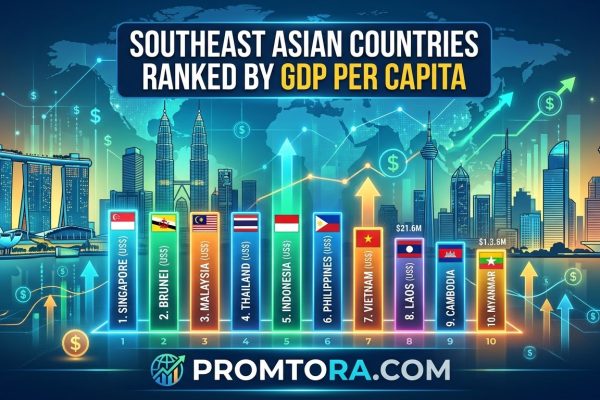
Using the most recent IMF World Economic Outlook projections for 2026, the ranking by nominal GDP per capita places the region’s eleven economies in a clear order. The figures below draw on those estimates and related reporting from late 2025 and 2026. Exact dollar amounts shift slightly with exchange rates and data revisions, but the order has been stable at the top and has seen only modest movement in the middle of the table.
The ranking by GDP per capita (2026 estimates)
| Rank | Country | Approx. GDP per capita (USD, nominal) | Key economic character |
|---|---|---|---|
| 1 | Singapore | $99,000 – $109,000 | Finance, trade, high-value services, technology |
| 2 | Brunei | $32,000 – $41,000 | Oil and gas, small population |
| 3 | Malaysia | $14,000 – $16,000 | Manufacturing, electronics, services, commodities |
| 4 | Thailand | $8,000 – $8,400 | Tourism, automotive, electronics, agriculture |
| 5 | Vietnam | $5,200 – $5,300 | Export manufacturing, electronics, FDI-driven growth |
| 6 | Indonesia | $5,100 – $5,400 | Largest economy by total size, domestic market, resources |
| 7 | Philippines | $4,300 – $4,600 | Services, remittances, BPO, growing digital economy |
| 8 | Cambodia | $2,900 – $3,000 | Garments, tourism, construction, agriculture |
| 9 | Laos | $2,200 – $2,300 | Hydropower, mining, agriculture, infrastructure |
| 10 | Timor-Leste / Myanmar | Around $1,300 – $1,550 | Resource-dependent / conflict-affected, lower base |
Figures are approximate 2026 nominal GDP per capita estimates drawn from IMF World Economic Outlook releases and regional reporting. Vietnam has recently edged ahead of or drawn level with Indonesia on this metric in some projections. Myanmar and Timor-Leste occupy the bottom of the regional table; exact ordering between them can vary with data availability.
Why Singapore and Brunei sit so far ahead
Singapore’s position is the result of decades of deliberate policy: a focus on high-value services, trade logistics, finance, and human capital in a city-state with no natural resources to speak of. Productivity per worker is extremely high, and the population is small relative to the size of the economy. The result is a per-capita income that rivals or exceeds many Western European countries and sits far above every other Southeast Asian economy.
Brunei’s ranking is driven almost entirely by oil and gas revenues shared among a population of under half a million. The absolute size of its economy is modest — among the smallest in ASEAN by total GDP — yet the combination of energy wealth and a tiny population produces a high average. Diversification efforts continue, but hydrocarbons still dominate.
VIEW ALSO Malaysia gdp per capita vs China
Malaysia occupies a clear third place. It has a more diversified base than Brunei, with established electronics and electrical manufacturing, palm oil and other commodities, a growing services sector, and a relatively developed middle class. Its per-capita figure is roughly half that of Brunei and a fraction of Singapore’s, yet it remains well ahead of the rest of the region.
The middle of the pack and the shifting order
Thailand holds fourth place. Tourism, automotive production, electronics and agriculture support an upper-middle-income economy, though growth has been slower than in some of its neighbours in recent years. The gap between Malaysia and Thailand on a per-person basis is still substantial.
One of the more notable recent movements has been Vietnam’s rise. Rapid expansion in export-oriented manufacturing, strong foreign direct investment (especially in electronics), and sustained growth rates have lifted its GDP per capita to the point where it has overtaken or drawn level with Indonesia in several 2026 projections. Indonesia remains by far the largest economy in the region by total GDP — roughly three times the size of Vietnam’s — but its much larger population keeps the average lower.
The Philippines follows, supported by business-process outsourcing, remittances from overseas workers, and a young, growing domestic market. Cambodia, Laos and the two economies at the bottom of the table (Timor-Leste and Myanmar) remain at lower income levels, with Cambodia’s garment and tourism sectors and Laos’s hydropower and mining providing the main growth engines in those cases.
Total GDP versus income per person
It is worth stressing the distinction. Indonesia’s economy is the largest in Southeast Asia by a comfortable margin when measured by total output. Singapore’s total GDP is far smaller, yet its citizens and residents on average command much higher incomes. Brunei’s total economy is tiny by regional standards; its per-capita ranking is high only because the population is small. Anyone comparing “richest countries” needs to be clear whether the question is about the size of the economy or the average standard of living implied by output per person.
Purchasing-power-parity (PPP) measures narrow some of the gaps because they adjust for lower local prices in poorer countries. Even on PPP terms, however, Singapore and Brunei remain at the top, and the broad ordering of the middle and lower tiers does not reverse.
What the numbers do and do not capture
GDP per capita is an average. It says nothing about how income is distributed inside a country. A high national figure can coexist with significant inequality, just as a lower average can mask pockets of considerable prosperity. It also does not automatically translate into better public services, cleaner air, shorter working hours or higher life satisfaction. Singapore’s high income comes with high housing and living costs; Brunei’s oil wealth has not fully translated into a diversified private sector.
Exchange-rate movements can also shift the nominal dollar rankings from year to year even when domestic growth is steady. Vietnam’s recent overtaking of Indonesia on the per-capita measure reflects both strong real growth and currency effects. Longer-term trends matter more than any single year’s snapshot.
Looking at the region as a whole
Southeast Asia remains one of the world’s most economically diverse regions. The distance between Singapore’s nearly six-figure per-capita income and the figures in the low thousands at the bottom of the table is extreme. At the same time, several middle-income economies — Vietnam in particular — have narrowed gaps that once looked permanent. Malaysia continues to sit in a distinct tier of its own between the high-income city-state and oil producer above it and the larger lower-middle-income economies below.
For investors, policymakers and ordinary residents, the practical question is rarely “which country is richest on paper.” It is how productivity, education, infrastructure and institutions are evolving in each place, and whether the gains from growth are broadly shared. The 2026 ranking by GDP per capita simply makes the starting differences visible in a single, comparable number.