Rwanda Social Security Contributions: RSSB Pension Rates and Employee Benefits
The Rwanda Social Security Board (RSSB) runs the main mandatory social security schemes for formal-sector workers. The largest piece is the pension scheme. Alongside it sit maternity leave benefits, occupational hazards (work injury and disease) cover, and, for many employees, medical-related contributions. Rates were raised significantly from January 2025, and further increases are scheduled through 2030. Understanding the current percentages, what counts as insurable earnings, and the benefits those contributions buy helps both employees and employers plan correctly.
This article sets out the main RSSB contribution rates in force in 2026, the benefits linked to them, and practical points on how the system works in practice.
Pension scheme rates
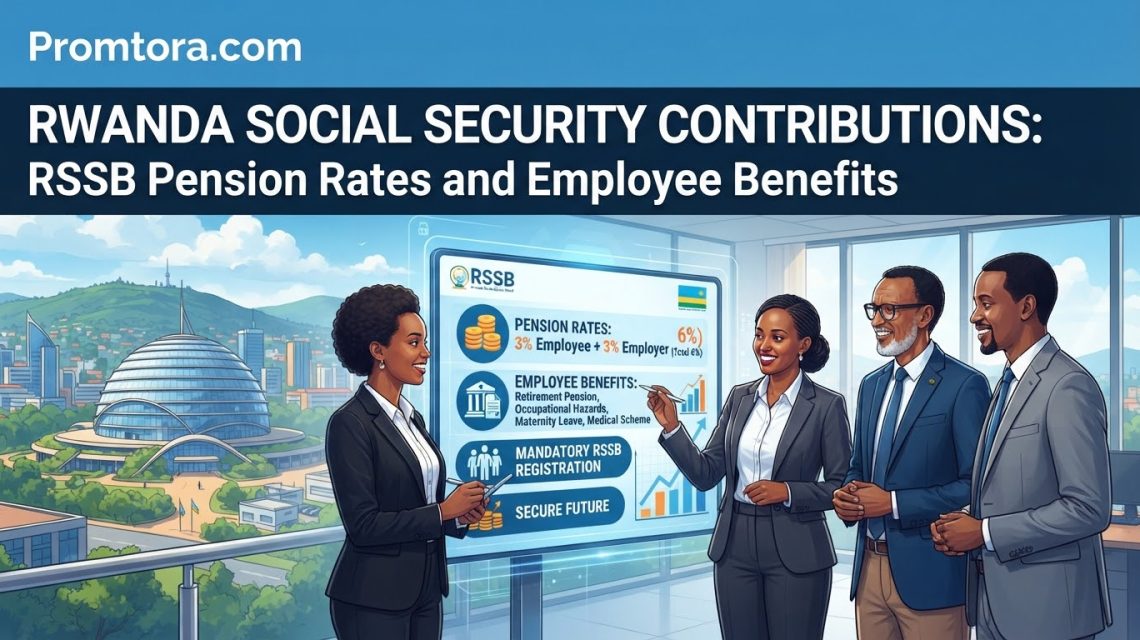
From 1 January 2025 the mandatory pension contribution rate moved to a total of 12% of gross insurable earnings, split equally between employee and employer:
| Party | Rate (2025–2026) |
|---|---|
| Employee | 6% of gross insurable earnings |
| Employer | 6% of gross insurable earnings |
| Total | 12% |
The increase from the earlier lower total rate produced a sharp rise in recorded pension contributions nationally. Further stepped increases are planned: the total rate is scheduled to rise toward 20% by 2030 (with equal sharing between employee and employer at each step).[1][2]
There is no upper ceiling on the earnings base for these contributions in the current framework. Contributions are calculated on gross insurable earnings, which generally include basic salary plus regular allowances and bonuses that form part of normal remuneration.
VIEW ALSO : Rwanda Business Registration Costs: Company, Trading Licences and Taxes
The employer deducts the employee share from salary and remits both the employee and employer portions to RSSB, usually by the middle of the following month. Declarations are made through the RSSB online systems (including the Ishema portal).
Maternity leave scheme
A separate small contribution funds the statutory maternity leave benefit. The rate is:
- Employee: 0.3% of gross insurable earnings
- Employer: 0.3% of gross insurable earnings
- Total: 0.6%
This scheme supports the 12-week maternity leave benefit and reduces the direct cost that would otherwise fall entirely on the employer during the leave period. Both shares are calculated on the same insurable-earnings base as the pension contribution.
Occupational hazards scheme
The occupational hazards scheme covers work-related injuries, occupational diseases, medical costs linked to those events, and related disability or survivor payments. The contribution is paid only by the employer:
- Employer: 2% of gross insurable earnings
- Employee: 0%
From November 2026, RSSB requires pension and occupational hazards contributions to be declared and paid separately, although the rates themselves did not change.[3]
Benefits under this scheme include temporary incapacity payments, permanent incapacity pensions or lump sums according to the degree of disability, medical care for the injury or disease, and survivor benefits when a worker dies as a result of an occupational event.
Combined picture for a typical employee
Putting the main mandatory pieces together for 2026:
| Scheme | Employee rate | Employer rate |
|---|---|---|
| Pension | 6% | 6% |
| Maternity | 0.3% | 0.3% |
| Occupational hazards | — | 2% |
| Subtotal (core RSSB) | 6.3% | 8.3% |
In addition, many employees pay a Community-Based Health Insurance (CBHI / Mutuelle) contribution of 0.5% of net salary, which the employer deducts and remits. Separate medical insurance arrangements under RSSB Medical exist for certain groups (including public servants and admitted private employers) with their own contribution rules; these are not universal for every formal-sector worker.
The employee’s direct deduction for the core pension and maternity schemes is therefore around 6.3% of gross insurable earnings, before CBHI and before income tax (PAYE). The employer’s statutory social security cost is around 8.3% plus any medical scheme contributions that apply to that workplace.
VIEW ALSO : Rwanda Business Registration Costs: Company, Trading Licences and Taxes
What the contributions buy: main benefits
Pension scheme — Provides retirement pensions, invalidity (disability) benefits, and survivors’ benefits for eligible dependants. The exact pension amount depends on the member’s contribution history, earnings record and the formula in force at the time of claim. The 2025 rate increase and the planned further rises are intended to strengthen the long-term sustainability and level of benefits.
Maternity leave benefits — Funds the statutory maternity leave income replacement so that the cost is shared across the system rather than borne solely by the individual employer.
Occupational hazards — Covers medical treatment for work injuries and occupational diseases, temporary incapacity allowances (often a high percentage of recent earnings), permanent incapacity pensions or lump sums, and survivor benefits when death results from an occupational event.
Members and employers can obtain detailed benefit rules, claim procedures and current forms from RSSB directly or through the official website and service centres.
Insurable earnings and practical payroll points
Insurable earnings generally mean regular remuneration: basic salary plus housing, transport and other regular allowances and bonuses that form part of normal pay. Irregular or purely one-off payments may be treated differently; employers should follow the latest RSSB guidance when in doubt.
There is no contribution ceiling in the current pension rules, so higher earners contribute on their full insurable earnings. The employee share of pension contributions is taken into account in the normal way when calculating taxable income for PAYE.
Employers must register with RSSB, declare contributions monthly, and pay on time. Late payment can attract penalties. From November 2026 the separate declaration of pension and occupational hazards requires payroll systems and filing processes to show the two amounts distinctly.
VIEW ALSO : Rwanda Public Service Salary Structure: Government Job Grades
Planned rate path to 2030
The pension total rate of 12% (6% + 6%) is not the final level. Official and secondary sources describe a phased increase:
- 2025–2026: 12% total (6% employee, 6% employer)
- Subsequent years: stepped increases
- Target by 2030: 20% total (shared equally)
Employers and employees should budget for higher contribution rates in the later years of the decade. Exact percentages for each intermediate year should be confirmed from the latest presidential orders or RSSB circulars as they are issued.
Summary for employees and employers
In 2026 a typical formal-sector employee in Rwanda contributes 6% of gross insurable earnings to the RSSB pension scheme and 0.3% to the maternity scheme. The employer contributes a matching 6% for pension, 0.3% for maternity, and 2% for occupational hazards. Further pension rate increases are scheduled on the way to a 20% total by 2030. These contributions fund retirement, invalidity and survivors’ benefits, maternity leave support, and protection against workplace injury and disease.
Because rules and administrative details (including declaration procedures) can change, the most reliable current figures always come from RSSB notices, the Ishema portal, and the latest legal instruments. Employees who want to check their records or understand their future benefit entitlements should use the official RSSB channels and keep their personal contribution history up to date.
References
- KT Press / National Bank of Rwanda reporting. Pension contributions rose sharply after the rate increased from 6% to 12% of gross salary from January 2025 (shared equally). Further rise toward 20% by 2030 noted. https://www.ktpress.rw/2026/10/rwanda-pension-contributions-rise-51-7-as-rssb-expands-local-investment-portfolio/
- ValidWave Consulting and payroll guides (2026). RSSB pension 6% employee + 6% employer; maternity 0.3% each; planned stepped increases to 20% by 2030. https://www.validwaveconsulting.com/bulletin-rwanda-payroll.html
- Sokrab / RSSB announcement. From November 2026 pension (12%) and occupational hazards (2%) must be declared and paid separately; rates unchanged. https://sokrab.com/rssb-contributions-pension-occupational-hazards-separate-declaration/
- AnooreHR. “Rwanda RSSB Employer Guide 2026” — breakdown of pension, maternity and occupational hazards schemes and employer cost summary. https://anoorehr.com/blog/rwanda-rssb-employer-guide-2026
- RSSB official scheme pages and occupational hazards benefit descriptions (temporary and permanent incapacity, survivors’ benefits). https://rssb.rw/schemes/oh-scheme
- Presidential Order and related instruments fixing the mandatory pension contribution rate (effective 1 January 2025) and subsequent RSSB circulars.