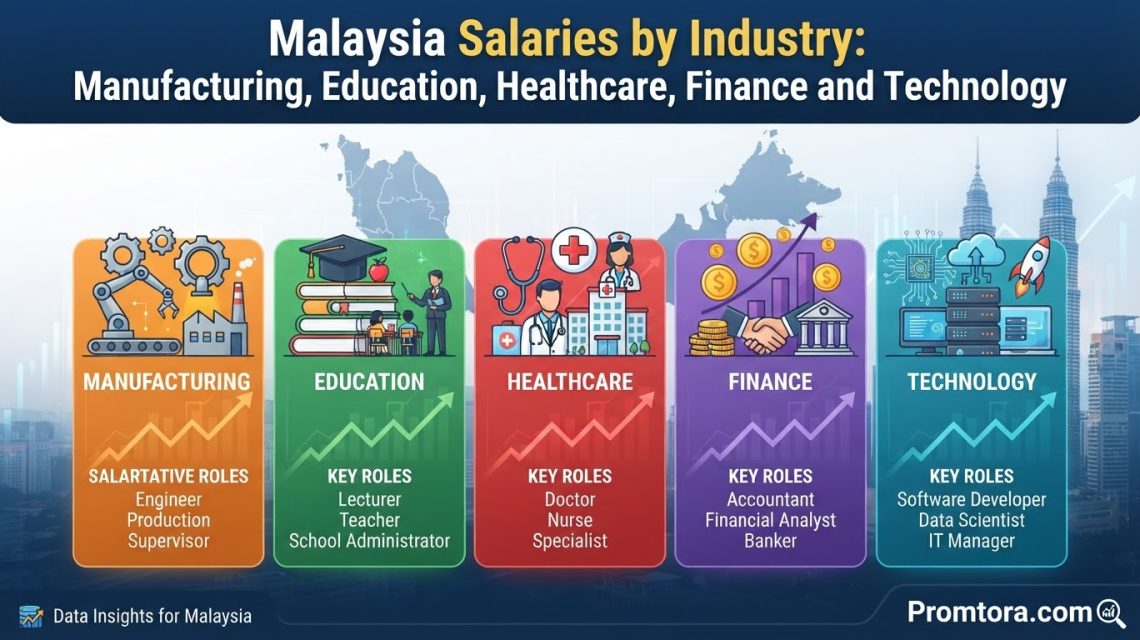
Malaysia Salaries by Industry: Manufacturing, Education, Healthcare, Finance and Technology
Malaysia’s formal labour market shows clear pay differences across industries. National figures from the Department of Statistics Malaysia put the median monthly wage for formal-sector workers around RM3,000 in mid-2026, with the mean for citizens higher still. Behind that single number sits a wide spread: finance and information & communication sit well above the median, manufacturing sits closer to it, and public education and many healthcare roles follow structured government scales that rise with grade and years of service. Location matters almost as much as industry. Kuala Lumpur and Selangor routinely pay 25–40% more than the national median for comparable private-sector jobs.
This article examines five major areas — manufacturing, education, healthcare, finance and technology — using official wage statistics and 2025–2026 market salary guides. Figures are monthly gross unless stated otherwise and should be read as ranges rather than guarantees. Actual offers depend on experience, qualifications, company size, exact role and whether the post is in the Klang Valley or elsewhere.
The national picture in 2025–2026
According to DOSM’s Salaries and Wages Survey and formal-sector wage reports, mean monthly salaries and wages for Malaysian citizens reached about RM3,803 in 2025, while the median climbed to roughly RM2,940–RM3,000 by 2026. Services employ the bulk of wage earners. Manufacturing remains a large employer with a median closer to RM2,900 in some formal-sector snapshots. Mining and quarrying posts the highest sector median but employs only a tiny share of the workforce. Within services, finance & insurance and information & communication stand out with medians reported around RM7,700 and RM6,000 respectively in one 2026 formal-sector release.
Skilled workers earn substantially more than semi-skilled and low-skilled groups. The gap between the top and bottom deciles remains large: the lowest 10% of formal workers receive RM1,700 or less, while the top 10% earn RM9,600 or more. These national patterns form the backdrop for the industry-specific ranges below.
Manufacturing
Manufacturing employs more than a million formal workers and remains central to Malaysia’s export economy. Electrical and electronics, automotive, petrochemicals, rubber, plastics and food processing are among the main sub-sectors. Pay varies sharply between operators on the line and engineers or managers in larger plants.
Market guides for 2026 typically place manufacturing salaries in these broad bands:
| Level | Indicative monthly range (RM) |
|---|---|
| Entry / junior | 2,000 – 3,200 |
| Mid-level | 3,500 – 6,000 |
| Senior | 7,000 – 12,000 |
DOSM formal-sector data has shown manufacturing medians near RM2,900 in recent releases, consistent with a large share of production and technician roles sitting below professional and managerial packages.[1]
Engineers (mechanical, electrical, process, quality) and production supervisors sit toward the upper part of the mid and senior bands, especially in multinational plants in Penang, Johor and the Klang Valley. Operators, assemblers and many technician roles cluster nearer the lower end. Shift allowances, attendance incentives and overtime can add meaningfully to take-home pay in continuous-process factories. Larger firms and those in electrical & electronics or automotive supply chains generally pay more than smaller local workshops.
Career progression in manufacturing often moves from technician or junior engineer into supervisory, process improvement, quality or plant management roles. Professional certifications and experience with lean manufacturing, automation or specific process technologies improve both employability and pay. Foreign direct investment and the push toward higher-value manufacturing continue to support demand for skilled technical staff, though overall sector medians remain moderate because of the large number of production workers.
Education
Education salaries in Malaysia fall into two broad groups: government teachers and lecturers on public service scales, and private-sector educators in international schools, private colleges and tuition centres.
Government teachers are paid under the education service schemes (commonly DG grades). Entry-level graduate teachers start on a structured scale; with allowances the gross package for early grades often sits in the low-to-mid RM2,000s and rises with promotion and years of service. More senior grades (for example DG10 and above) reach several thousand ringgit more once fixed allowances are included. Exact figures depend on the current scheme of service, grade, and any cost-of-living or duty allowances. Public university lecturers follow academic schemes that typically start higher than school-teacher entry points and rise with rank (lecturer, senior lecturer, associate professor, professor).
Private international schools and some private colleges pay more competitively for qualified teachers, especially those with international experience or specialist subjects. Packages can range from roughly RM4,000–RM8,000 or higher for experienced teachers, with leadership roles above that. Tuition centre tutors and private college lecturers show wide variation depending on subject demand and student volume.
Education remains a large employer with relatively predictable progression in the public system and more market-driven pay in the private segment. Benefits in government service (pension, medical, housing-related support where applicable) form an important part of total compensation even when basic pay looks modest compared with private finance or technology roles.
Healthcare
Healthcare pay differs strongly between public and private settings and between clinical and non-clinical roles.
Government nurses are paid on the U-scale (and related schemes). Entry grades with allowances often produce gross packages in the region of RM2,500–RM3,500; more senior nursing grades rise further. Allied health professionals follow their own schemes. Doctors in the public service progress through medical officer and specialist grades with corresponding increases; specialists and consultants earn substantially more than junior medical officers.
Private hospitals and clinics generally pay higher cash salaries for comparable clinical roles, especially for experienced nurses, pharmacists and doctors. Market guides for 2026 suggest staff nurse ranges around RM2,500–RM4,000 in many settings, with private-sector experienced nurses higher; pharmacists roughly RM3,500–RM6,500; and general practitioners in private practice often RM7,000–RM12,000 or more depending on patient load and clinic model. Specialists in private practice can earn well above these figures.
Healthcare demand remains steady because of population growth, an ageing society and the expansion of private facilities. Public-sector roles offer job security and structured benefits; private-sector roles often offer higher take-home pay and, in some cases, performance-linked incentives. Location again matters: major urban hospitals in the Klang Valley and other large cities tend to pay more than smaller facilities in less populated states.
Finance
Finance and insurance consistently rank among the higher-paying broad sectors in official statistics. One 2026 formal-sector release put the median monthly wage in finance & insurance around RM7,700 — well above the national formal median.
VIEW ALSO : Growing Career Sectors Opportunities in Malaysia
Market salary guides break the sector down by role and seniority:
| Role examples | Indicative monthly range (RM) |
|---|---|
| Entry / junior finance & accounting | 2,800 – 4,500 |
| Mid-level (analysts, accountants, relationship managers) | 5,000 – 9,000 |
| Senior / managerial | 9,000 – 16,000+ |
| Branch managers, selected director-level banking roles | 10,000 – 50,000 (wide seniority spread) |
Retail banking relationship managers might sit in the RM6,000–RM9,000 band; branch managers often RM10,000–RM15,000; and senior investment, corporate or risk roles can reach much higher, especially in large banks and multinational institutions. Accounting and finance professionals in commerce and industry follow similar progressions, with CFOs at large companies commanding packages far above the mid-level ranges.
Islamic finance has grown as a distinct segment and creates additional demand for specialists familiar with Shariah-compliant products. Professional qualifications (ACCA, CPA, CFA, local banking certifications) and experience in high-demand areas such as risk, compliance, credit and digital banking improve both starting pay and long-term trajectory. Kuala Lumpur remains the clear centre for the highest finance packages.
Technology
Technology and information & communication form one of the strongest-paying broad areas for skilled professionals. Official formal-sector data has shown information & communication medians around RM6,000, while specialised tech roles in the private market often exceed that figure, particularly in the Klang Valley and Cyberjaya.
2026 tech salary guides for the Klang Valley give indicative monthly gross ranges such as:
| Role | Junior | Mid-level | Senior+ |
|---|---|---|---|
| Software engineer (general) | 4,000 – 7,000 | 8,000 – 13,000 | 13,000 – 22,000 |
| Data / AI / ML roles | 5,000 – 9,000 | 7,000 – 12,000 | 12,000 – 20,000+ |
| Cybersecurity | 5,000 – 8,000 | 10,000 – 13,000 | 13,000 – 18,000+ |
| Engineering / tech managers | — | — | 15,000 – 28,000+ |
Entry-level tech graduates often start in the RM3,000–RM4,500 range; scarce skills (AI, certain cloud and security specialisms) push packages higher quickly.[2]
Multinational technology companies, regional shared-service centres and well-funded local tech firms tend to sit at the upper end of these bands. Smaller local firms and non-tech companies hiring developers may pay less. Location premiums are real: Kuala Lumpur and Cyberjaya pay more than Penang or Johor for the same role, although cost of living differences partially offset the gap.
Career growth in technology is often steeper than in more traditional industries. Moving from junior developer to mid-level and then to senior or lead roles can double or triple pay within a decade for those who keep skills current. Management tracks (engineering manager, head of engineering) and specialist IC tracks (staff/principal engineer) both offer high ceilings.
VIEW ALSO : Malaysia salary for domestic helper
Comparing the five industries
A simplified comparison of typical mid-career monthly ranges (private-sector market rates, Klang Valley bias) looks roughly like this:
- Technology: often RM8,000–RM15,000+ for solid mid-to-senior individual contributors
- Finance: often RM5,000–RM12,000+ depending on exact role and institution
- Healthcare (private clinical): wide spread; experienced nurses and allied health in the mid thousands, doctors and specialists substantially higher
- Manufacturing (professional/technical): often RM4,000–RM9,000 for engineers and supervisors; production roles lower
- Education (public): structured grades with allowances; private international schools higher for qualified teachers
Finance and technology lead in pure cash terms for skilled professionals. Manufacturing offers stable demand and clear technical career paths but lower median pay because of its large production workforce. Education and public healthcare trade some cash upside for job security, pensions and other benefits. Private healthcare and private education sit between these poles.
What drives the differences
Several factors explain why the same level of education or years of experience can produce very different salaries across these industries:
- Skill scarcity and global demand — Software, data, cybersecurity and specialised finance skills are mobile and in demand regionally; employers pay premiums to attract and keep them.
- Revenue models — Banks, tech product companies and private hospitals can often support higher pay than cost-constrained public education or labour-intensive manufacturing.
- Public vs private — Government scales emphasise equity, tenure and benefits; private employers emphasise market rates and performance.
- Location — KL/Selangor premiums of 25–40% above national medians appear consistently in private-sector data.
- Qualifications and registration — Professional certifications, specialist medical registration and teaching qualifications all affect grade and pay.
Overtime, shift allowances, performance bonuses, share schemes and benefits (medical, EPF, housing support) further widen effective differences in total compensation.
VIEW ALSO : IIUM Malaysia: Courses and Admission
Regional and practical considerations
Kuala Lumpur, Petaling Jaya, Shah Alam, Cyberjaya and the wider Klang Valley dominate high-paying private roles in finance and technology. Penang remains important for electronics manufacturing and has a growing tech scene, usually at a discount to KL. Johor benefits from proximity to Singapore and manufacturing investment. East Malaysia and less industrialised states generally show lower cash salaries, partly offset by lower living costs.
When comparing offers, look beyond basic salary. EPF contributions, medical coverage, bonus structure, claims and allowances, and working-hour expectations all affect real value. For public-sector roles, the pension and job security components are significant. For private tech and finance roles, variable pay and rapid progression can outweigh a slightly lower starting basic.
Outlook
Technology and higher-value services are likely to continue pulling ahead in skilled-pay terms as digitalisation and regional competition for talent persist. Manufacturing will remain a large employer; pay growth there will depend on the shift toward more automated, higher-skill production. Healthcare demand is structurally supported by demographics. Education will continue to offer stable public pathways and selective private premiums. Finance should stay near the top of the cash-pay league for qualified professionals, especially in Kuala Lumpur.
For individuals, the practical implication is clear: industry choice, skill specialisation and location together shape lifetime earnings as much as years of experience alone. Staying close to official DOSM releases and current market salary guides helps keep expectations realistic as the numbers move each year.
Summary
Malaysia’s 2025–2026 salary landscape shows finance and technology at the top for skilled private-sector pay, manufacturing in the middle with a wide internal spread, and education and healthcare offering a mix of structured public scales and higher private packages for certain clinical and teaching roles. National medians near RM3,000 mask large differences by industry, skill level and region. The ranges in this article are guides only; concrete offers always depend on the specific employer, role and candidate profile.
References
- Department of Statistics Malaysia (DOSM). Salaries and Wages Survey Report and formal-sector Employee Wages Statistics (2025–2026 releases) — national mean/median, sector medians including manufacturing, services, finance & insurance, information & communication. https://www.dosm.gov.my
- Aniday and market salary compilations. “Malaysia Salary Benchmarks: By Role and Industry 2026” — industry entry/mid/senior ranges for IT, financial services, manufacturing, healthcare. https://aniday.com/en/blog/malaysia-salary-benchmarks-by-role-industry-and-region-3356
- Seekers.my / tech salary guides. Malaysia Tech Salary Guide 2026 — software, data, AI, cybersecurity and engineering manager ranges for the Klang Valley. https://seekers.my/salary-guide
- SAYS / DOSM-based reporting. Sector median wages 2026, including finance & insurance and information & communication. https://says.com/my/news/how-much-do-malaysians-actually-earn-across-every-major-industry-in-2026
- PERSOL and other 2026 Malaysia salary guides — banking, accounting, technology leadership and professional role ranges.
- Public service scheme inf