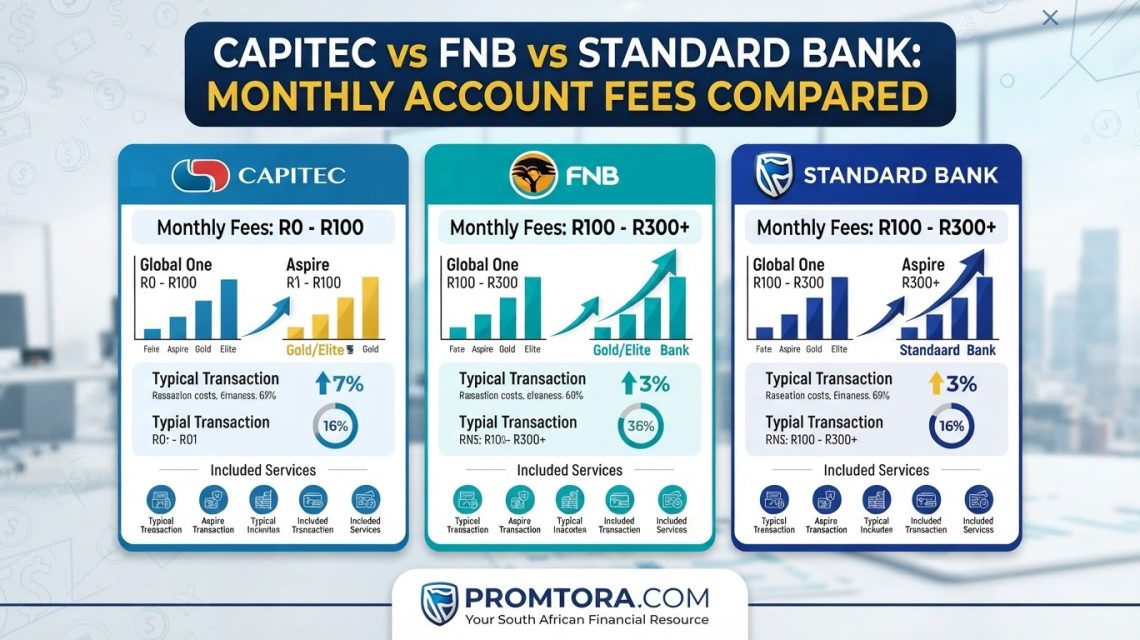
Capitec vs FNB vs Standard Bank: Monthly Account Fees Compared
Most South Africans who want a simple everyday bank account end up looking at three big names: Capitec, FNB and Standard Bank. Their entry-level products — Capitec Global One (Main Account), FNB Easy PAYU (and the higher Easy Bundle), and Standard Bank MyMo — sit in the same low-fee space. In 2026 the headline monthly fees are almost identical on the cheapest options, but the real cost of a month still depends on how often you withdraw cash, pay debit orders and send instant payments.
This comparison uses 2026 pricing guides and independent fee round-ups. Banks change their tables from time to time, so treat the numbers as a current snapshot and confirm the latest guide before you switch.
Headline monthly account fees
| Bank & account | Monthly admin / management fee |
|---|---|
| Capitec Global One / Main Account | R7.50 |
| Standard Bank MyMo | R7.50 |
| FNB Easy PAYU | R8.00 |
| FNB Easy Bundle | R77.00 (includes more free transactions) |
Capitec and Standard Bank match each other on the basic monthly fee. FNB’s pay-as-you-use option is only slightly higher; its bundled option costs far more but covers a larger allowance of withdrawals and payments.[1]
Card swipes (POS purchases) are free on all three of these accounts. The differences appear once you start using ATMs, debit orders and real-time payments.
Cash withdrawals
Cash is where the accounts diverge most clearly.
| Account | Own-bank ATM (typical) | Notes |
|---|---|---|
| Capitec Global One | R10 per R1,000 at any SA bank ATM; R2 at many supermarket tills | Simple flat structure |
| Standard Bank MyMo | R10 per R1,000 (often with a monthly free or low-limit band) | Till-point withdrawals frequently free or cheap |
| FNB Easy PAYU | Around R12 per R1,000 at FNB ATMs; cheaper at Cash@Till | Higher per-withdrawal cost on pure ATM use |
| FNB Easy Bundle | First R1,500 a month free at FNB ATMs and Cash@Till | Better for regular cash users |
If you rarely take cash out, the differences stay small. If you withdraw R1,000 or more every month, Capitec’s flat R10 per R1,000 and Standard Bank’s similar approach usually beat FNB’s pure pay-as-you-use rate. FNB’s bundle becomes attractive only when you use the free allowance regularly.
VIEW ALSO : Mining Engineer Salaries in South Africa: Across Mining Industries
Debit orders and electronic payments
External debit orders and payments to other banks add up quickly for anyone with multiple stop orders.
- Capitec — External debit orders typically around R3 each. Standard EFT to other banks about R2 on the app; immediate/PayShap payments often R2–R6 depending on the exact product.
- Standard Bank MyMo — Debit orders commonly around R3.50. PayShap and low-value instant payments often R2.
- FNB Easy PAYU — Debit orders around R3.50. Instant payments and PayShap roughly R3.50 each.
- FNB Easy Bundle — Debit orders usually included; a monthly allowance of free real-time payments, then lower rates thereafter.
Heavy users of debit orders (rent, school fees, insurance, subscriptions) often find the pure pay-as-you-use accounts more expensive than the monthly fee alone suggests. The FNB bundle can work out cheaper once you have several debit orders and regular instant payments, despite its R77 monthly charge.
Example monthly cost scenarios
These illustrative totals combine the monthly fee with a simple set of transactions. They are not formal quotes — only a way to see how the structures behave.
Light digital user (few cash withdrawals, 2–3 debit orders, mostly card and app payments):
- Capitec: roughly R25–R40
- Standard Bank MyMo: roughly R25–R45
- FNB Easy PAYU: roughly R35–R55
- FNB Easy Bundle: R77 (often higher than needed for light use)
Regular cash + debit-order user (one R1,000 ATM withdrawal, five external debit orders, a few instant payments):
- Capitec: often around R40–R50
- Standard Bank MyMo: similar, sometimes a little higher on debit orders
- FNB Easy PAYU: frequently R50–R60+
- FNB Easy Bundle: R77–R85 (the free allowances start to help)
Once cash and debit-order volume rises further, the gap between pure pay-as-you-use and a proper bundle widens in favour of the bundle for some customers.
VIEW ALSO : South African Bank Manager Salaries by Position: Regional and Executive
What each bank offers beyond the fee
Capitec Global One
One account number covers transactional banking, savings and, if you choose, credit and insurance products. The structure is deliberately simple. The app is widely regarded as easy to use. There is no minimum income requirement for the basic account. Capitec has the largest retail customer base in the country, so branch and ATM access is extensive.
VIEW ALSO : South African Government Employee Benefits: Housing, Medical Aid, Pension
Standard Bank MyMo
Designed as a direct low-fee competitor to Capitec. Monthly fee matches at R7.50. Digital statements and push notifications are free. Younger customers (roughly 16–25) sometimes get extra retail or lifestyle benefits linked to the account. The wider Standard Bank network and UCount rewards ecosystem sit behind the product for those who later move up to higher-tier accounts.
FNB Easy PAYU and Easy Bundle
PAYU keeps the monthly fee low but charges per transaction. The Bundle raises the fixed fee and includes a meaningful allowance of ATM/Cash@Till withdrawals and real-time payments. FNB’s eBucks rewards programme can offset some costs for customers who actively use FNB channels and partners. The bank’s app and digital tools are strong, and the branch/ATM network remains large.
Which account suits which user?
- Mostly digital, low cash, few debit orders — Capitec Global One or Standard Bank MyMo. The R7.50 fee and low per-item charges keep the total modest.
- Regular cash withdrawals and several debit orders — Compare Capitec’s transparent per-transaction costs with FNB’s Easy Bundle. Run your own numbers; the bundle can win once volume is high enough.
- Wants one simple account that also handles savings — Capitec’s Global One model is built for this.
- Already deep in the FNB ecosystem or values eBucks — Staying with FNB (PAYU or Bundle) may still make sense even if the pure fee comparison is not the cheapest.
- Young customer who can use lifestyle discounts — Standard Bank MyMo’s youth-linked benefits are worth checking.
Other low-fee options worth knowing
Capitec, FNB and Standard Bank are not the only players. Digital-first banks such as TymeBank (GoTyme) and Bank Zero offer accounts with R0 monthly fees. Their cash-withdrawal and payment charges still exist, but the absence of a fixed monthly fee makes them competitive for very light users. Anyone serious about minimising bank charges should put at least one zero-monthly-fee account next to the three traditional options when comparing.
Practical advice before you switch
- List your real monthly behaviour: how many ATM withdrawals, debit orders, instant payments and cash deposits you actually make.
- Add the monthly fee to those transaction costs for each bank.
- Check whether any rewards (eBucks, UCount, Capitec-related benefits) meaningfully reduce your net cost.
- Confirm the exact fee guide date — FNB, Capitec and Standard Bank update their tables at different times of the year.
- Look at branch and ATM convenience in the areas you actually use; a slightly higher fee can be worth it if the network saves you time and transport costs.
Summary
In 2026 Capitec Global One and Standard Bank MyMo both charge R7.50 a month. FNB Easy PAYU sits at R8, while the FNB Easy Bundle jumps to R77 in exchange for included transactions. Card payments are free across all three. Cash withdrawals and debit orders create the real differences: Capitec’s flat, predictable charges suit many everyday users; Standard Bank matches the low monthly fee and stays competitive; FNB’s pay-as-you-use option is fine for light use, and its bundle becomes rational once cash and payment volume is high.
There is no universal winner. The cheapest account is the one whose fee structure best matches how you actually bank. A quick tally of your own last three months of transactions against the current pricing guides will tell you more than any headline monthly fee alone.
References
- 2026 bank pricing guides and independent comparisons (Capitec personal banking fees from March 2026; FNB Easy PAYU and Easy Bundle guide July 2026–June 2027; Standard Bank MyMo 2026 pricing). Summarised in Codecash, Prices in South Africa and Rateweb fee round-ups.
- Codecash. “Bank Fees Compared 2026” and “Cheapest Bank Accounts in South Africa” — side-by-side monthly fees, ATM, debit-order and instant-payment costs. https://codecash.co.za/bank-fees-compared-2026/
- Prices in South Africa. Capitec vs FNB vs Standard Bank monthly account fee comparison and Capitec Global One fee detail. https://pricesinsouthafrica.co.za/capitec-vs-fnb-vs-standard-bank-monthly-account-fees-compared/
- Rateweb and bank own pricing pages — confirmation of R7.50 (Capitec, MyMo), R8 (FNB Easy PAYU) and higher bundle fees.