Mining Engineer Salaries in South Africa: Pay Across Major Mining Industries
Mining engineering remains one of the better-paid technical professions in South Africa. Pay depends heavily on experience, professional registration, whether the role carries legal accountability (for example a Government Certificate of Competency), the commodity being mined, and whether the operation is underground or open-cast. Base salary is only part of the package: production bonuses, shift and remote-site allowances, housing support and medical aid often add a substantial amount to total cost-to-company earnings.
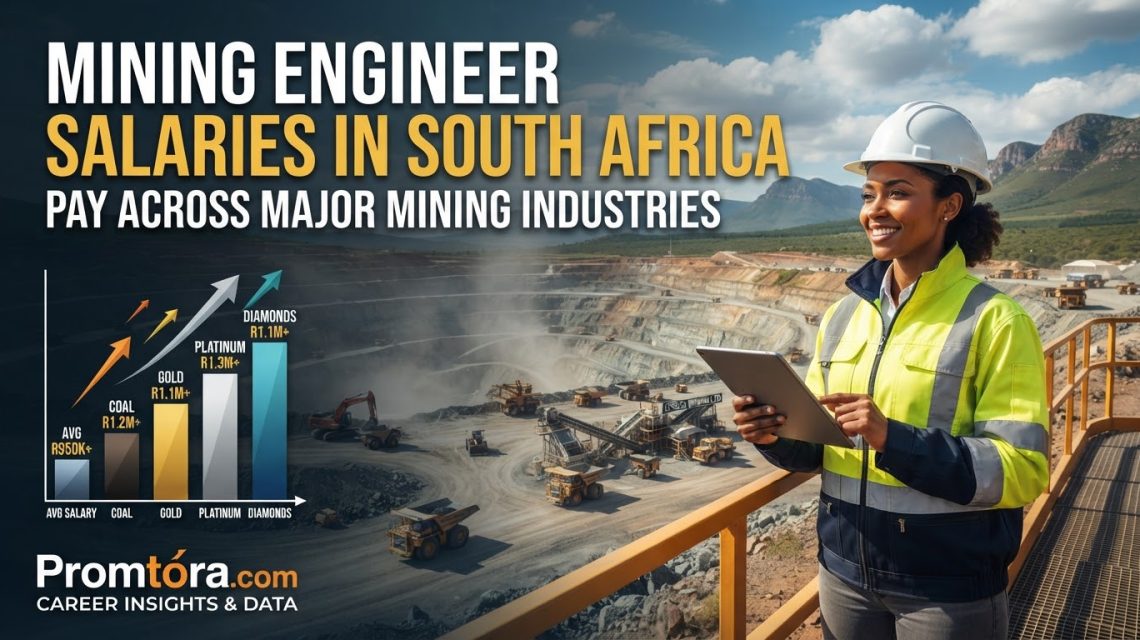
Survey and job-board figures for 2025–2026 show wide ranges. Junior packages start in the low-to-mid hundreds of thousands of rand per year; experienced and senior engineers commonly move into the R700,000–R1.5 million band and beyond, with mine management and principal roles higher still.
Overall salary ranges by experience
Industry guides and aggregated salary data for 2026 point to the following broad bands (gross / cost-to-company style figures; individual offers vary):
| Experience level | Indicative annual range (ZAR) | Notes |
|---|---|---|
| Graduate / junior (0–2 years) | Roughly R250,000 – R450,000 (some guides R280,000 – R620,000) | Candidate engineer status; graduate programmes |
| Mining engineer (2–5 / 3–5 years) | Roughly R450,000 – R850,000 | Growing responsibility; registration progress |
| Senior mining engineer (5–10 years) | Roughly R750,000 – R1,200,000+ | Often with GCC or equivalent accountability |
| Principal / lead / specialist / management | R1.1 million – R2 million+ (and higher for mine managers) | Technical leadership or production-accountable roles |
VIEW ALSO : Top 50 careers in demand in South Africa
Sources include 2026 industry salary guides, Indeed averages (around R945,000 based on a sample of reported salaries), PayScale medians (lower because of the mix of profiles), and career-site compilations. Monthly figures for qualified mid-level engineers are often cited in the R55,000–R85,000 range; seniors and managers can exceed R100,000–R150,000 per month in total package terms.[1][2]
Indeed’s reported average of about R945,000 per year (range roughly R561,000 – R1.59 million) sits toward the middle-to-upper part of the market and reflects a sample that includes more experienced roles. PayScale’s lower median reflects a broader mix that includes earlier-career profiles. The practical takeaway is that a single “average” is less useful than the experience and responsibility band.
Pay across major mining industries and regions
Commodity and location matter. South Africa’s main mining hubs each have their own cost and risk profile:
| Region / hub | Main commodities | Pay dynamic |
|---|---|---|
| Rustenburg / North West | Platinum group metals (PGMs), chrome | Deep-level underground; volatile prices; technical complexity and allowances can lift packages |
| Witbank / Emalahleni (Mpumalanga) | Coal | Large open-cast and underground operations; steady domestic energy demand |
| Kathu / Postmasburg (Northern Cape) | Iron ore, manganese | Large-scale surface mining; remote locations often attract housing and lifestyle premiums |
| Gold fields (various, including Free State, Gauteng, West Wits) | Gold | Deep-level complexity; long-established operations with structured grade systems |
| Limpopo and other PGM / base-metal areas | PGMs, copper, other | Project and production roles; remote-site premiums common |
Underground operations generally carry higher complexity, stricter safety regimes and shift patterns. That often translates into higher allowances and incentive potential compared with many open-cast roles. Remote sites (Northern Cape iron ore and manganese, some Limpopo and North West operations) frequently add housing, travel or living-out allowances that improve the total package even when the basic salary looks similar to a metro-based role.
VIEW ALSO : Countries With the Highest Youth Unemployment in Southeast Asia
High-value or tight-skills commodities (certain PGM, gold and specialised projects) tend to pay at the upper end of the ranges for comparable experience. Coal and bulk commodities can still offer strong packages at large, efficient operations, especially where production bonuses are material.
What drives differences in pay
- Experience and track record — The biggest single step is from junior to mid-level and then to senior/production-accountable roles.
- Professional registration and certificates — ECSA registration and, where relevant, the Government Certificate of Competency (GCC Mines and Works) significantly improve both employability and pay. GCC holders who can take legal responsibility for machinery or systems are in a stronger bargaining position.
- Underground vs open-cast — Underground roles often command higher total packages through allowances and incentives.
- Commodity and cycle — Boom periods in a commodity can lift bonuses and hiring premiums; downturns can slow progression and bonus payouts.
- Company size and structure — Large listed groups (Anglo American and others appear in salary samples) typically offer structured grades, benefits and long-term incentives. Smaller or contractor operations may pay differently and with more variable components.
- Location — Remote and high-cost living areas often include housing or living allowances that raise effective earnings.
Benefits and total package
Mining packages are usually quoted on a cost-to-company basis. Common elements beyond basic salary include:
- Medical aid and retirement / provident fund contributions
- Housing or living-out allowances (especially on remote sites)
- Transport or vehicle allowances
- Production, safety and performance bonuses
- Shift, standby and overtime payments where applicable
- Risk and life cover
These can add a meaningful percentage on top of base pay. When comparing offers, it is more useful to look at total guaranteed package plus realistic on-target incentives than at basic salary alone.
Career path and earnings growth
A typical progression runs from graduate/candidate engineer through mining engineer and senior mining engineer into principal, planning lead, section or mine management roles. Earnings rise steeply once an engineer can take production or legal accountability and once scarce skills (mine planning, rock engineering, ventilation, specialised software, ESG and data skills) are demonstrated.
VIEW ALSO : South African Bank Manager Salaries by Position: Regional and Executive
Senior and management packages in the R1.2 million – R2.5 million+ range (and higher for larger mine manager roles) are reported in industry guides for experienced professionals with the right tickets and track record. Mining engineering also ranks among the higher-paid engineering disciplines in South Africa at senior level.[3]
Practical takeaways
For a graduate, a starting package in the R250,000–R450,000 region (sometimes higher in strong graduate programmes) is a realistic expectation. By mid-career, total packages commonly move into the R600,000–R950,000 band and above. Senior and management roles regularly exceed R1 million and can reach well over R2 million with incentives and benefits.
Commodity, underground versus surface, remote location and possession of a GCC or equivalent remain the main levers that push an individual toward the top of the ranges. Always treat published averages as a guide and evaluate any concrete offer on total cost-to-company, bonus structure and living costs at the site.
References
- Jobrato. “Mining Engineer Salary in South Africa: 2026 Industry Pay Rates & Career Guide” and “Mining Industry Salary Guide (2026 Edition)” — experience bands, regional commodity hubs, and CTC structure. https://jobrato.co.za/mining-engineer-salary-in-south-africa-2026-industry-pay-rates-career-guide/; https://jobrato.co.za/mining-industry-salary-guide-how-much-do-miners-and-engineers-make-in-south-africa-2026-edition/
- Indeed. “Mining engineer salary in South Africa” — average about R945,380 per year (sample of reported salaries, updated 2026); range and city differentials. https://za.indeed.com/career/mining-engineer/salaries
- Rand Tools / CareerJunction-style surveys. “Highest Paid Engineers in South Africa (2026)” — mining engineers among the top-paid disciplines at senior level. https://randtools.co.za/salary/highest-paid-engineers
- PayScale. “Mining Engineer Salary in South Africa in 2026” — average/median base and total pay ranges from user-reported profiles. https://www.payscale.com/research/ZA/Job=Mining_Engineer/Salary
- bbrief. “Mining engineer salary ranges – Employment guide” (2026) — practical ranges by seniority and notes on underground vs open-cast and commodity effects. https://www.bbrief.co.za/2026/03/04/mining-engineer-salary-ranges-employment-guide/