Botswana’s Diamond Industry: Export Earnings and Contribution to GDP
1. Historical Role of Diamonds in the Botswana Economy
Diamonds were discovered in commercial quantities shortly after independence in 1966. The formation of Debswana Diamond Company (Pty) Limited — a 50/50 partnership between the Government of Botswana and De Beers — became the cornerstone of the industry. Over subsequent decades the partnership delivered exceptional results: high production volumes, relatively high average prices for Botswana’s gem-quality stones, and a stable fiscal and foreign-exchange contribution that financed infrastructure, education, health and public services.
At its peak, diamonds accounted for roughly a quarter to a third of GDP, around 70–85% of goods exports, and approximately one-third of government revenue. These ratios made Botswana one of the most diamond-dependent economies in the world. The country’s prudent management of diamond revenues — including the creation of sovereign savings and relatively disciplined fiscal policy for much of the post-independence period — helped convert mineral wealth into broader development gains. GDP per capita rose from a fraction of South Africa’s level in 1980 to surpass it in later decades.
2. Contribution to Export Earnings
Diamonds remain by far the largest single source of foreign-exchange earnings. Recent data illustrate the continuing dominance:
- In the third quarter of 2025, diamonds accounted for 72.7% of Botswana’s goods exports, according to the Bank of Botswana.
- Broader estimates place the share typically in the 70–85% range depending on the year and price cycle.
- During the downturn that began in mid-2023, total goods exports fell sharply — on a rolling four-quarter basis to roughly half their 2022 peak — reflecting both lower volumes and lower prices. The loss of hard-currency income was estimated at more than 15% of GDP.
The state-owned Okavango Diamond Company (ODC) markets a growing share of Debswana’s production. Under the sales agreement signed in 2025, ODC’s allocation rose to 30% for the first five years and is scheduled to increase to 40% thereafter. In 2026, ODC reported sales of 8.11 million carats generating US$645.2 million in revenue — a marked recovery from approximately US$457 million in 2025. A significant portion of these sales occurred through spot auctions, reflecting efforts to clear inventory in a still-challenging price environment.
VIEW ALSO : Botswana Teacher Salary Structure: Government School Earnings
Despite the recovery in volumes, average realised prices have remained under pressure. Reports indicate substantial year-on-year declines in price per carat in 2025 and into 2026, driven by weaker demand in key markets (particularly China), competition from lab-grown stones, and earlier oversupply.
3. Contribution to GDP and Fiscal Revenue
The diamond sector’s direct contribution to GDP has historically been large, although the precise share fluctuates with production and prices. Mining (dominated by diamonds) has at times accounted for around a quarter of GDP at peak periods. More importantly, diamond output swings heavily influence overall GDP growth:
- The economy contracted by approximately 2.8% in 2024 and a further 0.7% in 2025, largely because of sharp cuts in diamond production and lower prices.
- Debswana reduced output significantly — to around 17.9 million carats in 2024 and further to approximately 15.1–15.5 million carats in 2025 — in response to weak market conditions.
- In the second quarter of 2026, GDP rebounded strongly (reported growth of 8.7% year-on-year), driven by an 81.7% rise in mining and quarrying value added and a nearly 95% increase in diamond mining activity.
On the fiscal side, mineral revenues (primarily royalties and dividends from Debswana) have historically provided about one-third of government revenue. During the trough of the downturn, mineral revenues fell dramatically — from more than 13% of GDP in 2022 to around 3% of GDP in 2025 according to IMF figures. This contributed to large budget deficits (over 7% of GDP in 2024/25) and rising public debt. By late 2026, improved diamond revenues and other measures allowed the government to revise the projected deficit downward substantially. Mineral income was expected to contribute a smaller share (around 16% in some 2026/27 budget projections) than the long-term average, reflecting both lower prices and efforts to broaden the tax base.
Key ratios (approximate, recent years):
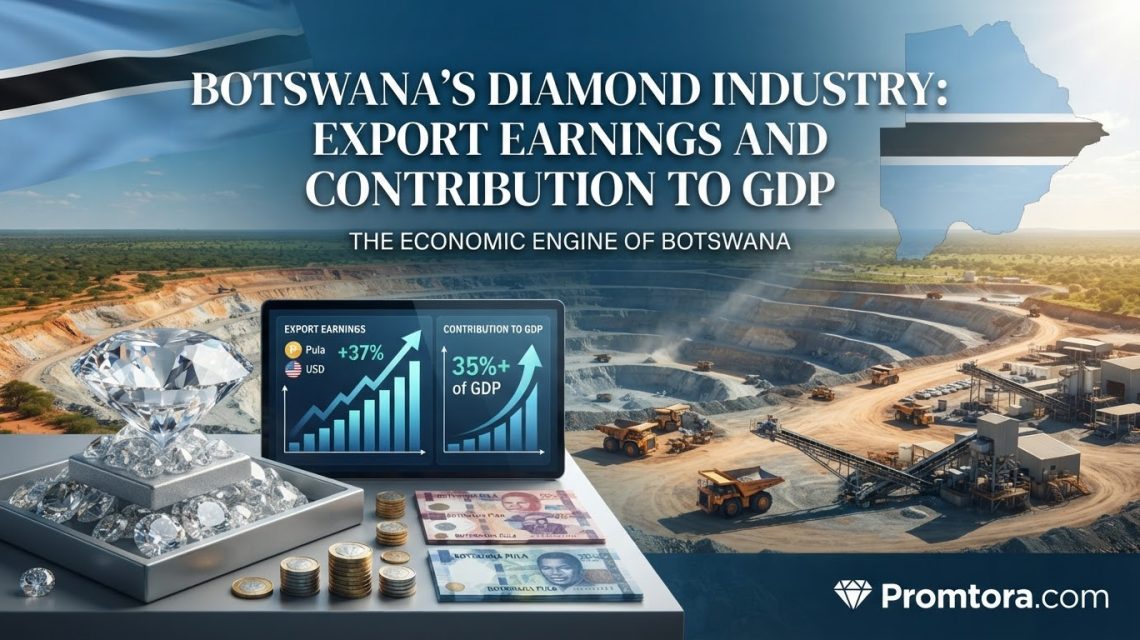
• Share of goods exports: 70–85% (72.7% in Q3 2025)
• Historical peak share of GDP: \~25–33%
• Historical share of government revenue: \~33%
• 2025 mineral revenue: \~3% of GDP (trough)
• 2026 recovery: rising production volumes and improved ODC sales
4. Production, Companies and Market Structure
Debswana remains the dominant producer, operating the major mines including Jwaneng (one of the world’s richest diamond mines by value) and Orapa. Lucara Diamond’s Karowe mine is another significant producer, known for recovering large and high-value stones. The industry is capital-intensive and relatively concentrated. Downstream activities — cutting, polishing and jewellery manufacturing — remain limited relative to the scale of rough production, although successive governments have pursued beneficiation policies.
In 2026 Debswana indicated plans to raise output (targets in the region of 18 million carats were discussed), and first-half production showed a clear rebound. Cost-reduction programmes were also under way, with Debswana targeting substantial operating-cost savings by 2028 in response to the lower-price environment.
5. Challenges: Lab-Grown Diamonds, Demand and Prices
The most significant structural challenge is competition from laboratory-grown diamonds, which have captured a growing share of the jewellery market at lower price points. Combined with softer demand in China and inventory accumulation after the post-pandemic period, this produced a prolonged price downturn from mid-2023. Average realised prices declined sharply, forcing production cuts and causing the first sustained economic contraction Botswana had experienced outside major global crises.
VIEW ALSO : Botswana Public Service Salary Scale: Government Pay and Allowances
Additional pressures include:
- High concentration risk — the absence of a strong second export engine.
- Limited progress on large-scale domestic value addition (cutting, polishing and jewellery).
- Fiscal vulnerability when mineral revenues collapse.
- Rising public debt and rating pressure during the downturn.
6. Recovery, Policy Responses and Outlook
By late 2026 there were clear signs of stabilisation and partial recovery. Higher production volumes, improved ODC sales, and stronger demand signals from the United States supported a revised GDP growth forecast of 3.8% for 2026 (up from earlier projections around 3.1%). Mining was expected to remain the main near-term growth driver.
Policy responses have included:
- Renegotiated sales agreements giving ODC a larger marketing share.
- Extension of Debswana mining licences.
- Creation of a Diamonds for Development Fund.
- Discussions around increasing Botswana’s stake in De Beers itself.
- Continued emphasis on economic diversification, although progress has been slow relative to the scale of diamond dependence.
- Cost-cutting and operational efficiency programmes at Debswana.
The medium-term outlook remains cautiously constructive but constrained. Most forecasts see growth recovering but remaining well below the 5%+ rates of earlier decades. Diversification into non-mining sectors (services, tourism, agriculture, manufacturing and emerging minerals) is widely regarded as essential for long-term resilience, yet the short-term fiscal and growth impulse still depends heavily on diamonds.
7. Value Addition and the Broader Diamond Value Chain
Industry leaders have repeatedly noted that Botswana has captured only a limited share of the full diamond value chain. Global estimates place substantial value in sorting and sales, cutting and polishing, and especially jewellery and retail. While beneficiation policies have created some local cutting and polishing capacity, the country continues to export the majority of its rough diamonds. Expanding domestic value addition remains a stated priority, constrained by skills, scale and the competitive global nature of polishing and jewellery manufacturing.
Conclusion
Botswana’s diamond industry continues to provide the bulk of export earnings (typically 70%+) and a critical share of government revenue and GDP growth. The 2024–2025 downturn demonstrated the risks of this concentration: sharp contractions in output and prices translated directly into recession, fiscal stress and lower foreign-exchange inflows. The partial recovery underway in 2026, supported by higher production and improved sales by Okavango Diamond Company, has lifted growth forecasts and eased immediate fiscal pressures. Nevertheless, the structural challenge remains: converting a still-dominant diamond sector into a more diversified, resilient economy while maximising the value retained from the stones that continue to underpin national prosperity.
Diamonds built modern Botswana. Whether they can continue to sustain it at previous rates of growth and fiscal contribution will depend on global demand for natural stones, successful cost management and, crucially, progress in building alternative engines of growth and employment.
References
- Bank of Botswana and Statistics Botswana data on export composition and GDP growth (2025–2026 reports cited in regional media).
- bne IntelliNews reporting on Okavango Diamond Company 2026 sales (US$645.2 million on 8.11 million carats) and broader diamond-market conditions. https://www.intellinews.com/botswana-s-state-diamond-seller-okavango-returns-to-profit-as-2026-sales-reach-645mn-485961/
- Capital Economics and IntelliNews analysis of diamond dependence, export collapse and growth outlook. https://www.intellinews.com/lab-grown-diamonds-leave-botswana-facing-weaker-pula-slower-growth-capital-economics-484753/
- IMF Article IV and related assessments of fiscal impact and growth contraction in 2024–2025.
- Government of Botswana budget strategy papers and finance ministry statements on revised 2026 growth forecast (3.8%) and mineral revenue shares.
- Debswana and De Beers production and sales data reported via Kimberley Process, company statements and media (2024–2026).
- Mining.com and other industry reporting on ODC recovery and market conditions. https://www.mining.com/botswanas-okavango-diamond-sales-surge-as-profit-returns/
- Additional analysis from African Development Bank, World Bank and regional economic commentary on diversification challenges and diamond-market structural shifts.