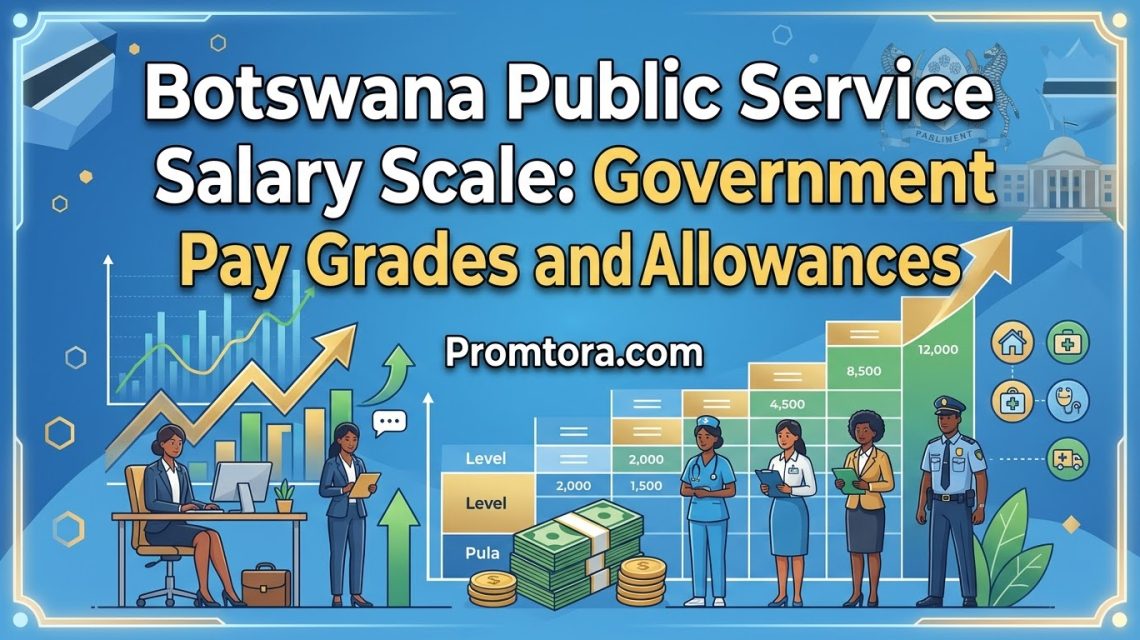
Botswana Public Service Salary Scale: Government Pay Grades and Allowances
Every permanent public officer in Botswana is placed on a formal salary scale administered through the Directorate of Public Service Management. The system uses letter-and-number grades, notches within each grade, and a set of allowances that can make a material difference to take-home pay — especially at the lower end. In mid-2026 the government confirmed in Parliament that the lowest-paid public officer received a combined package of P4,000 a month. That figure, and the structure around it, is the practical starting point for understanding how government pay currently works.
This article outlines the grading framework, the confirmed low-end amounts in Botswana Pula, the role of allowances, and the ongoing discussions about stagnation and structural reform.
How the grading system is organised
Botswana’s public service remuneration is built on a graded structure rooted in job evaluation principles (historically linked to the Paterson framework). Positions are classified according to the nature, complexity and requirements of the work. The main visible scales run through letter bands such as A, B, C, D and higher, with numbers indicating levels within those bands (for example A1, A3, C1, D4).
Within each scale, officers progress through notches. Historically the intra-grade differential between notches has been set around 2 percent, although the exact application and consistency of differentials have been the subject of union-government discussion and, at times, legal attention. Many scales have been relatively narrow — often around ten notches or fewer — which means a significant share of officers eventually reach the top of their scale and then depend on general adjustments or promotion for further increases.
Semi-skilled support roles (cleaners, messengers, security personnel, gardeners and similar) commonly sit on the A scales, including A1. In April 2026 the government stated in Parliament that it had no immediate plans to phase out the A1 scale, describing it as part of the structured grading system for these categories of work.
Current low-end pay: the P4,000 package
One of the clearest official benchmarks available in 2026 is the floor for the lowest-paid public officers. According to a parliamentary response given on behalf of the Minister of Finance in July 2026, the lowest-paid public officer received P4,000 per month. That total was broken down as:
- Basic salary: P2,895.00
- Housing and upkeep allowance: P1,105.40
This combination brings the cash package to the stated P4,000. The figure reflects both the basic scale amount and the allowance component that has been used to lift the effective earnings of the lowest grades.
Housing and upkeep allowances more broadly were enhanced for employees on salary scales A3 to D1 during the 2025/26 financial year under the Collective Labour Agreement. The government allocated further resources (reported as P542 million in the 2026/27 budget provision) to sustain improvements in this area. Allowances therefore remain an important part of the total reward for a wide band of public servants, not only those at the very bottom of the structure.
VIEW ALSO : Botswana Teacher Salary Structure: Government School Earnings
Indicative picture across grades
A complete, notch-by-notch official table is not reproduced here because the precise current amounts for every grade and notch are set by Public Service Management directives and collective agreements and can change with each adjustment cycle. What can be stated from recent public reporting is the following broad orientation:
| Area of the structure | Indicative position (2025–2026 context) | Notes |
|---|---|---|
| Lowest paid public officers | P4,000 total (P2,895 basic + P1,105.40 housing/upkeep) | Confirmed in parliamentary statement, mid-2026 |
| A scales (including A1) | Semi-skilled support roles; A1 still in active use | No plans announced to abolish A1 as of April 2026 |
| A3 to D1 | Housing and upkeep allowances enhanced in 2025/26 | Part of the Collective Labour Agreement adjustments |
| C and D scales (teachers, senior officers, etc.) | Higher basic amounts; many officers reported at or near top of C1 | Progression and stagnation remain live issues |
Exact notch values for intermediate and higher grades should be confirmed from the latest DPSM salary schedules or the officer’s own appointment and payslip documentation. Across-the-board increases in earlier years and the 2025 collective agreement have shifted the absolute numbers from older published tables.
Teacher salaries, for example, commonly reference C4, C3 and C1 bands, with temporary appointments in recent recruitment notices falling in annual ranges that translated to roughly P9,000–P12,600 per month at the lower C grades, and higher figures for experienced senior teachers. Those amounts sit well above the absolute floor but still illustrate how the letter-number system translates into monthly earnings once an officer moves beyond the lowest support grades.
Allowances and total package
Basic salary is only one part of the picture. Housing and upkeep allowances have been deliberately used to raise the effective pay of lower and middle grades. Other allowances (for example those related to specific duties, location or professional requirements) may apply depending on the post. When an officer is transferred to a position that does not attract the same allowances, the previous allowances generally cease from the date of assumption of the new post.
Pension contributions form another long-term component of the package. The government contributes a percentage of salary toward the Botswana Public Officers Pension Fund, with employees also contributing; the combined effect adds to the cost of employment and to the long-term value of public-service employment.
Stagnation and the fan-shaped structure debate
A recurring theme in union and official discussions is the number of officers who reach the top notch of their scale and then remain there for years. Earlier assessments noted high proportions of staff on certain A and B scales already at the ceiling. The proposed response has been a move toward a “fan-shaped” salary structure — broader scales with more notches (potentially around 25 instead of the current narrower bands) so that officers can continue to progress within a grade for longer without requiring a promotional post.
Consultations and preparatory work on the fan-shaped approach have been under way for several years. Implementation has been discussed as a way to reduce stagnation and improve motivation, although the full transition depends on further agreement and administrative readiness. In the meantime, general salary adjustments, allowance improvements and competitive promotion remain the main routes to higher earnings for officers who have reached the top of their current scale.
Recent adjustments and the wider context
Public-sector wage negotiations in 2025 produced a comprehensive collective agreement later that year after a period of fragmented bargaining. Across-the-board increases in preceding financial years, the enhancement of housing and upkeep allowances, and the explicit P4,000 floor for the lowest-paid officers form part of the recent trajectory. At the same time, the overall public-service wage bill has continued to grow and accounts for a substantial share of recurrent expenditure, which keeps fiscal sustainability central to any further large-scale changes.
For individual officers the practical implication is that pay is determined by the grade and notch on the official scale, plus applicable allowances, minus statutory deductions. The lowest combined package has been publicly anchored at P4,000. Movement above that depends on the specific scale, notch progression, allowance eligibility and any future collective or structural adjustments.
Practical takeaway
Botswana’s public service salary system remains a formal, graded structure with clear low-end benchmarks expressed in Pula. The current floor of P4,000 (P2,895 basic plus P1,105.40 housing and upkeep) provides a concrete reference point for the bottom of the structure. Allowances, particularly housing and upkeep for scales A3 to D1, form an important part of total earnings. Higher grades carry correspondingly higher basic amounts, but many officers eventually encounter the ceiling of their scale, which is why structural reform continues to be discussed.
Anyone seeking precise current figures for a particular grade and notch should refer to the latest Public Service Management directive, the relevant collective agreement, or their own employment documentation. The framework is public and structured; the exact monthly amount depends on where an individual sits within it.