Botswana Military Salaries: Defence Force Ranks, Monthly Earnings and Allowances
The Botswana Defence Force (BDF) does not publish a complete public payslip for every rank in the way some civilian services do. Pay and allowances are determined by the Defence Council under the Botswana Defence Force Act and related regulations. What is public is the rank structure, the main categories of benefits offered to recruits and serving members, and the fact that military remuneration has been the subject of structural change and legal challenge in recent years. For anyone considering a career in the BDF, or simply trying to understand how military pay compares with the broader public service, the useful picture is a combination of rank hierarchy, known allowances, and the limited salary indications that appear in recruitment material and secondary reporting.
Rank structure
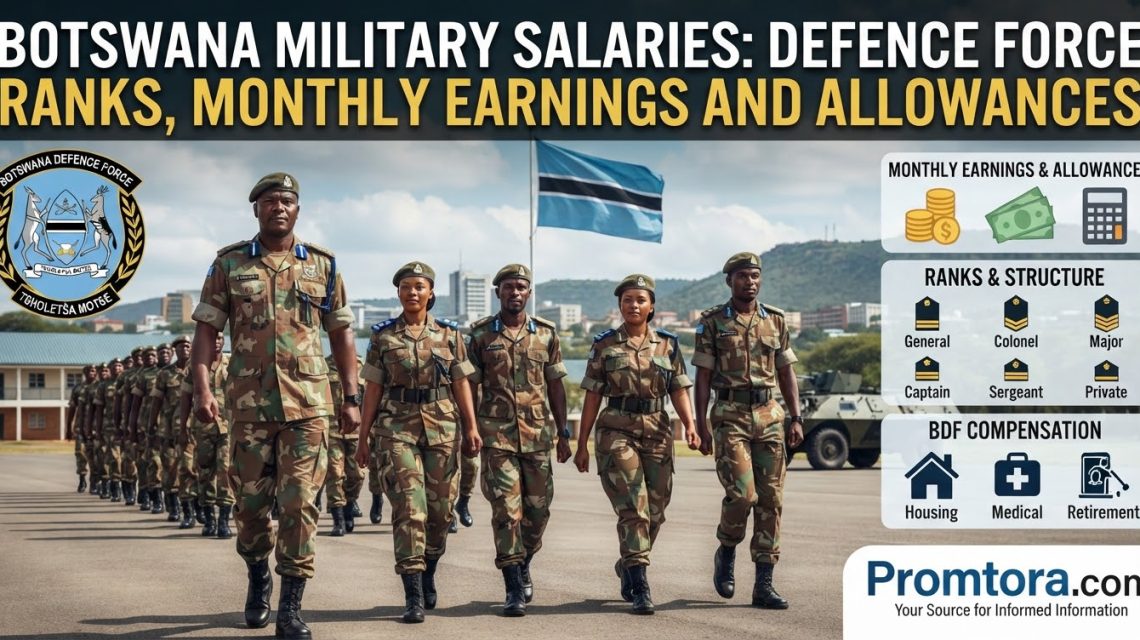
The BDF is organised into Ground Forces, Air Arm and supporting commands. Commissioned officer ranks (from junior to senior) broadly follow this order:
- Officer Cadet / student officer ranks
- Second Lieutenant
- First Lieutenant
- Captain
- Major
- Lieutenant Colonel
- Colonel
- Brigadier
- Major General
- Lieutenant General
- General
The rank of General (four-star) was used for the BDF Commander in a 2025 promotion, marking a high point in the force’s modern rank structure. The Deputy Commander has held Lieutenant General rank. Component commanders typically sit at Major General level.[1]
VIEW ALSO : Botswana Public Service Salary Scale: Government Pay and Allowances
Other ranks (enlisted and non-commissioned) run from Private through Lance Corporal, Corporal, Sergeant, Staff Sergeant, and Warrant Officer classes. Exact titles and insignia align with Commonwealth-influenced patterns used by the Ground Force and Air Wing.
Senior appointments (Commander and officers above Lieutenant Colonel) are made by the President. The Defence Council has formal responsibility for determining pay, allowances and conditions of service.[2]
How pay is set
Under the Defence Force regulations, officers and other ranks are paid at rates determined by the Defence Council. There is provision for acting rank and an acting allowance equal to the difference between substantive pay and the minimum of the higher rank. Entertainment allowances can apply to certain commanding officers. Free furnished quarters are provided where available. Family and course allowances apply in specific circumstances, including service or training outside Botswana.[3]
A notable feature of recent recruitment advertising is the BDF X-factor allowance of 20 percent. Officer Cadet vacancy notices have listed this alongside free accommodation and subsidised utilities, professional development opportunities, local and international exposure, and mandatory medical care on a 50/50 government–employee basis.[4]
Because the full scale is not released as a public document in the same way as some civilian grade tables, precise monthly figures for every rank remain internal. Secondary and recruitment-related sources give only partial indications.
Indicative earnings and packages
Publicly available numbers are limited and should be treated as approximate:
| Category | Indicative information | Source context |
|---|---|---|
| Officer Cadet (recruitment material / secondary reports) | Ranges sometimes cited in secondary articles from roughly P8,000 upward during training stages; official adverts emphasise “competitive remuneration” plus the 20% X-factor and benefits rather than a fixed published band | Recruitment notices and secondary summaries |
| Serving members (general) | Pay rises with rank and years of service; total package includes basic pay, X-factor where applicable, housing (or free quarters), medical contributions and other regulated allowances | Regulations and recruitment terms |
| Senior officers | Substantially higher; exact figures not routinely published | Defence Council determinations |
No comprehensive, officially published rank-by-rank monthly salary table for the BDF is in the public domain in the same form as some civilian scales. Figures circulating online should be cross-checked against current recruitment notices and, for serving members, internal pay advice.
VIEW ALSO : Botswana Police Service Salaries and Ranks
Compared with the civilian public service, where the lowest combined package has been stated around P4,000 and higher grades rise well above that, BDF entry packages (especially for officer cadets) are generally presented as competitive once the X-factor, accommodation and medical benefits are counted. The military also offers structured career progression, training and the possibility of international courses and deployments.
Main allowances and benefits
From regulations and recent recruitment material, the following elements form part of the typical package:
- Basic pay — set by rank and determined by the Defence Council
- BDF X-factor allowance (20%) — highlighted in Officer Cadet recruitment as a standard addition
- Free accommodation or subsidised utilities — free furnished quarters where available; subsidised utilities noted in adverts
- Medical care — mandatory scheme with government and employee each contributing 50%
- Acting allowance — difference between substantive and higher-rank minimum when acting
- Entertainment allowance — for certain commanding officers in respect of official entertainment
- Family / course / overseas-related allowances — payable under specified conditions
- Uniform and equipment support — commonly provided or reimbursed for cadets and serving members
Leave with pay is provided under the regulations, and members may receive advance payment of pay and allowances for authorised leave periods. Deductions can be made for certain disciplinary or civil liabilities in accordance with the Act and regulations.
Salary structure debates
Military pay in Botswana has not been static. In 2019 a unitary salary structure (sometimes referred to in reporting as the Ntlole structure) was introduced, replacing an earlier delinked arrangement. In 2025 a High Court ruling required reconsideration of that change, finding that the termination of the previous delinked structure had not followed proper consultation. The outcome and any subsequent adjustments form part of the ongoing context in which BDF remuneration is managed.[5]
Separately, historical pension and transfer-value issues affecting some former BDF members (particularly those whose service pre-dated or overlapped with the move into the Botswana Public Officers Pension Fund framework) have been the subject of large government allocations and parliamentary discussion in recent years. Those matters concern retirement benefits rather than current monthly salaries, but they underline that conditions of service for the force have been under active review.
Recruitment and career context
The BDF is a volunteer force. Typical entry windows have included ages 18–24 for general recruits, with slightly different bands for officer cadets and special entrant officers. Selection involves medical examination, physical fitness assessment, aptitude tests and interviews. Successful officer cadets enter a training path that leads to commissioning; other ranks progress through non-commissioned grades.
Remuneration is only one part of the offer. Free or subsidised housing, medical cover, the X-factor allowance, training, and the possibility of specialist or overseas exposure are repeatedly emphasised in official recruitment messaging. For many members the total package — cash plus benefits — is more relevant than basic pay alone.
Practical summary
Botswana Defence Force salaries are set by the Defence Council and rise with rank. A 20% X-factor allowance, free or subsidised accommodation, and shared medical cover form important parts of the package advertised to new entrants. Precise monthly figures for each rank are not published in a single open table; recruitment notices stress competitive pay plus benefits rather than listing every notch. Senior officers earn substantially more than junior ranks and cadets, consistent with the hierarchy used in most professional armed forces. Anyone evaluating a BDF career should treat current vacancy circulars and the terms offered at enlistment or commissioning as the authoritative source for the package that will actually apply.
References
- Military ranks of Botswana — rank tables and 2025 promotions to General and Lieutenant General. See also DefenceWeb overview of the Botswana Defence Force structure and approximate strength. https://en.wikipedia.org/wiki/Botswana_military_ranks_and_insignia; https://defenceweb.co.za/security/african-militaries/botswana-2/
- Botswana Defence Force Act — provisions on the Defence Council and its power to determine pay, allowances and conditions of service. https://botswanalaws.com/principal-legislation/botswana-defence-force
- Botswana Defence Force subsidiary legislation (Officers and Other Ranks regulations) — Part on Promotion, Seniority, Pay and General Allowances, including acting allowance, entertainment allowance, free furnished quarters and related rules. https://botswanalaws.com/subsidiary-legislation/botswana-defence-force-subsidiary-legislation
- Botswana Defence Force. Officer Cadet vacancy advertisement (e.g. VAC 2/2025 and related circulars) — competitive remuneration, 20% BDF X-factor allowance, free accommodation and subsidised utilities, medical care (50% government / 50% employee). Official BDF recruitment notices.
- Sunday Standard. “Masisi’s Ntlole salary structure blows up in BDF’s face,” April 2025 — High Court ruling on the 2019 unitary (Ntlole) structure and the earlier delinked arrangement. https://www.sundaystandard.info/masisis-ntlole-salary-structure-blows-up-in-bdfs-face/
- Parliamentary and government reporting on BDF pension and transfer-value adjustments for certain cohorts of former members (related to conditions of service rather than current monthly pay).