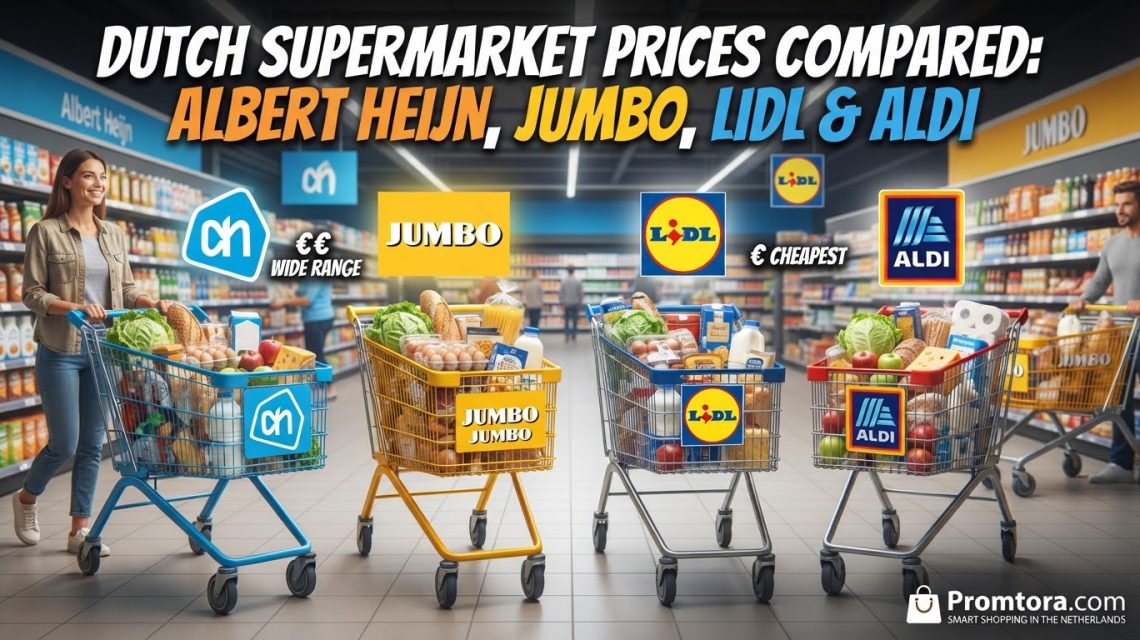
Dutch Supermarket Prices Compared: Albert Heijn, Jumbo, Lidl and Aldi
This article compares prices at Albert Heijn, Jumbo, Lidl and Aldi using data from independent price monitors, basket tests and market analyses conducted in 2025 and 2026. It covers overall price positioning, differences between own brands and A-brands, example basket results, the role of promotions, and practical tips for saving money. Figures reflect the situation around mid-to-late 2026 and can change with new offers and supplier negotiations.
Market Overview and Positioning
Albert Heijn is the largest supermarket chain in the Netherlands by market share and store numbers. It positions itself as a full-service retailer with a wide assortment, strong fresh departments, extensive private-label ranges (including AH, AH Basic and premium lines) and frequent Bonus promotions. Jumbo is the main challenger in the full-service segment, emphasising competitive pricing, spacious stores and its own loyalty and offer programmes.
Lidl and Aldi operate as discounters. Their assortments rely heavily on own-brand products, with a more limited selection of A-brands. This model allows lower everyday prices on many staple items, although the exact ranking versus full-service chains varies depending on the products compared and whether promotions are included.
Independent monitors consistently show that price gaps between chains can reach 15–28 percent on comparable own-brand baskets. On A-brands the gaps are often smaller but still material, and the ranking of chains can reverse.
Own-Brand (Huismerk) Price Comparison
Own-brand products form a large share of many Dutch shopping baskets and are the area where discounters traditionally hold a clear advantage. Large-scale comparisons of thousands of comparable private-label items in 2026 found the following pattern:
| Chain | Relative Price Level vs Cheapest (Own Brands) | Notes |
|---|---|---|
| Aldi | Baseline (often cheapest or joint cheapest) | Strong on staples and everyday items |
| Dirk (for reference) | +1–2% | Very close to Aldi in many monitors |
| Lidl | Competitive, frequently among the lowest | Strong performance in many basket tests |
| Jumbo | Approximately +15–16% | Similar level to other full-service chains |
| Albert Heijn | Approximately +15–17% | Among the higher-priced on pure own-brand comparisons |
In one major September 2026 analysis covering more than 1,700 comparable own-brand products, Aldi ranked as the cheapest, with Albert Heijn around 17 percent more expensive and Jumbo close behind. Translating this into annual savings, a household spending the equivalent of €100 per week on own-brand groceries at Albert Heijn could save several hundred euros per year by switching a large share of those purchases to Aldi or a similarly priced discounter.
Basket tests that focus on the cheapest available private-label versions of common staples often place Lidl or Aldi at the top, followed by price-fighter chains, with Albert Heijn and Jumbo higher up the list.
A-Brand (Branded Products) Price Comparison
When the basket consists mainly of national and international brands (Coca-Cola, Campina, Heineken, etc.), the ranking changes. Full-service chains compete more aggressively on A-brands through promotions, and some regional or mid-sized chains frequently undercut the largest players.
In 2026 monitors, Albert Heijn and Jumbo often ranked among the more expensive options for a pure A-brand basket, while certain other chains (notably DekaMarkt in some studies) emerged as cheaper. Discounters carry fewer A-brands, so direct like-for-like comparisons are harder; when they do stock the same branded items, prices are competitive but the limited range reduces the practical impact for shoppers who prefer specific brands.
Jumbo has publicly challenged Albert Heijn on selected A-brand and private-label baskets, publishing comparisons showing lower totals for specific lists of drinks and staples. These targeted campaigns illustrate the intensity of price competition between the two full-service leaders, even if overall market data still place both above the pure discounters on many everyday items.
VIEW ALSO: What jobs pay well in the Netherlands?
Example Basket Results from 2026
Several independent basket comparisons conducted in 2026 provide concrete illustrations:
- In one test of 55 common items using the cheapest private-label options, Lidl came out lowest, followed closely by other value-oriented chains, with Albert Heijn and Jumbo higher (differences of roughly €5–€6 between cheapest and most expensive in that particular basket).
- Another monitor of 30 staple products ranked a value-oriented full-service chain cheapest and Albert Heijn among the more expensive, with a spread of around 20 percent between the lowest and highest totals.
- Head-to-head comparisons of smaller sets of basic items between Albert Heijn and Jumbo have shown Jumbo slightly cheaper in some recent snapshots, though results fluctuate with weekly offers.
These examples underline an important point: the “cheapest” supermarket depends on the exact contents of the shopping list. A basket heavy in private-label dairy, bread, pasta and vegetables will usually favour Lidl or Aldi. A basket dominated by specific branded products and premium fresh items may narrow the gap or even reverse the ranking when promotions are taken into account.
The Role of Promotions and Loyalty Programmes
Weekly offers significantly influence final spend. Albert Heijn’s Bonus system and Jumbo’s Extra’s programme regularly discount both private-label and A-brand items. Shoppers who plan around the folder and use the respective apps or cards can reduce the effective price gap with discounters.
Discounters also run promotions, but their everyday prices on core private-label lines are already low, so the relative impact of offers is different. Apps and comparison tools that aggregate current folder prices across chains help identify the best deal for a given list in any given week.
Quality, Range and Shopping Experience
Price is only one dimension. Albert Heijn and Jumbo generally offer broader assortments, more extensive fresh counters, wider choice of organic and specialty products, and more convenient store locations for many households. Lidl and Aldi prioritise efficiency and low prices, with simpler store layouts and a stronger emphasis on their own brands.
Perceived quality of private-label products has improved across all chains in recent years. Many shoppers now regard discounter own brands as comparable to mid-tier private labels at full-service stores for everyday items, while still preferring branded or higher-tier options for certain categories.
VIEW ALSO : Uber Eats Netherlands Rider Earnings – Incentives and Monthly Income
Practical Tips for Lower Grocery Bills
To minimise spending while shopping at these four chains:
- Build the core of the basket from private-label staples at Lidl or Aldi when possible.
- Use Albert Heijn Bonus and Jumbo offers for specific branded items or products not available (or more expensive) at discounters.
- Compare unit prices (per kilo or litre) rather than pack prices.
- Check current folders or comparison apps before shopping, as weekly promotions can change the ranking for individual products.
- Consider splitting the shop: staples at a discounter and selected fresh or specialty items at a full-service store if the overall saving justifies the extra trip.
Regional availability also matters. Not every chain is equally present in every neighbourhood, so the practical cheapest option is often the nearest competitive store rather than the theoretical national winner.
Conclusion
In 2026 Dutch supermarket price comparisons, Aldi and Lidl generally offer the lowest prices on own-brand staples, with differences of 15 percent or more versus Albert Heijn and Jumbo on pure private-label baskets. On A-brands the picture is more mixed, and aggressive promotions at the full-service chains can close or reverse gaps on specific items. Jumbo frequently positions itself as slightly cheaper than Albert Heijn on selected comparisons, while both remain more expensive than the discounters on everyday own-brand shopping.
The largest savings come from shifting a substantial share of the basket to private-label products at the lowest-priced available chain and using weekly offers strategically. For many households a combination of discounter and full-service shopping, guided by current prices rather than habit, produces the best overall value.
Prices continue to evolve with supplier negotiations, inflation trends and competitive responses, so regular checking of current offers remains the most reliable way to keep grocery costs under control.
References
- Allesupers price monitor and related reporting on own-brand and A-brand comparisons (September 2026). Coverage in Metro Nieuws and Welingelichte Kringen. https://www.metronieuws.nl/geld-carriere/2026/10/goedkoopste-duurste-supermarkten-nederland-prijsverschil-loopt-flink-op/
- Voordly Boodschappenlijst Index and Albert Heijn vs Jumbo comparisons (November 2026). https://voordly.com/boodschappenlijst
- Gierige Gerda basket tests (October 2026) comparing Lidl, Aldi, Albert Heijn, Jumbo and others.
- Mandje supermarket comparison data on cheapest chain frequency (November 2026). https://mijnmandje.nl/en/supermarkets
- Consumentenbond and related market analyses of Dutch supermarket price levels in 2026.
- Jumbo and Albert Heijn public price-challenge communications and industry reporting (Gondola and others, 2026).