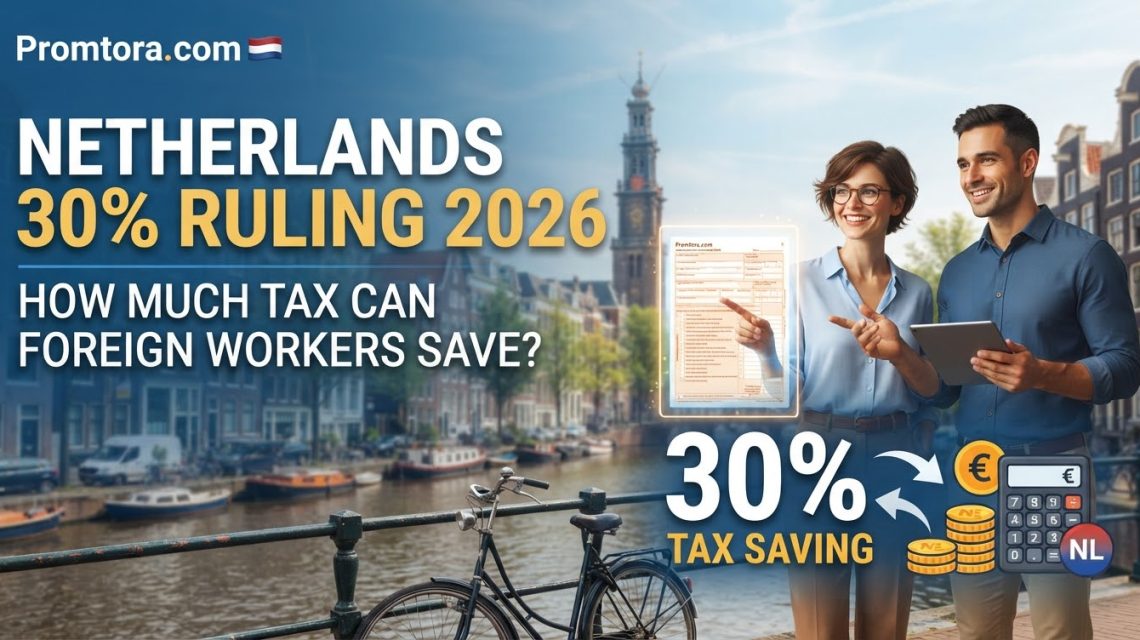
Netherlands 30% Ruling 2026: How Much Tax Can Foreign Workers Save?
What the 30% Ruling Is and How It Works in 2026
Under the 30% ruling an employer may treat a portion of an eligible employee’s remuneration as a tax-free reimbursement for the extra costs of living and working outside the employee’s home country. In practice the employer pays up to 30 percent of salary without deducting wage tax or national insurance contributions on that portion. The remaining 70 percent is taxed normally under the Dutch progressive rates.
In 2026 the maximum percentage remains 30 percent for the full duration of an approved ruling. The allowance is calculated on salary up to a statutory ceiling linked to the Wet normering topinkomens (WNT) norm. For 2026 that ceiling is €262,000, so the absolute maximum tax-free amount for a full year is €78,600. If the employee’s salary is lower, the tax-free portion is simply 30 percent of actual salary (provided the salary norm is still met after the allowance is subtracted).
The ruling is granted by the Belastingdienst on joint application by employer and employee. Once approved it normally runs for a maximum of 60 months, reduced by any earlier periods the employee lived or worked in the Netherlands in the preceding 25 years (with limited exceptions for short visits).
2026 Salary Norms and Eligibility Conditions
To qualify, three core conditions must be satisfied.
First, the employee must have been recruited from abroad (or transferred within an international group). The 150-kilometre rule requires that, in the 24 months before the first Dutch working day, the employee lived more than 150 km from the Dutch border for more than 16 of those months.
VIEW ALSO : What jobs pay well in the Netherlands?
Second, the employee must possess specific expertise that is scarce on the Dutch labour market. In most cases this is demonstrated by meeting a minimum taxable salary threshold after the tax-free allowance has been deducted:
| Category | 2026 Taxable Salary Norm (after allowance) | Approximate Gross Salary Needed for Full 30% |
|---|---|---|
| Standard employees | More than €48,013 | Approximately €68,590 |
| Under 30 with a Dutch or equivalent master’s degree | More than €36,497 | Approximately €52,140 |
| Scientific researchers at designated institutions or doctors in specialist training | No salary norm | Any qualifying salary |
Third, the employer and employee must obtain a formal decision from the Belastingdienst. Applications submitted within four months of the start of employment can take effect from the first working day; later applications generally start from the first day of the following month, and the intervening period is deducted from the five-year maximum.
How Much Tax Can Foreign Workers Save in 2026?
The exact saving depends on the employee’s total income, the progressive tax brackets, available credits, and whether the salary is high enough to reach the full 30 percent or the €78,600 ceiling. Illustrative examples based on typical 2026 rates (Box 1 income tax plus national insurance) show the scale of the benefit.
For an employee with a gross salary of €80,000 who qualifies for the full 30 percent:
- Tax-free portion: €24,000
- Taxable salary: €56,000
- Approximate annual tax saving compared with full taxation of €80,000: in the region of €9,000–€12,000 depending on exact credits and personal situation.
For a higher earner on €120,000:
- Tax-free portion: €36,000
- Taxable salary: €84,000
- Approximate annual saving: often €15,000–€18,000 or more.
At the ceiling, an employee earning €262,000 or more can receive the maximum €78,600 tax-free. The tax that would otherwise have been payable on that amount at the top marginal rate of 49.5 percent produces a gross tax saving approaching €39,000 per year before any interaction with other credits or deductions. Actual net benefit is lower once the progressive nature of the system and the loss of certain credits on the sheltered portion are taken into account, but the advantage remains substantial.
VIEW ALSO : Uber Eats Netherlands Rider Earnings – Incentives and Monthly Income
Because the allowance reduces taxable income, it can also affect the phase-out of labour tax credits and other means-tested elements. Employers and employees therefore commonly run detailed payroll simulations before finalising remuneration packages.
Key Figures at a Glance for 2026
| Item | 2026 Figure |
|---|---|
| Maximum tax-free percentage | 30% |
| Standard salary norm (taxable, after allowance) | €48,013 |
| Under-30 master’s salary norm | €36,497 |
| Salary base ceiling (WNT) | €262,000 |
| Maximum annual tax-free amount | €78,600 |
| Maximum duration | 5 years (60 months) |
Changes Taking Effect in 2027
Legislation already enacted reduces the maximum percentage from 30 percent to 27 percent with effect from 1 January 2027 for most employees. The reduction applies to rulings that first took effect in 2024 or later. Employees whose ruling was already being applied in the final pay period of 2023 (and who have had no subsequent break) generally keep the 30 percent rate for the remainder of their five-year term.
In addition, employees whose ruling first applied in 2025 or later will face a higher salary norm from 2027 (indicative figures published in earlier planning documents pointed to roughly €50,400 for the standard norm and €38,300 for the under-30 master’s norm, subject to final indexation). The salary-base ceiling itself is also expected to be indexed upward (to around €273,000 in some projections).
Partial non-resident taxpayer status, which previously allowed many 30%-ruling holders to exclude most foreign savings and investments from Box 3, was already largely abolished from 2025. Transitional protection for the oldest group of rulings extends only through the 2026 income-tax return.
Practical Considerations for Employees and Employers
The ruling is applied through the payroll. Once the Belastingdienst decision is received, the employer adjusts the wage-tax calculation so that the agreed percentage is paid free of tax. The employee still receives a gross salary figure that includes the tax-free portion; only the tax treatment changes.
Changing employers does not automatically transfer the ruling. A new application is normally required, and the remaining term is calculated from the original start date. Breaks in employment or failure to meet the salary norm in a given year can affect continuity.
Because the salary norm is tested on taxable salary after the allowance, careful structuring is sometimes needed in the first year or when an employee is close to the threshold. Employers frequently obtain written confirmation of the exact calculation method from their tax adviser or the Belastingdienst before the first payroll run.
Frequently Asked Questions
Is the 30% ruling still available in 2026?
Yes. Eligible employees can still receive up to 30 percent of salary tax-free throughout 2026, subject to the salary norms and the €262,000 ceiling.
How much can I actually save?
Savings typically range from several thousand euros for salaries just above the threshold to more than €30,000 per year for those reaching the maximum tax-free amount of €78,600, depending on the marginal tax rate that would otherwise apply.
What happens in 2027?
The maximum percentage falls to 27 percent for most people. Those whose ruling was already active at the end of 2023 generally keep 30 percent for the rest of their term. Higher salary norms will apply to newer cases.
Does the 150 km rule still apply?
Yes. The employee must have lived more than 150 km from the Dutch border for more than 16 of the 24 months preceding the start of Dutch employment.
Can the ruling be used for partial years?
Yes. Both the percentage and the maximum cap are applied proportionally for periods shorter than a full calendar year.
Is the ruling available to self-employed persons?
No. The facility is limited to employees in a genuine employment relationship.
What if my salary falls below the norm in a later year?
The ruling can be suspended or lost for periods in which the salary condition is not met. Continuous compliance is required.
How long does the Belastingdienst take to decide?
The tax authorities aim to issue a decision within eight weeks of a complete application.
Conclusion
In 2026 the Netherlands 30% ruling continues to offer meaningful tax relief to qualifying foreign workers. With a maximum 30 percent tax-free allowance, clear salary thresholds of €48,013 (or €36,497 for eligible younger master’s graduates), and a hard cap producing up to €78,600 tax-free, the facility can reduce an employee’s effective tax burden by thousands to tens of thousands of euros per year. The five-year maximum duration and the forthcoming reduction to 27 percent in 2027 mean that timing and careful documentation remain important. Employees and employers should verify current Belastingdienst figures, run precise payroll calculations, and submit applications promptly to secure the full benefit available under the 2026 rules.
References
- Belastingdienst – Official guidance on the Expat Scheme (30% facility), salary norms for 2026, and maximum untaxed allowance. https://www.belastingdienst.nl
- Belastingdienst – Application forms and procedural information for the 30% facility.
- Handboek Loonheffingen 2026 – Technical rules on calculation of the allowance and the WNT-linked ceiling of €262,000.
- Dutch Tax Plan and implementing decrees establishing the reduction to 27% from 1 January 2027 and transitional provisions for earlier rulings.
- Independent analyses and summaries from tax advisory firms confirming 2026 thresholds (€48,013 / €36,497), the €78,600 maximum, and the 2027 changes (various professional publications 2025–2026).