Netherlands Unemployment Benefit (WW): How Much You Receive After Losing Your Job
Losing a job in the Netherlands does not leave you without income overnight. If you meet the conditions, the WW-uitkering (unemployment benefit) from UWV steps in. It replaces a large share of your previous wage for a limited time while you look for new work. The system is rules-based and fairly transparent once you know the percentages, the maximum daily wage and how long your work history stretches the benefit.
This guide walks through the 2026 rules in plain language: who qualifies, how the amount is calculated, how long it lasts, and what to watch for when you apply.
The short version
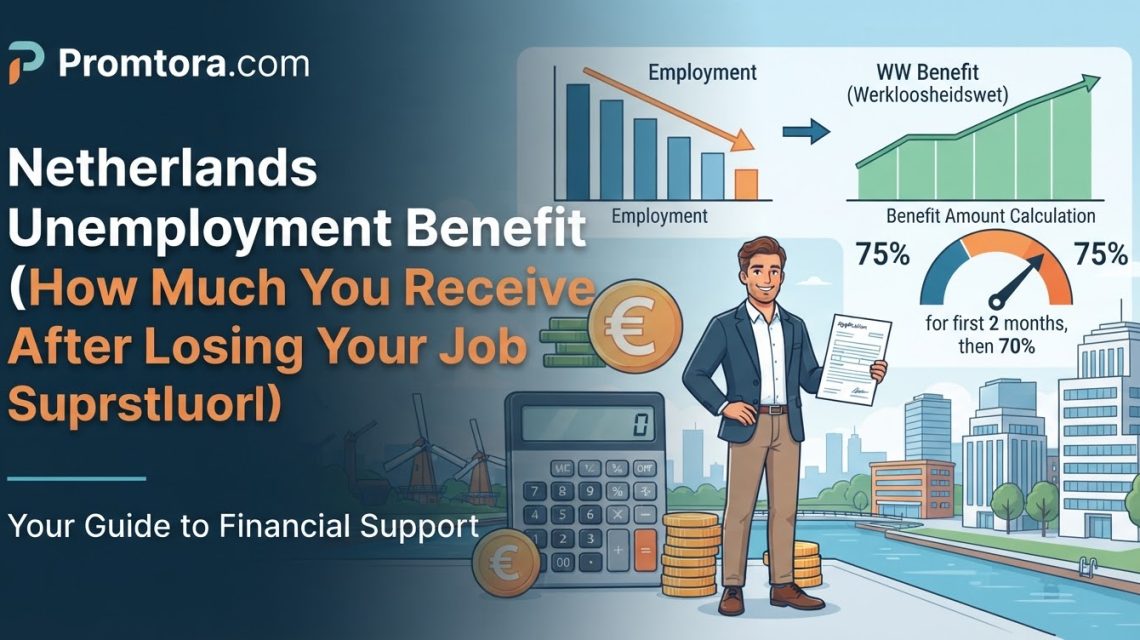
For the first two months you receive 75% of your WW monthly wage. From the third month it drops to 70%. Both percentages are capped by a legal maximum daily wage. In mid-2026 that maximum stood at €309.91 gross per day. The benefit lasts a minimum of three months and can run up to 24 months if your employment history is long enough.
You apply through UWV, usually within one week of becoming unemployed. The decision often arrives in a couple of weeks if your file is complete.
Who can claim WW?
You generally need to satisfy these core points:
- You worked as an employee (not as a pure self-employed person).
- You lost the job through no fault of your own — redundancy, end of a fixed-term contract, or similar situations that UWV accepts. Resignation without good reason or dismissal for serious misconduct usually blocks the claim.
- You meet the weeks condition (wekeneis): you worked in at least 26 of the 36 weeks before unemployment.
- You are available for work and registered as a jobseeker.
Agency workers and many flexible contracts can also qualify if the hours and weeks add up. People who recently arrived in the Netherlands can still claim the basic three-month period if they meet the 26-week rule; longer entitlement needs a longer Dutch (or recognised) work history.
How much do you actually receive?
UWV first calculates your daily wage (dagloon) from the social-security wages you earned in the year before you became unemployed. That daily wage is then turned into a WW monthly wage by multiplying by 21.75 (the average number of working days in a month). Your benefit is a percentage of that monthly figure.
| Period | Percentage of WW monthly wage | Maximum (gross, based on €309.91 daily wage) |
|---|---|---|
| First 2 months | 75% | Around €5,055 per month (including holiday allowance component) |
| From month 3 onward | 70% | Around €4,718 per month (including holiday allowance component) |
The maximum daily wage is set by the government and adjusted twice a year (1 January and 1 July). From 1 July 2026 it is €309.91 gross per day, inclusive of holiday pay. If your calculated daily wage is higher, UWV still uses the maximum.[1]
Holiday allowance (vakantiegeld) is built into the calculation and is usually paid out in May. Tax is withheld from the benefit, and you generally do not receive the full labour tax credit that employees get, so the net amount is lower than the same gross salary would have produced while you were working.
Any income you earn from part-time or temporary work while on WW is offset against the benefit. UWV has clear rules for how much of that income is deducted.
VIEW ALSO : Netherlands 30% Ruling : How Much Tax Foreign Workers Save?
A simple example
Suppose your WW monthly wage (after the daily-wage calculation) comes out at €3,500 gross.
- Months 1–2: 75% × €3,500 = €2,625 gross per month.
- From month 3: 70% × €3,500 = €2,450 gross per month.
If your previous earnings were high enough to hit the maximum daily wage, you would receive the capped amounts shown in the table above instead.
UWV’s online calculation tools let you estimate your own figure once you have recent payslips.
How long does the benefit last?
Duration depends on two tests.
Weeks condition only
If you meet the 26-out-of-36-weeks rule but do not have a longer work history that satisfies the years condition, you receive WW for three months.
Years condition (jareneis)
If you also worked in at least four of the five calendar years before the year you became unemployed (with a minimum number of hours in those years), your full employment history lengthens the benefit:
- Each of the first 10 years of work history adds one month.
- Years after that are counted differently: years up to 2015 still add a full month; years from 2016 onward add half a month.
- The absolute maximum is 24 months.
Some collective agreements include a private top-up (PAWW) that can extend income support after the statutory WW ends. That is separate from the UWV benefit and depends on your former sector.
| Work history example | Approximate WW duration |
|---|---|
| Only the 26-week rule met | 3 months |
| About 6–8 years of qualifying history | 6–8 months |
| Long career (10+ years, mixed pre- and post-2016) | Up to 15–24 months depending on exact years |
Applying and practical steps
Apply as soon as you know the end date of your employment — ideally within one week. You do this via the UWV website (Mijn UWV). You will need:
- Your citizen service number (BSN)
- Details of your last employer(s) and employment dates
- Recent payslips or annual statements so UWV can calculate the daily wage
- Bank account details for payment
UWV normally decides within four weeks; many complete applications are handled faster. Once awarded, you must keep looking for work, report any earnings, and follow the obligations set out in your decision letter. Failure to do so can lead to reductions or recovery of payments.
If you move to another EU/EEA country to look for work, limited export of the benefit is possible under strict conditions and usually for a short period (often up to three months) with the right forms.
What the money feels like in practice
For many people the drop from full salary to 75% and then 70% is noticeable, especially once tax and the loss of the labour credit are taken into account. Housing costs, health-insurance premiums and other fixed outgoings do not shrink automatically. Some households therefore combine WW with careful budgeting, temporary part-time work (which is offset but can still raise total income), or other support such as healthcare or housing allowances if they become eligible.
The benefit is designed as a bridge, not a permanent income. The longer rates reward people who have paid into the system for many years, while the three-month minimum still gives recent workers a short breathing space.
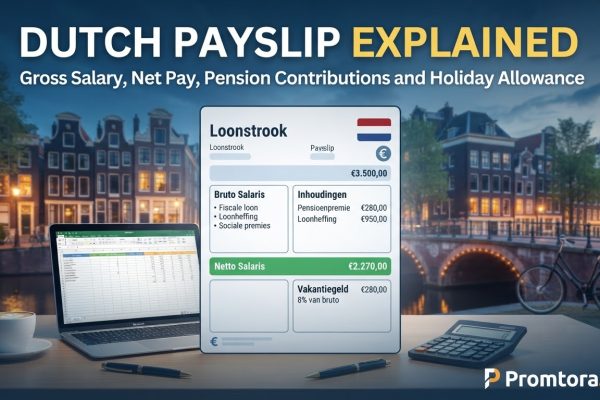
VIEW ALSO : Dutch Payslip Explained: Salary, Net Pay, Pension and Holiday Allowance
Common points of confusion
- Net versus gross — Always distinguish the gross percentage from the net amount that lands in your account.
- Maximum daily wage — High earners do not receive 75% or 70% of their full previous salary; the cap applies.
- Part-time work — Earnings reduce the WW payment according to fixed rules; they do not automatically stop the claim.
- Holiday pay — It is included in the calculation and paid (usually) in May.
- Residence and availability — You must remain available for work in the Netherlands unless you have formal permission to seek work abroad for a limited time.
Summary
In 2026 the Dutch WW benefit pays 75% of your calculated WW monthly wage for the first two months and 70% thereafter, subject to the maximum daily wage of €309.91 (from July 2026). The shortest entitlement is three months; the longest is 24 months, depending on your employment history. The scheme is administered by UWV and requires a prompt application, ongoing job-search efforts and honest reporting of any other income.
The rules are detailed, and individual situations (recent migration, flexible contracts, parallel income, private top-up schemes) can change the outcome. For a personal estimate use the calculation tools on the UWV website and, if needed, speak to UWV or an independent adviser once you have your employment documents ready.
References
- UWV. Maximum daily wage (maximumdagloon) and WW amount pages — €309.91 gross per day from 1 July 2026; 75% for the first two months, 70% thereafter. https://www.uwv.nl/nl/premies-bedragen/maximum-dagloon and https://www.uwv.nl/nl/ww/hoogte-ww
- UWV and government explanations of the weeks condition, years condition and duration rules (3 to 24 months).
- Independent 2026 guides summarising WW percentages, maximum monthly amounts and application timing (NL Compass, Infobak, MoreThanTax and similar).