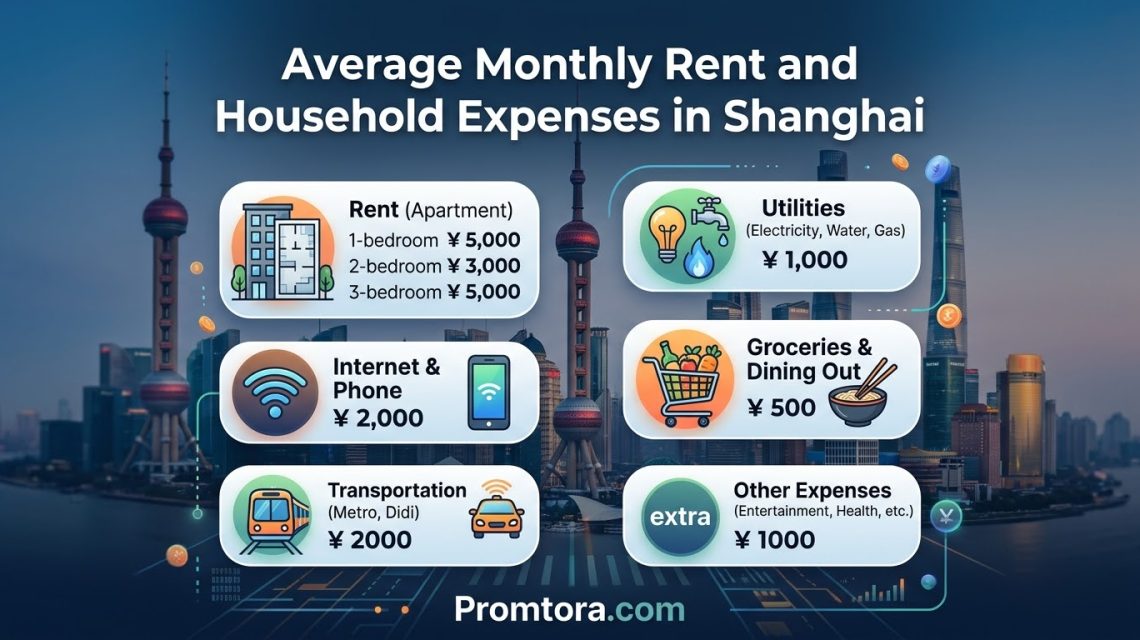
Average Monthly Rent and Household Expenses in Shanghai
Ask three people what it costs to live in Shanghai and you will often get three different answers. One person in a shared flat in Putuo will talk about manageable numbers. Another in a renovated lane house in the Former French Concession will quote figures that sound like a second salary. Both can be right. Location, size, condition and lifestyle still decide more than any single “average” figure.
By late 2026, official and platform data continued to show Shanghai as one of the most expensive rental markets in mainland China. Rents had risen for several consecutive months in the city even as many other Chinese cities softened. Understanding the typical ranges — and what sits on top of rent — helps anyone planning a move, negotiating a package, or simply checking whether their current budget still makes sense.
Average rents in 2026
City-wide averages hide large differences, but they provide a useful starting point. According to data from the China Index Academy, the average monthly housing rent in Shanghai stood at roughly CNY 85 per square metre in October 2026, still rising modestly month on month while the broader 50-city average declined.
Translated into whole-apartment figures from listing platforms and market reports around the same period, typical monthly asking rents looked roughly like this:
| Apartment type | Typical range / median (CNY per month) | Notes |
|---|---|---|
| 1-bedroom / studio (city-wide median) | Around 7,000 – 8,000 | Central districts often 8,000–15,000; outer areas can start lower |
| 1-bedroom, central (Jing’an, Xuhui, Huangpu etc.) | 8,000 – 15,000+ | Character properties and prime locations at the top end |
| 2-bedroom | Median around 12,000 – 13,000; central often 13,000–25,000 | Wide spread by district and fit-out |
| 3-bedroom / family | Often 20,000 – 45,000 in popular central or international-school areas | Compound quality and school access drive large premiums |
Figures are approximate asking rents drawn from late-2026 market reports and listing medians. Actual negotiated rents, furniture level, agent fees and utilities arrangements vary. Serviced apartments and short-term options usually cost more.
District differences remain stark. Huangpu, parts of Jing’an and the classic Former French Concession streets command clear premiums. Changning (including areas around Zhongshan Park and Gubei), Putuo and some northern or outer districts offer more space for the same money. Proximity to a metro line still matters heavily in day-to-day convenience and in the rent landlords can ask.
VIEW ALSO : China Average Salary by City: Beijing, Shanghai, Shenzhen and Guangzhou
What household expenses look like beyond rent
Rent is usually the largest single line, but it is far from the only one. A realistic monthly household budget in Shanghai also needs to cover utilities, food, transport, communications and everyday living.
Cost-of-living aggregators updating figures through November 2026 put estimated total monthly costs (including rent) for a single person in the region of US$1,200–1,300, or roughly CNY 8,500–9,500 and upward depending on exchange rates and lifestyle. Couples and small families scale from there, with housing again the dominant variable.
A practical breakdown of non-rent items for a moderate urban lifestyle often falls into these ranges:
- Utilities and internet — electricity, water, gas and broadband for a one- or two-person apartment commonly run a few hundred to around CNY 600–800 in a typical month, higher in summer with air-conditioning or in winter with heating needs.
- Food and groceries — cooking at home keeps costs manageable; regular supermarket and wet-market shopping for one person might sit in the CNY 1,500–2,500 range, rising with more imported goods or frequent delivery. Eating out regularly adds significantly more.
- Transport — metro and bus travel is inexpensive by international standards. A monthly pass or regular top-ups often stay under a few hundred yuan for many workers. Taxis and ride-hailing increase the total quickly if used daily.
- Mobile and miscellaneous — phone plans, streaming, household items and modest entertainment add further hundreds of yuan.
Families face additional pressure points. International school fees, when required, can run into the low-to-mid hundreds of thousands of yuan per year and dwarf ordinary household spending. Domestic help, if employed, is another recurring cost that varies with hours and experience.
How lifestyle and location change the total
Two people with similar salaries can have very different monthly outgoings in Shanghai. The biggest levers are:
- Housing choice — a shared room or outer-district one-bedroom versus a renovated central two-bedroom can differ by CNY 5,000–15,000 or more per month.
- Eating habits — cooking most meals versus frequent restaurant and delivery orders.
- Transport pattern — relying on metro versus regular taxis or car ownership (parking and related costs add up fast in central areas).
- Social and leisure spending — Shanghai offers everything from inexpensive local options to high-end international experiences.
Expatriate packages that include housing allowances or school fees change the personal cash burden dramatically. Local professionals and those without allowances feel the full weight of market rents, which is why many younger workers share flats or live further from the core.
Practical budgeting notes
For a single professional aiming for a comfortable but not luxurious standard in a decent location, a working monthly total (rent plus ordinary living costs) often lands in the CNY 12,000–20,000 range once a one-bedroom in a reasonable district is factored in. Couples sharing a two-bedroom can achieve better per-person efficiency. Families needing space near international schools or in premium compounds should plan for substantially higher housing outlays.
Agent fees, deposits (commonly one or two months’ rent) and the cost of furnishing an unfurnished apartment are front-loaded expenses that catch some newcomers by surprise. Utility setup and the occasional need for a local guarantor or specific documentation also form part of the practical picture.
Rents in Shanghai have shown more resilience than in many other Chinese cities through 2026, supported by ongoing talent inflows and the city’s economic role. That does not mean every neighbourhood moves in lockstep, nor that individual negotiations cannot produce better deals, especially in less central locations or during quieter leasing periods.
The bottom line
There is no single “average” monthly cost of living in Shanghai that fits every household. A realistic 2026 picture starts with rent that frequently runs from roughly CNY 7,000–8,000 for a typical one-bedroom city-wide median, climbing well above CNY 10,000–15,000 in popular central districts, and with family-sized apartments often requiring CNY 20,000 and more in sought-after areas. On top of that, ordinary household expenses for food, utilities, transport and daily life commonly add several thousand yuan more per person.
The most useful approach is to fix the housing requirement first — size, district, commute tolerance — then build the rest of the budget around it. Once those choices are clear, the numbers become far more predictable than the wide headline ranges initially suggest.