China Average Salary by City: Beijing, Shanghai, Shenzhen and Guangzhou
A young software engineer in Shenzhen once told me that the first time he saw a Shanghai offer, the number looked almost 30 percent higher than what he was earning. Then he ran the rent numbers for a comparable apartment near the office and realised the real difference in what he could save each month was far smaller. That conversation captures the problem with city averages in China. The headline figures are real and useful, but they sit on top of very different cost structures, industry mixes and bonus cultures. Looking only at the average salary without the context of housing, taxes, social contributions and sector can lead people to the wrong conclusion about where they will actually be better off.
Beijing, Shanghai, Shenzhen and Guangzhou remain China’s four first-tier cities and the places where the highest concentrations of high-paying white-collar work are found. Recent 2025 and 2026 data from recruitment platforms, local statistics bureaus and salary surveys continue to show Shanghai and Beijing at the top of the overall rankings, with Shenzhen close behind in technology-heavy roles and Guangzhou typically recording the most moderate city-wide averages of the four. National urban non-private average pay sits far lower — around 10,800 yuan a month in the latest full-year figures — so all four cities still represent a clear premium over the rest of the country.
What follows is a detailed look at how those averages break down, what they mean in practice, and how cost of living changes the picture once the salary lands in a bank account.
The headline numbers in 2025–2026
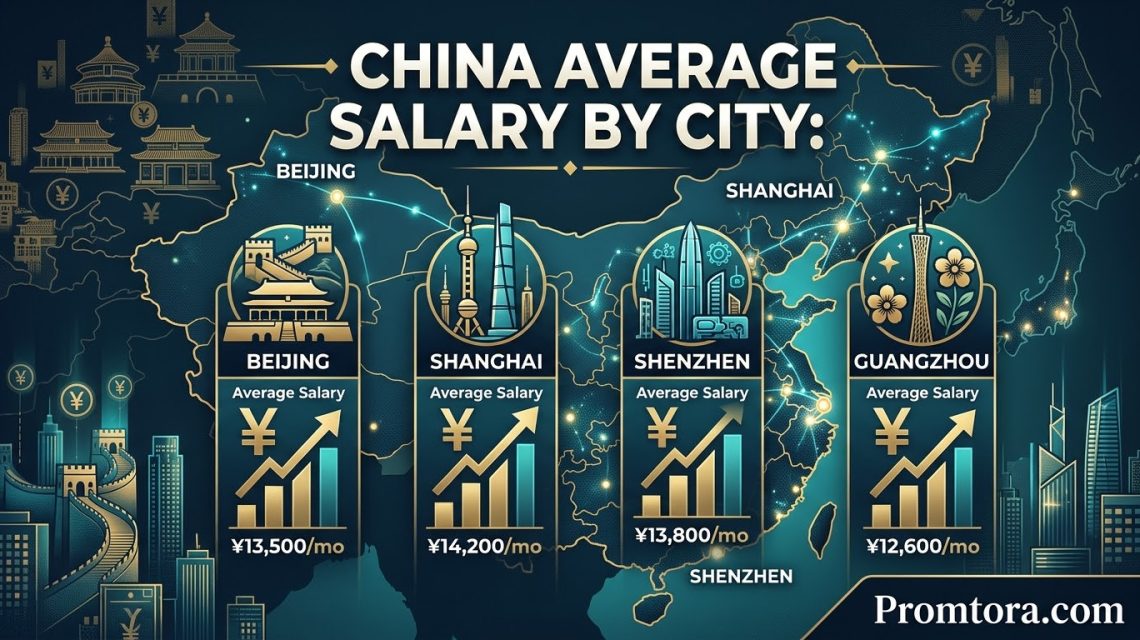
Recruitment-site and human-resources white-paper data circulating in 2026 typically place average monthly base salaries (excluding bonus) roughly as follows: Shanghai around 13,500 yuan, Beijing around 12,500 yuan, Shenzhen around 10,900 yuan and Guangzhou around 10,400 yuan. When typical year-end or performance bonuses are folded in, Shanghai’s effective monthly equivalent often rises above 17,000 yuan, Beijing above 16,000 yuan, Shenzhen into the mid-13,000s and Guangzhou into the high 12,000s.
Official statistics published by municipal or provincial bureaus tell a related story with important differences in methodology. Non-private sector averages (covering government units, state-owned enterprises and many larger formal employers) can run significantly higher. Beijing has posted some of the highest non-private figures in the country in recent releases. Shanghai sometimes publishes an all-urban-units average that is used as a reference for social-insurance contribution bases. Private-sector averages sit noticeably lower across every city. Because high earners pull the mean upward, the median salary in each city is usually lower than the published average.
These city-wide numbers mix junior service workers, factory staff, teachers, civil servants, mid-level professionals and senior managers. They are therefore best treated as a rough map of relative pay levels rather than a precise prediction of any individual offer.
| City | Approx. average monthly base (recent surveys) | Indicative with bonus effect | Typical character of high-paying work |
|---|---|---|---|
| Shanghai | \~13,500 RMB | \~17,000+ RMB | Finance, multinationals, professional services, HQ functions |
| Beijing | \~12,500 RMB | \~16,000+ RMB | Government-linked, tech, education, central SOEs |
| Shenzhen | \~10,900 RMB | \~13,400 RMB | Technology, hardware, electronics, startups |
| Guangzhou | \~10,400 RMB | \~12,900 RMB | Trade, logistics, manufacturing, services |
Figures are approximate compilations from 2025–2026 recruitment surveys and public reports. Official non-private averages can be higher, especially in Beijing. Actual offers vary widely by role, seniority and employer type.
Shanghai: the highest packages and the highest costs
Shanghai continues to lead most overall salary rankings. The concentration of commercial banks, investment firms, multinational regional headquarters, consulting practices and professional-services firms supports both higher base pay and thicker bonus pools. In finance and certain tech or consulting roles, total annual compensation can sit well above the city average once performance bonuses and year-end awards are included. Many employers still operate on a 13- to 16-month effective pay structure in strong years.
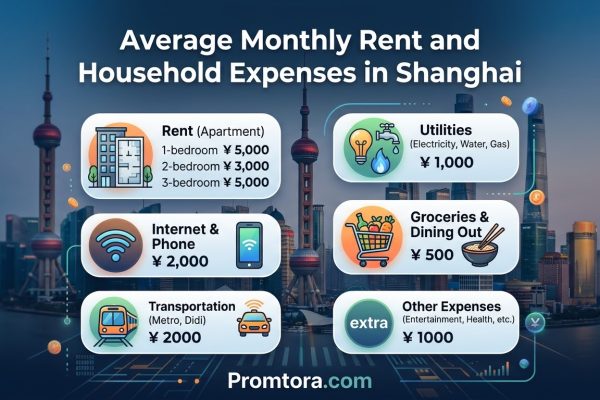
The flip side is housing. A one-bedroom apartment in a convenient central or popular residential district frequently costs 6,000–8,000 yuan or more per month; family-sized apartments in international-school corridors can run substantially higher. Everyday costs for dining, transport and imported goods are also among the highest in mainland China. A single professional earning the city average may find that a large share of take-home pay disappears into rent if they insist on living close to the main business districts. Those who move a few metro stops outward or share housing recover more of the salary advantage.
For many career-focused professionals, the density of high-value employers, the depth of the talent market and the international character of the city still justify the cost. Families weighing international school fees and dual incomes often find Shanghai’s infrastructure unmatched even when the net savings rate is lower than in cheaper cities.
Beijing: strong official and tech pay, different lifestyle trade-offs
Beijing’s averages sit close to Shanghai’s on most measures and can exceed them in certain non-private and state-linked segments. The presence of central government bodies, major state-owned enterprises, top universities, research institutes and a large technology sector keeps both average and upper-quartile pay elevated. Tech, education, media and policy-related roles form an important part of the high-earning landscape.
Living costs are high, though some comparisons show Beijing slightly less expensive than Shanghai on overall baskets once rent is included. Winter heating adds to utility bills, and air quality, while improved over the past decade, remains a factor that many residents monitor closely during the colder months. The city is geographically vast; commuting times can be long if housing is chosen purely on price.
Professionals who value proximity to policy, academia or specific state-owned employers often accept the environmental and sprawl trade-offs. Those whose work is purely commercial sometimes find that Shanghai or Shenzhen offers a more straightforward commercial environment at similar or higher total pay.
Shenzhen: technology premium and a younger profile
Shenzhen’s city-wide average sits below Shanghai and Beijing, yet in core technology, hardware, electronics and product roles the city frequently matches or exceeds the other first-tier markets. The presence of major technology companies, a dense supplier and manufacturing ecosystem, and a large population of young engineers creates strong demand for specialised skills. In artificial intelligence, semiconductors, software and advanced manufacturing, compensation for experienced talent can be highly competitive.
Housing in the most popular districts (Nanshan, parts of Futian and the Shekou area) is expensive, though generally not at the absolute peak levels of central Shanghai. The city feels newer and more planned than Beijing or the older parts of Guangzhou; it also has less historical texture. Proximity to Hong Kong remains a practical advantage for some professionals who need to travel or maintain cross-border connections.
For pure technology careers, Shenzhen is often the most focused environment of the four. For those seeking a broader mix of industries or a more established international community, Shanghai or Beijing may still feel more complete.
Guangzhou: lower averages, meaningfully lower costs
Guangzhou typically records the lowest overall averages of the four first-tier cities. Its economic base is weighted toward trade, logistics, manufacturing, wholesale markets and a large services sector. While there are well-paid roles in these fields and in the growing number of private hospitals, education providers and regional offices, the city does not have the same concentration of ultra-high-paying finance or pure internet headquarters that Shanghai and Beijing do.
The compensating advantage is cost. Central one-bedroom rents are frequently reported in the 3,500–4,500 yuan range in many comparisons — substantially below Shanghai or Beijing. Overall monthly living costs for a single person can sit 20–30 percent lower than in Shanghai once rent is included. For many local professionals and some expatriates, the lower nominal salary still leaves more disposable income after housing and daily expenses.
Guangzhou’s food culture, milder winters and slightly less intense pace are additional factors that influence quality-of-life calculations. English is less widely spoken than in Shanghai’s main international districts, and the foreign professional community is smaller, but the city remains a major commercial and transport hub for southern China and the Pearl River Delta.
Industry and role differences that matter more than the city average
City averages conceal large gaps by sector. Information technology, software, internet services and finance consistently rank among the highest-paying industries nationally and in the first-tier cities. In recent national data, information transmission, software and IT services posted average annual wages well above 200,000 yuan in the non-private sector; finance was not far behind. Manufacturing sits lower on the overall average but shows strong premiums for automation, new-energy and advanced process roles. Hospitality, traditional retail and many service occupations pull city averages downward.
Within technology, artificial-intelligence, large-model, chip-design and senior software roles in first-tier cities can command annual packages several times the city mean, especially once equity or performance bonuses are counted. Entry-level and junior positions in the same cities often sit close to or only modestly above the published average. Experience, scarce skills and the ability to work in English or manage cross-border teams create additional premiums that are only loosely related to the city-wide figure.
Company ownership also matters. Foreign-invested enterprises and large private technology or finance firms generally pay more in cash compensation than smaller domestic private employers. State-owned enterprises may offer lower base salaries but stronger benefits, greater job security and, in some cases, housing or other support. These differences can be as large as the differences between cities.
Taxes, social contributions and take-home pay
China’s individual income tax is progressive. Social-insurance and housing-fund contributions (the “five insurances and one fund”) are calculated as percentages of a base that is usually capped and floored by reference to local average wages. Both the employee and employer portions are significant. The practical result is that the gap between gross and net pay is material, and the exact percentage depends on the contribution base used by the employer and the city’s rules.
Local average wage figures are also used in other regulatory contexts, including certain work-permit salary thresholds for foreign professionals and severance calculations. For anyone comparing offers, looking only at the gross monthly number without understanding the social-insurance base and tax treatment can produce an incomplete picture of actual cash flow.
What the salary actually buys
A single professional in Shanghai or Beijing earning a solid mid-level package can live comfortably, but the definition of “comfortable” often requires either a higher-than-average salary or willingness to live outside the most expensive districts. International schooling for children adds a major cost layer that can exceed many local professionals’ entire annual salaries. In Guangzhou the same mid-level package typically stretches further on housing and everyday expenses. Shenzhen sits between the two extremes for many technology workers.
Purchasing-power comparisons with other countries are complicated by differences in what is included in “cost of living” baskets and by the fact that many foreign professionals receive housing allowances or other benefits that local staff do not. Broad indices often show that consumer prices and rent in Chinese first-tier cities remain lower than in major Western or developed Asian hubs, but the gap has narrowed in the most international neighbourhoods.
Trends and practical considerations
Salary growth in the first-tier cities has moderated compared with the rapid increases of earlier years. Companies have become more disciplined about headcount and variable pay. At the same time, demand for scarce technical skills — particularly in artificial intelligence, semiconductors, advanced manufacturing and certain finance specialisations — continues to support strong packages for the right profiles.
Second-tier and strong new first-tier cities (Hangzhou, Nanjing, Suzhou, Chengdu and others) have narrowed the gap on some measures and offer lower living costs. For many roles the absolute pay difference with Guangzhou or even Shenzhen is no longer dramatic, while the saving