Best Cities to Live in China for Foreigners
There is no single “best” city in China for foreigners. The right place depends on what you need: a large English-speaking community and international schools, a tech job, lower rent, cleaner air, or a slower pace of life. What works for a finance professional with children is rarely ideal for a young teacher or a hardware engineer. Recent surveys of foreign talent and practical cost-of-living data still point to a clear shortlist of cities that dominate most conversations.
According to the 2025–2026 Foreign Talent Attraction Index released by China’s Ministry of Human Resources and Social Security, Shanghai, Beijing and Guangzhou lead the ranking, followed by Hangzhou, Shenzhen, Suzhou and others. Chengdu consistently appears among the livability favourites for those prioritising cost and lifestyle over corporate density. The differences between these places are real and worth understanding before accepting an offer or planning a move.
Shanghai: the default international choice
Shanghai remains the city with the largest and most established foreign community in mainland China. English is more widely usable in daily life than almost anywhere else, international schools are plentiful, and the range of Western-style restaurants, medical clinics and social groups is unmatched. Multinational headquarters, finance, consulting and trade roles cluster here.
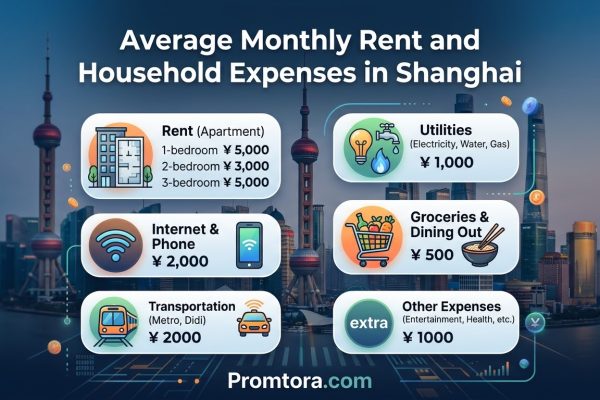
The trade-off is cost. A comfortable single lifestyle with a central one-bedroom often lands in the region of RMB 10,000–11,000 or more per month once rent and everyday expenses are included. Summers are hot and humid; winters are damp. Some long-term residents eventually feel they are living in an international bubble rather than “real China.” For first-time arrivals, families needing school choice, or anyone whose work is tied to global companies, the infrastructure usually outweighs the drawbacks.
Beijing: culture, power and winter air
Beijing is the political and cultural centre. It suits diplomats, journalists, academics, Mandarin learners and people working with government or state-linked organisations. The historical and cultural density is unmatched — museums, hutongs, universities and a serious arts scene. The expat community is sizeable, though more dispersed than Shanghai’s.
Air quality has improved compared with a decade ago, and 2025 was one of the cleaner years on record, yet winter pollution episodes still occur. The city is vast, winters are cold, and English is less commonly spoken outside international zones. Housing costs sit close to Shanghai’s in the popular districts. Many who choose Beijing do so because their work or studies require it, or because they want deeper immersion in Chinese language and history.
Shenzhen: tech, youth and proximity to Hong Kong
Shenzhen is China’s hardware and innovation hub. The population is young, the infrastructure modern, and the air generally cleaner than the northern cities. Hong Kong is a short train or ferry ride away, which is useful for banking, travel and weekend escapes. Tech, electronics and manufacturing-related roles dominate the foreign professional scene.
Costs have risen and now sit not far below Shanghai for many lifestyles. The work culture can be intense, and the city has relatively little historic character. For engineers, product people and entrepreneurs in the tech ecosystem, the career density and energy often justify the intensity. For those seeking a slower or more cultural experience, it can feel one-dimensional.
Guangzhou: big-city life at a lower price
Guangzhou offers Tier-1 scale and connectivity at a noticeably lower cost than Shanghai, Beijing or Shenzhen. A central one-bedroom can be found for roughly half the Shanghai equivalent in many comparisons. The food scene is excellent, the climate subtropical, and the city has long been a trading hub with diverse communities, including significant African and Middle Eastern populations in certain districts.
The foreign professional community is smaller and English is less ubiquitous. International school options exist but are more limited than in Shanghai or Beijing. Guangzhou works well for people in trade, sourcing, logistics or those who want major-city amenities without the top-tier rent bill.
Chengdu and Hangzhou: lifestyle and rising alternatives
Chengdu is frequently praised for quality of life. Costs are substantially lower — a comfortable single budget can sit well under the Tier-1 figures — the pace is slower, and the food culture is famous. It attracts teachers, some tech and startup workers, and people who want a more relaxed inland base. International school choice is thinner, and the winters can feel grey. For budget-conscious professionals or those prioritising lifestyle over corporate density, it ranks highly.
VIEW ALSO : Malaysia gdp per capita vs China
Hangzhou has risen quickly in attractiveness rankings. It combines a strong tech and e-commerce presence (Alibaba’s home) with West Lake scenery and better access to nature than the pure megacities. Costs sit between the coastal giants and Chengdu. It appeals to people who want modern work opportunities without the full intensity or price of Shanghai or Shenzhen.
Side-by-side snapshot
| City | Best suited for | Approx. single monthly cost (central 1-bed + living) | Main trade-off |
|---|---|---|---|
| Shanghai | Corporate, finance, families needing schools | ≈ RMB 10,500+ | Highest costs, humid summers |
| Beijing | Culture, academia, diplomacy, Mandarin | ≈ RMB 10,000–10,400 | Winter air, sprawl, cold |
| Shenzhen | Tech, hardware, proximity to Hong Kong | ≈ RMB 9,000–9,200 | Work intensity, limited history |
| Guangzhou | Trade, lower Tier-1 budget, food | ≈ RMB 7,600 | Smaller expat scene, less English |
| Chengdu | Lifestyle, teaching, tighter budgets | ≈ RMB 6,000–6,500 | Fewer international schools |
| Hangzhou | Tech/e-commerce + nature | Mid-range (below Shanghai) | Smaller overall foreign community |
Cost figures are approximate 2026-2027 estimates drawn from Numbeo-based and expat-oriented reports for a single person with central one-bedroom rent plus everyday expenses. Actual spending varies widely with lifestyle, neighbourhood and whether housing is employer-provided.
Practical factors that matter more than rankings
International schools are concentrated in Shanghai, Beijing and Shenzhen. Families usually choose housing near the school corridor rather than the most central business district. Air quality remains a planning issue, especially in the north during winter; many international schools and compounds invest in filtration. Southern cities generally fare better on this measure.
Visa and work-permit rules are national, but the density of employers who regularly sponsor foreigners is highest in the coastal hubs. English usability drops quickly outside the main international districts in every city. Learning basic Mandarin improves daily life dramatically almost everywhere except the most insulated Shanghai neighbourhoods.
Safety is generally high across these cities by international standards. Public transport is extensive and affordable. Healthcare quality for those with international insurance is good in the major centres, with private international clinics available in Shanghai, Beijing and Shenzhen.
How to choose
If your priority is the softest landing, the widest job market for non-Chinese speakers, and the most international infrastructure, Shanghai is still the leading option. If your work is tied to government, media, universities or deep language study, Beijing makes more sense despite the climate and air. Tech and hardware careers point toward Shenzhen. Budget-conscious professionals and those seeking a less intense rhythm often prefer Chengdu or Guangzhou. Hangzhou sits in between for people who want both modern industry and easier access to nature.
The 2025–2026 talent-attraction rankings confirm that the same names keep appearing at the top. The useful question is not which city is objectively best, but which combination of cost, community, career opportunity, climate and family needs matches your situation. Many foreigners try one of the coastal hubs first and later move inland or to a secondary city once they understand what they actually value in daily life. Starting with clear priorities, rather than a generic ranking, remains the most reliable way to decide.