Botswana Salary Scales: Monthly Pay and Allowances Explained
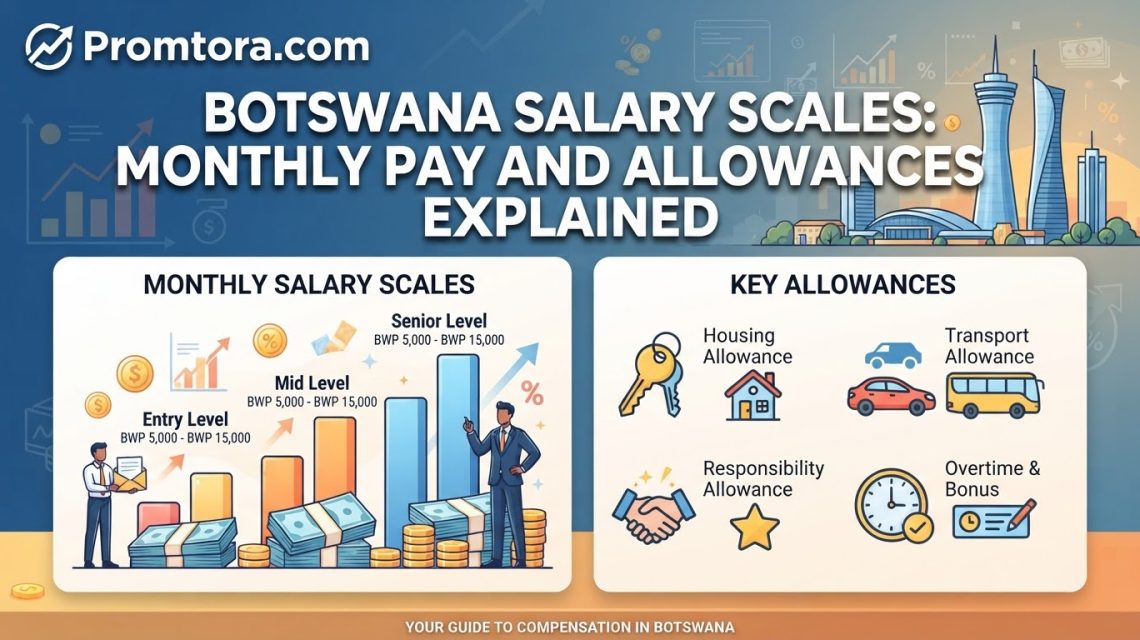
Botswana’s formal salary landscape is dominated by the public service scales. Most government employees are paid on lettered grades — A, B, C, D and higher — with notches inside each grade. Private-sector and parastatal pay often reference or compete with these scales, especially in mining, banking and large corporates. Understanding the system means looking at three things together: the basic salary on the grade and notch, the allowances that sit on top of it, and the fact that the lowest and highest packages differ by a very large margin.
Official statements in 2026 give a clear floor for the public service. The full picture of every notch is not published as a single open table for the public, but the structure, the role of allowances, and recent adjustments are well documented through parliamentary answers, collective agreements and Directorate of Public Service Management (DPSM) commentary.
The grade and notch system
Public officers are placed on scales identified by a letter and number (for example A3, B1, C4, D1). Within each scale there are notches — incremental steps that an employee can move up over time, usually on the basis of satisfactory performance and years of service. Historically many scales were relatively narrow, with officers reaching the top notch after roughly a decade. That has contributed to widespread complaints of stagnation: large numbers of staff sit at the ceiling of their grade with limited promotion opportunities above them.[1]
Inter-grade differentials (the gap between one scale and the next) and intra-grade differentials (the step between notches) have been the subject of long-running negotiation and litigation. Unions have argued that earlier directives on percentage gaps were not consistently applied, and that across-the-board increases and minimum adjustments sometimes compressed or overlapped grades. A “fan-shaped” structure — with broader scales containing many more notches — has been under discussion for several years as a way to allow longer progression inside a grade before an officer hits a ceiling. Implementation has been gradual and remains a live topic between government and labour.[2]
VIEW ALSO : Botswana Pension Payments: How Much Retired Workers Receive
The bottom of the public service scale
Government has stated that the lowest-paid public officer receives a total package of about P4,000 per month. That figure is made up of:
- Basic salary of approximately P2,895
- Housing and upkeep allowance of approximately P1,105
The distinction matters. Basic salary is the core wage; the housing and upkeep allowance is a significant part of what the officer actually takes home. In parliamentary exchanges, ministers have pointed to this P4,000 combined package as evidence of efforts to protect the purchasing power of the lowest earners. Housing and upkeep allowances for employees on scales A3 to D1 were also enhanced under the collective labour arrangements for the 2025/26 financial year, with further budget provision made for 2026/27.[3]
Critics sometimes note that relying heavily on allowances rather than a higher basic can leave lower-paid officers more exposed if allowances are ever reviewed or restructured. For now, the published floor remains the combined basic-plus-allowance figure around P4,000.
How allowances work
Allowances are not uniform across the entire service, but several are common or important:
| Element | Role in the package | Notes |
|---|---|---|
| Basic salary | Core pay according to grade and notch | Subject to general adjustments and notch progression |
| Housing and upkeep allowance | Significant top-up, especially at lower grades | Enhanced for A3–D1 in recent collective agreements; forms a large share of the P4,000 floor |
| Scarce skills / responsibility / other specialised allowances | Paid where the post or conditions attract them | Vary by ministry, profession and location |
| Overtime / shift-related payments | Common in operational services (e.g. police, health) | Often expressed as a percentage of basic |
Exact allowance rates and eligibility are set by Public Service Management directives, collective agreements and departmental rules. They can change with negotiations. The figures cited for the lowest package are those given in official 2026 parliamentary responses.
In sectors such as the police, additional elements appear in recruit advertisements: overtime allowances (for example 20 percent of basic), housing or a housing allowance in lieu, medical aid contributions, and pension contributions. Similar logic applies across much of the public service: the gross monthly amount an officer receives is basic plus the applicable allowances, less statutory deductions (tax, pension, medical aid where applicable).[4]
Middle and upper scales
Moving up the lettered scales (from A into B, C, D and beyond) brings higher basic salaries and, in many cases, different or additional allowances. Entry-level professional and technical posts, supervisory roles, and middle management sit on these intermediate scales. Senior management, directors and the highest administrative posts occupy the upper grades.
Public reporting has occasionally referenced the top of the civil service. One parliamentary exchange in 2026 put the highest-paid civil servants in the region of P97,000 per month when allowances were included. That figure is an order of magnitude above the P4,000 floor and illustrates the width of the public-service pay distribution. Exact current notch values for each grade are held in internal DPSM schedules and are adjusted through collective bargaining and management directives rather than being released as a single public spreadsheet each year.[5]
Specialised services (police, teaching, nursing, defence) operate within or alongside the same broad framework, sometimes with their own entry scales and allowance patterns. Police constable recruits, for example, have been advertised on B and C scales with annual ranges that translate to several times the absolute minimum public-service package once confirmed in post.
Recent adjustments and disputes
Public-sector pay in Botswana is negotiated through the Public Service Bargaining Council and related processes. Recent years have seen:
- Across-the-board percentage increases in successive financial years
- Targeted improvements to housing and upkeep allowances for lower and middle scales
- A comprehensive salary agreement in late 2025 that settled a period of fragmented negotiations and litigation
- Ongoing argument over whether historical inter-grade and intra-grade differentials have been properly maintained
The push toward a fan-shaped structure is intended to give officers more room to progress inside a grade through notches rather than depending almost entirely on scarce promotions. Whether and how fully that redesign is implemented will shape career earnings for the next decade.[6]
Private sector and other employers
Private companies, mines, banks and parastatals set their own scales. Many benchmark against the public service, especially for comparable administrative, technical and professional roles. Mining packages (including at copper and diamond operations) often exceed public-service totals for equivalent skills once site, underground and production allowances are counted. Banking and professional services likewise pay premiums for scarce skills. The public-service scales therefore act both as a direct pay system for government employees and as a reference point for the wider formal labour market.
VIEW ALSO : Botswana Police Service Salaries and Ranks
What the monthly figure really means
When someone quotes a “Botswana salary scale” figure, it is worth asking whether it is:
- Basic salary only
- Basic plus housing and upkeep
- Full cost-to-company including all allowances and benefits
At the bottom of the public service the difference is large: basic around P2,900 versus a total near P4,000. Higher up the scales the absolute value of allowances may be larger, but their share of the total package can be smaller. Tax, pension and medical contributions further reduce net take-home pay.
For job-seekers and employees the practical approach is to look at the grade and notch, the published or offered basic, the specific allowances attached to the post, and the statutory deductions. Official statements from DPSM, the Ministry of Finance and parliamentary records remain the most reliable public sources for the current floor and for the direction of policy on allowances and structure.
Summary
Botswana’s public service salary system is built on lettered grades and notches, with housing and upkeep allowances playing a major role in the monthly package — especially at the lower end, where the combined total for the lowest-paid officers is stated at about P4,000. Higher grades and specialised services pay substantially more. Allowances have been adjusted through collective agreements, and structural reform aimed at reducing stagnation continues to be discussed. The scales set the tone for much of the formal economy, even though private and mining employers often pay above the government benchmark for comparable skills.
References
- Directorate of Public Service Management (DPSM). Commentary on salary structure, notch progression and the proposed fan-shaped scales. Reported in DailyNews, “DPSM moves to implement fan-shaped structure,” 23 July 2024. https://dailynews.gov.bw/news-detail/80739
- Mmegi. “Five+1 unions to sue gov’t over 2% intra-grade differential,” 24 November 2025. Coverage of disputes over inter-grade and intra-grade differentials and the effect of minimum adjustments on the salary structure. https://www.mmegi.bw/ampArticle/120154
- DailyNews. “Govt commits to improve the welfare of workers,” 16 July 2026. Parliamentary response stating the lowest-paid public officer receives approximately P4,000 (basic P2,895 + housing and upkeep allowance P1,105.40), and noting enhancements to housing and upkeep allowances for scales A3 to D1. https://dailynews.gov.bw/news-detail/92278
- Botswana Police Service. Vacancy Circular No. 2 of 2026 (Police Recruits) — entry salary scales (B.1, C.4, C.3), overtime allowance at 20% of basic, housing or housing allowance, medical aid and pension contributions. Reported via career and job listings, September 2026.
- Parliamentary / DPSM reporting (2026). References to the highest-paid civil servants receiving packages in the region of P97,000 per month (including allowances). Circulated in public commentary and parliamentary committee exchanges.
- DailyNews. “Court ends public sector wage appeal after settlement,” 31 March 2026. On the October 2025 comprehensive collective salary agreement that aligned public-sector wage outcomes after earlier fragmented negotiations. https://dailynews.gov.bw/news-detail/90813
- Public Service Act and related Public Service Management Directives — framework for grading, salary administration and conditions of service.
- Collective Labour Agreements between Government and public-sector unions (2025/26 and prior) — adjustments to basic pay and housing/upkeep allowances.