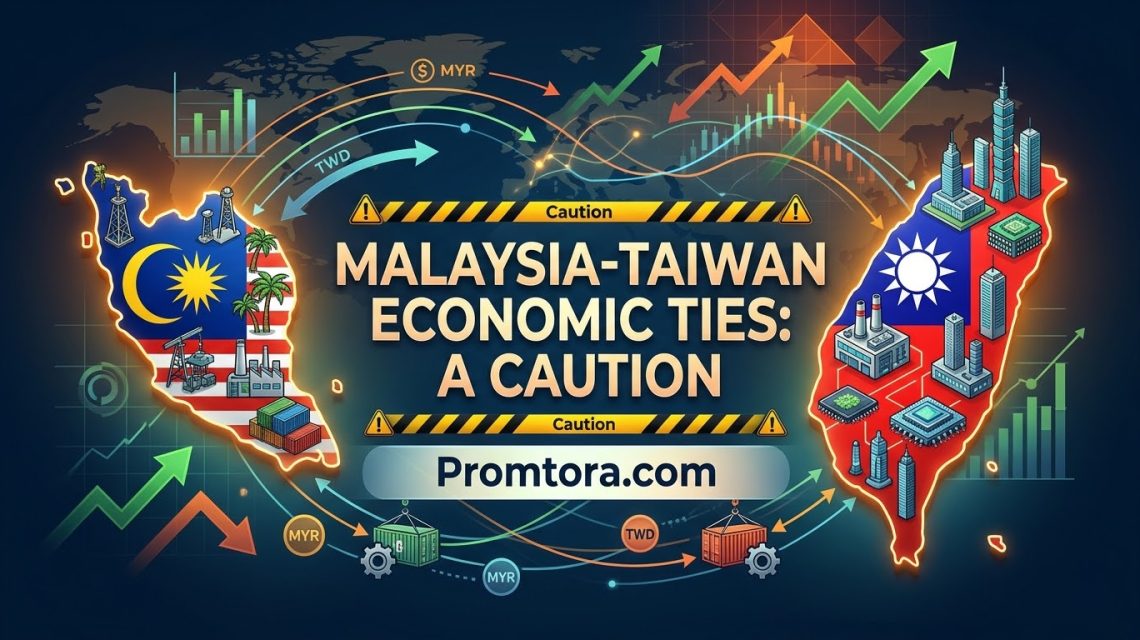
Malaysia-Taiwan Economic Ties: Why Malaysia Should Exercise Caution in Strengthening Relations
Malaysia has long managed a delicate balancing act with Taiwan. Trade and investment flows are substantial, particularly in semiconductors and electronics, yet official policy remains firmly anchored in the One-China principle recognised since 1974. In late 2026 this tension became more visible when Taiwan suspended investment talks following remarks by Prime Minister Anwar Ibrahim that reaffirmed Taiwan as part of China. The episode illustrates why any move to “strengthen” relations needs careful calibration rather than open-ended expansion.
Economic pragmatism has served Malaysia well. At the same time, treating the relationship as purely commercial while ignoring the political sensitivities that surround it risks miscalculation. The question is not whether economic engagement should continue — it already does at scale — but how far and how visibly Malaysia should push the formal and symbolic dimensions of that engagement.
The scale of existing economic links
By the numbers, Taiwan is an important partner. Bilateral trade in the first nine months of 2026 reached RM254.21 billion, up 47.1 percent year-on-year. Malaysian exports to Taiwan rose sharply (reported at 88 percent in official statements), while imports also increased. Taiwan ranked among Malaysia’s top trading partners in the preceding year.
On the investment side, Taiwanese participation in manufacturing projects stood at 1,737 projects worth RM34.3 billion as of mid-2026, supporting more than 230,000 jobs. Semiconductor and related electronics firms have been especially active, reflecting both Malaysia’s established role in the global chip supply chain and Taiwan’s own interest in geographic diversification of production.
These figures show that substantive economic cooperation has already grown under the existing unofficial framework of trade offices and economic cooperation committees. The relationship does not require dramatic political upgrading to deliver commercial results.
The One-China framework and its constraints
Malaysia’s formal position has been consistent for five decades: it recognises the government in Beijing as the sole legitimate government of China and does not maintain diplomatic relations with Taipei. Economic and people-to-people ties are conducted through non-diplomatic channels. This approach is shared, with variations, by the large majority of countries.
When Malaysian leaders publicly restate that policy in strong terms, Taiwanese authorities can interpret the language as dismissive of their status. In 2026, remarks that framed the Taiwan question as an internal Chinese matter and drew analogies to national unity triggered a formal reaction from Taipei, including the postponement of investment discussions. Malaysian officials subsequently emphasised that existing trade and investment continued and that they remained open to resuming practical talks, while reiterating that the One-China policy itself was not open to revision.
The episode demonstrates the low tolerance on both sides for perceived shifts in political signalling. Malaysia gains little from language that appears to endorse the use of force or that treats Taiwan solely as a provincial matter, just as it gains little from actions that Beijing would read as a dilution of the One-China commitment.
Where caution is warranted
Several practical considerations argue for measured rather than expansive political or institutional upgrading of ties.
First, China is Malaysia’s largest trading partner by a significant margin and a major source of investment, tourists and diplomatic engagement across ASEAN. Any perception that Malaysia is moving toward a more formal or political relationship with Taiwan would invite scrutiny and potential friction with Beijing. Given the asymmetry in economic weight, the cost of such friction would fall disproportionately on Malaysia.
Second, the semiconductor sector that has driven recent Taiwanese investment is itself highly sensitive. Global supply-chain politics, export controls and geopolitical risk assessments already shape corporate decisions. Additional political uncertainty between Kuala Lumpur and Taipei can affect the confidence of Taiwanese firms considering further expansion, even if current operations continue. Industry commentary in 2026 noted exactly this risk.
VIEW ALSO : Growing Career Sectors Opportunities in Malaysia
Third, Malaysia’s broader foreign-policy posture emphasises ASEAN centrality, non-alignment and the avoidance of great-power confrontation. Becoming a visible arena for China-Taiwan political contestation sits uneasily with that approach. Quiet, rules-based economic engagement is more consistent with Malaysia’s traditional diplomacy than high-profile political gestures.
Fourth, the domestic political context matters. Clear restatements of the One-China policy reassure one set of constituencies and external partners; overly enthusiastic political outreach to Taiwan can create domestic and external pushback from others. Managing both sets of expectations requires discipline.
The case for continued, carefully bounded engagement
None of the above implies that economic ties should be scaled back. Taiwanese capital, technology and supply-chain linkages bring tangible benefits in employment, skills and industrial upgrading. Malaysia’s position as a manufacturing and logistics hub in Southeast Asia is strengthened by diversified sources of investment, including from Taiwan.
The practical path is to keep the relationship commercial and technical. Regular working-level meetings of economic cooperation committees, facilitation of investment approvals, and sector-specific collaboration in semiconductors, electronics and related fields can proceed without crossing into political symbolism that either side finds unacceptable. Trade offices can continue to perform their established functions. High-level political visits, formal agreements that imply state-to-state relations, or language that appears to revise the One-China framework should be approached with extreme caution or avoided.
Malaysian officials have repeatedly stated that the One-China policy is not a barrier to trade and investment. That formulation is accurate as far as it goes, provided both sides treat it as a genuine boundary rather than a rhetorical convenience. When the boundary is tested — as it was in 2026 — the costs appear quickly in the form of postponed talks and heightened sensitivity around future projects.
Balancing interests in a contested environment
Southeast Asia sits at the intersection of major power competition. Malaysia’s interest lies in maximising economic opportunity while minimising the risk of being pulled into zero-sum political contests. Taiwanese investment and trade contribute to that opportunity. China’s scale and proximity make its sensitivities unavoidable. The One-China policy has provided a stable, if imperfect, framework for managing the contradiction for half a century.
Strengthening economic ties within that framework is rational. Attempting to strengthen the political or institutional character of the relationship beyond it is not. Recent events show how quickly commercial discussions can be affected by political language. The wiser course is to protect the economic relationship by keeping it clearly commercial, predictable and consistent with long-standing policy, rather than testing how far the boundaries can be stretched.
In short, Malaysia should continue to welcome Taiwanese trade and investment, facilitate practical cooperation, and avoid actions or rhetoric that convert a successful unofficial economic relationship into a political liability. Caution is not hostility; it is the price of sustaining the arrangement that has already delivered substantial results.