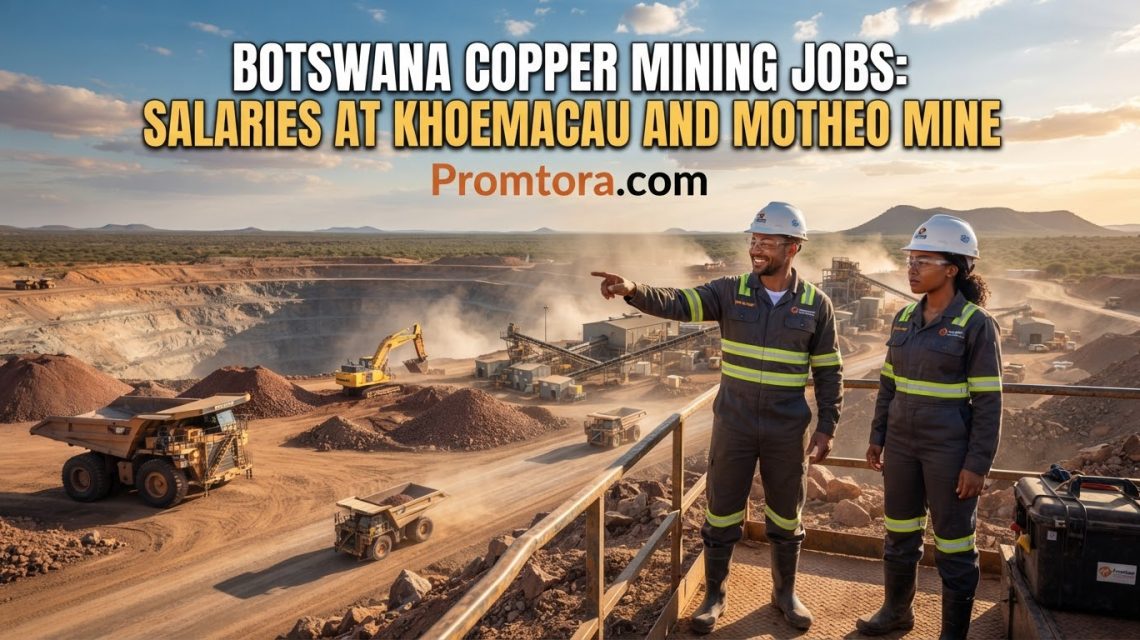
Botswana Copper Mining Jobs: Salaries at Khoemacau and Motheo Mine
The Kalahari Copper Belt has become one of the more active parts of Botswana’s mining map. Two names dominate the conversation: MMG’s Khoemacau operation and Sandfire’s Motheo mine near Ghanzi. Both are copper (and in Khoemacau’s case copper-silver) producers, both hire large numbers of Batswana, and both sit in the upper part of the local mining pay scale — though still below the very top packages associated with the biggest diamond operations. For job-seekers the practical questions are straightforward: what kinds of roles exist, what do they pay, and how does the full package compare once allowances and benefits are counted.
Neither company publishes a complete public salary grid. The ranges below are drawn from 2025–2026 industry market summaries, recruitment patterns and secondary reporting. They should be read as indicative rather than guaranteed offers.
The two operations in brief
Khoemacau, now under MMG after the 2023–2024 acquisition, operates in the Ghanzi/Ngamiland area with Zone 5 as a core underground focus. Headcount has been reported around 1,900–2,000 in recent official comments, with a major expansion under way. That expansion is expected to lift annual copper output toward 130,000 tonnes and to create several thousand additional jobs — construction peaks have been projected above 5,000 people on site, with a permanent workforce potentially exceeding 4,000 once the project is fully commissioned around 2028. Management has repeatedly stressed preferential hiring of locals and skills-transfer programmes.
Motheo, operated by Sandfire, is a more compact but established copper operation near Ghanzi. Permanent roles have been described in the region of 600, with over 95 percent held by Batswana and a high share of management positions also filled by citizens. Broader figures that include contractors push the on-site total higher. The mine contributes substantially to local procurement, wages and taxes, and continues to advertise technical and operational vacancies.
VIEW ALSO : Botswana Public Service Salary Scale: Government Pay and Allowances
Both employers compete for the same scarce skills — underground-experienced artisans, mining and metallurgical engineers, plant operators and supervisors — which helps keep their pay bands toward the stronger end of the Botswana copper and general mining market.
Indicative salary ranges
Across Botswana’s producing mines the 2026 market consensus looks roughly as follows. Khoemacau and Motheo generally sit in the upper part of these bands for comparable grades, especially once site and underground allowances are added.
| Role category | Indicative monthly base (BWP) | Notes for copper operations |
|---|---|---|
| General mine assistant / entry labourer | P3,500 – P8,000 | Lower end more common with contractors; majors toward the top plus allowances |
| Plant / machine operator, haul truck driver | P6,000 – P12,000 | Licences and tickets required |
| Trade-tested artisan (fitter, electrician, diesel mechanic, etc.) | P8,000 – P15,000 (copper mines often P9,000 – P14,000) | Khoemacau and Motheo compete actively for experienced underground artisans |
| Supervisor / overseer / shift boss | P15,000 – P25,000 | Trade background plus supervisory competence |
| Graduate / early-career engineer, geologist, metallurgist | P14,000 – P25,000 | Development programmes common |
| Mid-career mining / mechanical / electrical engineer | P25,000 – P60,000 | Experience and statutory competence move the figure upward |
| Section / engineering manager and above | P60,000 – P120,000+ | Fewer roles; higher responsibility and packages |
Figures are approximate 2026 industry ranges expressed in Botswana Pula. Actual offers depend on grade, notch, experience, site conditions and the prevailing collective or company terms. Debswana packages remain the national benchmark; copper producers typically sit a step below diamond majors on pure base pay but close much of the gap with allowances and benefits.
VIEW ALSO: Botswana’s Diamond Industry: Earnings and Contribution to GDP
Allowances and the real package
Base salary is only part of the story. At both Khoemacau and Motheo the full package commonly includes:
- Site or remote-area allowance (operations are outside major urban centres)
- Underground allowance where applicable (especially relevant at Khoemacau Zone 5)
- Shift differentials for night and continuous roster work
- Housing or housing support
- Medical aid
- Pension contributions
- Production or safety-related bonuses in some cases
Industry commentary regularly notes that allowances and benefits can add 15–40 percent or more to base pay. Underground and remote-site lines of P1,000–P3,500 per month (or higher in some configurations) are typical of the broader Botswana mining market and apply at these copper operations. That is why two people on similar grades can take home noticeably different amounts, and why base-only comparisons understate the value of a job at either mine.
Khoemacau-specific context
Khoemacau’s expansion is the largest single source of new mining jobs in Botswana in the mid-to-late 2020s. Construction and then operational hiring are expected to lift permanent employment well above current levels. Management has publicly committed to prioritising Batswana in both direct and contractor roles and to running skills programmes with local institutions. International specialists are still required for certain technical posts, but the stated direction is skills transfer and a rising local share of the workforce.
Because the operation includes underground mining, experienced fitters, electricians, miners and supervisors with underground tickets are in particular demand. Advertised artisan bases in the P9,000–P14,000 region are consistent with the competitive pressure these skills command on the copper belt.
Motheo-specific context
Motheo is smaller in permanent headcount but already operates with a high localisation rate — over 95 percent of direct employees and a strong majority of managers are Batswana according to company reporting. The mine continues to advertise technical, production, engineering and support roles. Pay sits in the same broad copper-mining bands as Khoemacau; the practical difference for many candidates is location, roster pattern and the precise mix of allowances rather than a fundamentally different salary structure.
Sandfire has also highlighted significant local economic contributions through wages, contractor payments, procurement and taxes, which reinforces the mine’s position as a major employer in the Ghanzi district.
What influences individual earnings
Several factors separate one offer from another even inside the same company:
- Trade test or professional registration — Class A artisans and registered engineers command higher bands.
- Underground versus surface experience — underground tickets and proven experience attract premiums.
- Roster and shift pattern — continuous operations and night work usually carry differentials.
- Grade and notch — both operations use structured grading; progression inside the scale matters.
- Contractor versus permanent employment — contractor packages are often lower and less secure on benefits.
Medical fitness, a clean safety record and, for many roles, a valid driver’s licence are standard requirements.
How to approach applications
Vacancies at both mines appear on company career portals, local job boards and occasionally through contractors involved in expansion work. Khoemacau roles are frequently listed via the MMG careers site with a Khoemacau location filter. Motheo posts appear on the Sandfire Motheo careers pages. Construction phases of the Khoemacau expansion also generate temporary and contractor demand that can serve as an entry route.
Because base scales are not fully public, candidates should ask for a clear breakdown of basic pay, allowances, housing arrangements, medical cover and any bonus scheme when an offer is made. Comparing only the basic figure with a public-service or pure contractor salary can understate the copper-mine package.
The broader copper-belt picture
Khoemacau and Motheo are the two most visible copper employers in Botswana right now. Together they are expanding the country’s non-diamond mining footprint and creating a growing pool of skilled jobs in the northwest. Pay is competitive within the local mining market, particularly for artisans and engineers with relevant experience, and the full package of allowances and benefits narrows the gap with the highest-paying diamond operations.
Exact monthly amounts still depend on the specific grade, site conditions and individual profile. The ranges above give a realistic 2026 frame of reference; the most reliable next step for anyone targeting these mines is to watch current vacancies, prepare the required tickets and qualifications, and evaluate each offer on the complete package rather than base salary alone.