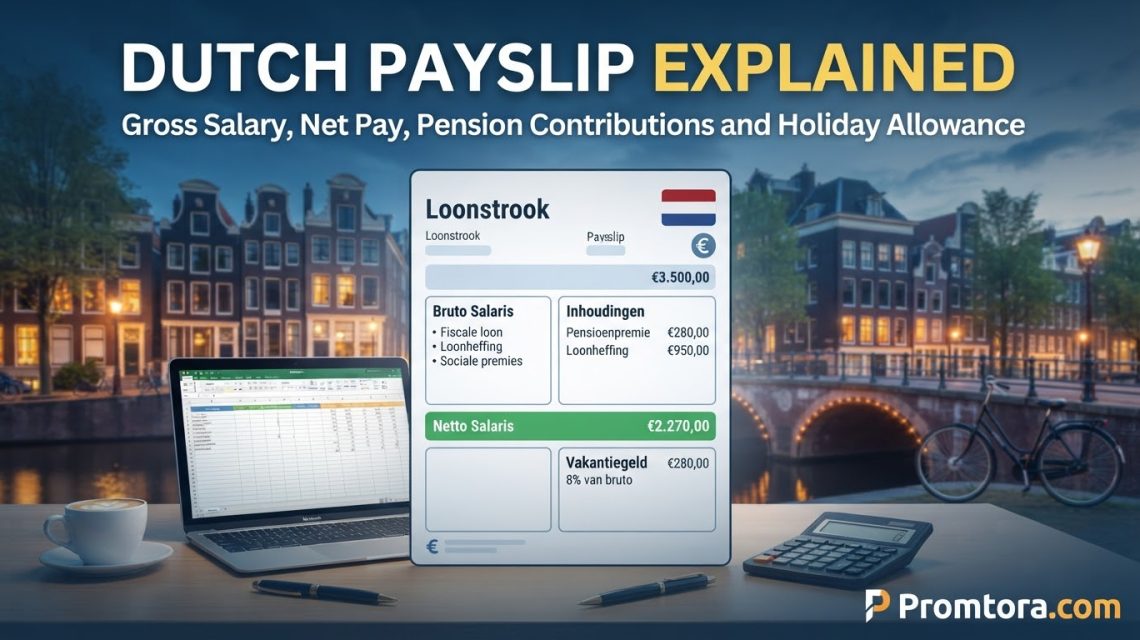
Dutch Payslip Explained: Gross Salary, Net Pay, Pension Contributions and Holiday Allowance
A Dutch payslip — the loonstrook — is usually short and dense. It starts with the amount you agreed with your employer (gross pay) and ends with the amount that lands in your bank account (net pay). Between those two figures sit payroll tax, any employee pension contribution, the build-up or payout of holiday allowance, and a handful of other lines that differ by employer and sector. Once you know what the main Dutch terms mean, the document becomes much easier to check.
VIEW ALSO Netherlands 30% Ruling : How Much Tax Foreign Workers Save?
This guide walks through the core elements: gross salary, how taxable pay is calculated, loonheffing, pension contributions, holiday allowance (vakantiegeld), and the net amount you actually receive.
Gross salary (brutoloon)
Brutoloon (also shown as salaris or basisloon) is your pay before tax and employee deductions. It is the contractual amount, or the amount set by a collective labour agreement (CAO), plus any overtime, shift allowances or other taxable supplements for that period.
Gross pay is not the same as the figure used for tax. Two adjustments commonly sit between brutoloon and the amount on which payroll tax is calculated:
- Your own pension contribution is usually deducted first. That reduces the wage that is subject to loonheffing.
- Tax-free reimbursements under the work-related costs scheme (for example a tax-free travel allowance) are handled outside the taxable wage.
What remains after the employee pension deduction is often labelled fiscaal loon, loon voor de loonheffing or similar — the taxable wage for that period.
VIEW ALSO : Dutch Supermarket Prices Compared: Albert Heijn, Jumbo, Lidl and Aldi
From gross to net: the main deductions
| Dutch term | English meaning | What it does |
|---|---|---|
| Brutoloon / basisloon | Gross pay | Contractual or CAO pay before deductions |
| Pensioenpremie (werknemer) | Employee pension contribution | Your share of the occupational pension; deducted before tax |
| Fiscaal loon / loon LB | Taxable wage | Base for calculating loonheffing |
| Loonheffing | Payroll tax | Wage tax + national insurance contributions withheld |
| Loonheffingskorting | Payroll tax credit | Whether the tax credits are applied on this payslip |
| Vakantiegeld / vakantiebijslag | Holiday allowance | At least 8% of gross; accrued and/or paid out |
| Nettoloon | Net pay | Amount transferred to your bank account |
Line names vary by payroll software and employer. The concepts above appear on almost every standard employee payslip.
Loonheffing: tax and national insurance in one line
Loonheffing is the combined withholding of:
- Wage tax (loonbelasting) — the income tax collected at source
- National insurance contributions (premie volksverzekeringen) — covering the state pension (AOW), survivor benefits (Anw) and long-term care (Wlz)
For employees below state pension age, the combined rates in 2026 are applied in brackets (illustrative): roughly 35.75% on the first band, 37.56% on the next, and 49.50% on income above the higher threshold. Exact bracket limits are set annually.[1]
Most employee insurance premiums (for unemployment and disability) and the employer’s Health Insurance Act levy are paid by the employer and do not appear as a deduction from your net pay. One possible exception is a small contribution toward the return-to-work fund (Whk), which some employers recover from net pay.
Tax credits — mainly the general tax credit (algemene heffingskorting) and the employed person’s tax credit (arbeidskorting) — reduce the loonheffing that is withheld, provided you have asked for the loonheffingskorting to be applied with this employer. You should normally apply the credit with only one employer or benefit agency to avoid under-withholding.
Pension contributions (pensioenpremie)
If your employer participates in an occupational pension scheme, your employee contribution appears as a deduction on the payslip. The employer also pays a (usually larger) share; that employer part does not reduce your net pay.
Typical employee shares often fall in a range of roughly 4–8% of pensionable salary, but the exact percentage and the definition of pensionable pay depend entirely on the scheme and the sector CAO. There is no single national employee pension rate.
Because the employee contribution is deducted before loonheffing is calculated, it reduces taxable wage. You do not pay income tax on the amount that goes into the pension in that year; pension income is taxed when you receive it later.
Always compare the pensioenpremie line with your employment contract, CAO and the pension fund’s own statements. Schemes differ widely between sectors and employers.
Holiday allowance (vakantiegeld / vakantiebijslag)
Dutch law gives employees a holiday allowance of at least 8% of gross wages. It is built up over a reference year (commonly June to May) and is usually paid out once a year, most often in May or June. Some contracts pay it monthly instead; in that case it still appears as a visible component.[2]
Key points:
- The legal minimum is 8%. CAOs or individual contracts can provide more.
- Structural pay elements (basic salary, regular overtime, fixed allowances) generally count toward the base; purely incidental payments often do not.
- When the annual amount is paid out in a lump sum, it is typically taxed at the bijzonder tarief (special rate), which is based on your annual income level and can look high on the payslip. The final tax position is settled in your annual income tax return.
- Many payslips show a monthly accrual (reservering vakantiegeld) even when payment is only once a year, so you can see how much has been built up.
A simple illustration: on a gross monthly salary of €3,000, the annual holiday allowance at 8% is 12 × €3,000 × 0.08 = €2,880 gross (before the special-rate tax is applied on payout).
Net pay (nettoloon)
Nettoloon is what remains after loonheffing, your pension contribution and any other employee deductions (for example a company-bicycle scheme, a net contribution to a staff association, or a small Whk premium). That is the amount transferred to your bank account for the period.
Net pay can change from month to month even if gross pay is fixed — for example when the holiday allowance is paid out, when a bonus is added, when tax credits are adjusted, or when a company-car addition (bijtelling) increases taxable wage.
Year-to-date (cumulatief) totals on the payslip help you check that the running sums of gross, tax and net are consistent with previous months.
Other lines you may see
- Dertiende maand — a thirteenth-month payment, if your contract or CAO provides it; often taxed at the special rate.
- Bijtelling auto — a taxable addition for private use of a company car.
- Onbelaste vergoeding — tax-free reimbursements (for example commuting) under the work-related costs scheme.
- Minimumloon — the statutory minimum wage for your age, which must be shown where relevant.
- 30% ruling — for qualifying expats, a tax-free allowance that reduces the taxable portion of salary (rules and percentages have changed over time; check current conditions).
What to check on every payslip
- Gross pay matches your contract or CAO for the hours worked.
- Pension contribution matches the rate and base you expect.
- Loonheffingskorting is applied by only one payer if you have more than one source of income.
- Holiday allowance is accruing (or has been paid) at least at the 8% minimum.
- Net amount and the payment date match what arrives in your account.
- Year-to-date figures look consistent.
If something is unclear, ask payroll or HR for a line-by-line explanation. The annual jaaropgaaf (year-end statement) summarises the totals you need for your tax return and is another useful cross-check.
Summary
On a Dutch payslip, brutoloon is pay before deductions; pensioenpremie (your share) is taken out before tax; loonheffing is the combined wage tax and national insurance withholding, reduced by tax credits if applied; vakantiegeld is at least 8% of gross and is usually paid in May or June; and nettoloon is what you receive. Employer social premiums are largely paid by the employer and do not reduce your net. Rates, brackets and credit amounts change by year, so the exact euros on your slip will differ from examples, but the structure stays the same.
References
- Expat Energy / payroll guides. “Dutch payslip (loonstrook) and jaaropgaaf explained” — required content of the payslip, loonheffing, employer Zvw levy, and special rate for holiday pay. https://www.expatenergy.nl/guides/work/dutch-payslip-jaaropgaaf
- Rijksoverheid and practical guides — statutory holiday allowance of at least 8% of gross wages; usual payout in May or June. See also Payslop and DutchExpatTax line-by-line explanations for 2026. https://payslop.com/guides/dutch-payslip-explained; https://www.dutchexpattax.com/guides/payslip-explained/
- NL Tax Guide. “Dutch payslip explained: every line decoded” — gross-to-taxable path, pensioenpremie, vakantiegeld accrual and bijzonder tarief. https://nltaxguide.com/guides/dutch-payslip-explained/
- ExpatTurtle. “Dutch Payslip Explained: Salary, Tax & Holiday Pay” (2026) — overview for newcomers of gross vs net, loonheffing, pension and holiday allowance. https://expatturtle.com/2026/10/02/dutch-payslip-salary-tax-pension-holiday-pay/
- Wet minimumloon en minimumvakantiebijslag (WML) — legal basis for the minimum 8% holiday allowance.
- Belastingdienst payroll tables and annual updates — loonheffing brackets, heffingskortingen and bijzonder tarief for the relevant tax year.