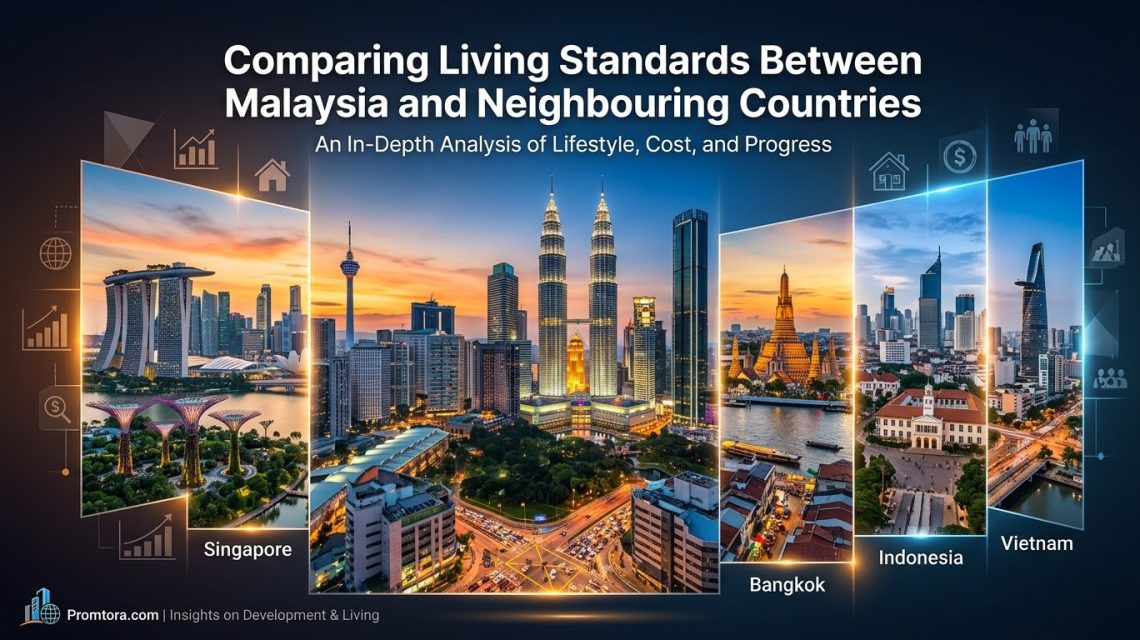
Comparing Living Standards Between Malaysia and Neighbouring Countries
Walk through a mid-range condominium in Petaling Jaya on a Saturday morning and you might hear the same conversation that plays out in countless Malaysian living rooms. Someone’s cousin just moved to Singapore and is sending photos of the new flat. Someone else is comparing grocery bills with a friend who relocated to Bangkok. A third person is quietly calculating whether the higher salary in the city-state actually leaves more money at the end of the month once rent and transport are paid. The question is never abstract. It is always personal: is life actually better over there?
Most regional rankings treat the answer as straightforward. Singapore sits at the top, Brunei follows thanks to oil, Malaysia occupies a respectable middle tier, and Thailand, Indonesia and the Philippines trail further behind. The numbers look clean on a spreadsheet. Lived experience is messier. Income figures, cost-of-living indices, hospital waiting times, school quality, traffic, and the simple ease of getting through an ordinary Tuesday all pull in different directions. Once you line the countries up properly, the hierarchy starts to shift depending on who you are and what you value.
The money picture that everyone starts with
IMF projections for 2026 put Singapore’s GDP per capita in purchasing-power-parity terms somewhere above $150,000. Brunei, with its small population and energy wealth, sits not far behind in the $90,000–$98,000 range. Malaysia lands roughly between $38,000 and $47,000 depending on the exact dataset. Thailand is lower, usually in the mid-$20,000s. Indonesia and the Philippines generally fall between $13,000 and $19,000.
Those headline numbers matter, but they do not automatically translate into daily comfort. A typical professional salary in Kuala Lumpur or Penang buys more housing space, more domestic help, and more restaurant meals than the same absolute amount would in Singapore. Numbeo’s 2026 cost-of-living index places Malaysia around 34 (with New York at 100). Thailand sits close by at 38. Indonesia and the Philippines are lower still, while Singapore climbs to the high 80s. Rent is the single biggest driver of the gap. A one-bedroom apartment that costs a few thousand ringgit a month in a decent Kuala Lumpur neighbourhood can easily cost four or five times that figure in central Singapore.
Average take-home pay follows the same broad pattern. Singapore’s median or average net monthly salary sits several times higher than Malaysia’s. Crowdsourced and official figures from late 2025 and 2026 put a typical Malaysian net salary somewhere around RM3,500–RM3,700. Thailand’s is lower, Indonesia’s lower again. Yet once you adjust for what that money actually purchases in housing, food and transport, the Malaysian position looks stronger for many middle-class households than the raw income rankings suggest.
| Country | Approx. GDP per capita PPP (2026) | HDI (2023 data) | Cost of Living Index (Numbeo 2026) | Typical net monthly salary range |
|---|---|---|---|---|
| Singapore | $150,000+ | 0.946 | \~87–88 | Several times higher than Malaysia |
| Brunei | $90,000–98,000 | 0.837 | \~48 | High relative to region |
| Malaysia | $38,000–47,000 | 0.819 | \~34 | RM3,500–3,700 average |
| Thailand | Mid-$20,000s | 0.798 | \~38 | Lower than Malaysia |
| Indonesia | $16,000–19,000 | 0.728 | \~26 | Significantly lower |
| Philippines | $13,000–14,000 | 0.720 | \~30 | Lower than Malaysia |
Figures drawn from IMF World Economic Outlook projections, UNDP Human Development Report 2025 (2023 data), and Numbeo cost-of-living indices updated through October 2026. Salary ranges are approximate averages and vary widely by sector and experience.
Health, schooling and the quieter advantages
The United Nations Human Development Index, which combines life expectancy, education and income, places Malaysia in the “very high” human development group alongside Singapore and Brunei. Thailand sits just below in the high category. Indonesia and the Philippines rank further down. Life expectancy follows a similar order. Singapore leads the region by a clear margin, often above 84 years. Malaysia and Thailand cluster in the mid-to-high 70s. Indonesia and the Philippines trail.
These differences show up in practical ways. Malaysia’s dual public-private healthcare system is widely regarded as more accessible and affordable for ordinary residents than Singapore’s heavily private model. Waiting times in public hospitals can still be long, but the overall cost of decent care remains lower. Many middle-class Malaysian families use private hospitals for routine procedures without facing the extreme bills common in Singapore. Thailand has built a strong medical-tourism sector that also benefits locals in major cities. Indonesia and the Philippines offer more uneven access, with quality care concentrated in a handful of urban centres.
Education tells a parallel story. Years of schooling and the quality of public secondary schools and universities give Malaysia a solid position relative to most neighbours except Singapore. Plenty of Malaysian families still send children to international schools or abroad when they can afford it, just as families in Thailand and Indonesia do. The difference is often one of degree. The baseline public system in Malaysia is generally stronger than in Indonesia or the Philippines, even if it does not match Singapore’s consistently high outcomes.
Housing, traffic and the texture of ordinary days
Housing is where the comparison becomes most concrete. Singapore’s HDB public-housing model has delivered high home-ownership rates and relatively predictable costs for citizens, yet private rental and ownership prices remain punishing for many, especially foreigners and younger residents. In the Klang Valley a professional couple can still realistically aim for a condominium or modest landed property on dual incomes in a way that is far harder across the Causeway. Bangkok offers a wide range of options at lower absolute cost than Kuala Lumpur in many segments, though quality and location vary sharply. Jakarta and Manila present steeper contrasts between modern gated communities and dense lower-income neighbourhoods.
Traffic and public transport shape daily life just as much as rent. Singapore’s MRT and bus network remain the regional benchmark. Kuala Lumpur has expanded its rail coverage significantly over the past decade, yet many residents still rely heavily on private cars. Bangkok’s congestion is notorious. Jakarta’s is frequently worse. These realities affect stress levels, family time, and the practical cost of living in ways that pure economic statistics rarely capture.
Air quality, green space, and the simple ability to walk or cycle safely also matter. Singapore scores high on cleanliness and order. Malaysian cities offer more space and a less intense pace for many residents, even if the infrastructure is less polished. Thai secondary cities such as Chiang Mai attract people precisely because they combine lower costs with a more relaxed atmosphere. Indonesian and Philippine cities often demand greater tolerance for infrastructure gaps and informal systems.
Safety, social life and the things that do not show up in indices
Personal safety rankings generally place Singapore at the top of the region, followed by Malaysia and then Thailand. The Philippines and parts of Indonesia lag further behind. Petty crime exists in Malaysian cities, as it does everywhere, but violent crime rates remain relatively low by regional standards. Political stability has also been more consistent in Malaysia than in several neighbouring countries over the past decade, though no system is free of tension.
Social texture is harder to measure but equally important. Many Malaysians who have spent time in Singapore remark on the efficiency and safety, yet also on the higher baseline intensity and the sense that every square metre is expensive. Those who have lived in Indonesia or the Philippines often note warmer, more flexible social atmospheres even while acknowledging weaker public institutions and greater economic insecurity for ordinary households. Thailand occupies a middle ground that many find appealing for lifestyle reasons, especially outside Bangkok.
Family networks and informal support systems remain strong across the region. In Malaysia these networks often function as a practical safety net that softens the impact of job loss or unexpected medical costs. The same is true, in different forms, in Thailand, Indonesia and the Philippines. Singapore’s more individualised and highly regulated environment offers fewer of those informal buffers, even as it provides stronger formal ones.
Who the numbers actually favour
The ranking changes depending on the person looking at it. A highly skilled professional or someone with Singapore permanent residency or citizenship usually finds the city-state offers higher absolute incomes, stronger public services, and clearer long-term career paths. For many middle-class Malaysian families with children, the combination of reasonable housing costs, accessible healthcare, and a less pressured daily rhythm makes life in Malaysia more practical and more comfortable than the GDP rankings alone would predict.
Lower-income households face tighter constraints everywhere. Subsidised public services and relatively lower housing costs in Malaysia and Thailand often provide more tangible relief than the equivalent systems in Indonesia or the Philippines. Expats and remote workers see yet another picture. Malaysia’s combination of moderate costs, decent infrastructure, and widespread English use makes it attractive. Thailand competes strongly on lifestyle and lower costs in secondary cities. Indonesia’s Bali and certain other locations draw people prioritising atmosphere over career infrastructure. Singapore remains expensive for most long-term stays unless a high-paying job covers the difference.
Young graduates chasing rapid salary growth and international exposure still look toward Singapore in large numbers. Families seeking space, dual-income stability, and room to breathe often stay in or return to Malaysia. People prioritising the lowest possible living costs and a relaxed pace may prefer certain Thai or Indonesian cities. None of these choices is universally right. Each involves trade-offs that the aggregate statistics only partially capture.
What the next few years are likely to change
None of these relative positions is fixed. Malaysia continues to push into higher-value manufacturing, digital services and regional logistics. If wage growth keeps pace with productivity and inflation remains moderate, living standards should continue to rise for a broad segment of the population. Singapore faces the familiar challenge of remaining competitive while managing high costs and an ageing society. Thailand’s tourism recovery and industrial base remain important, while Indonesia’s large domestic market