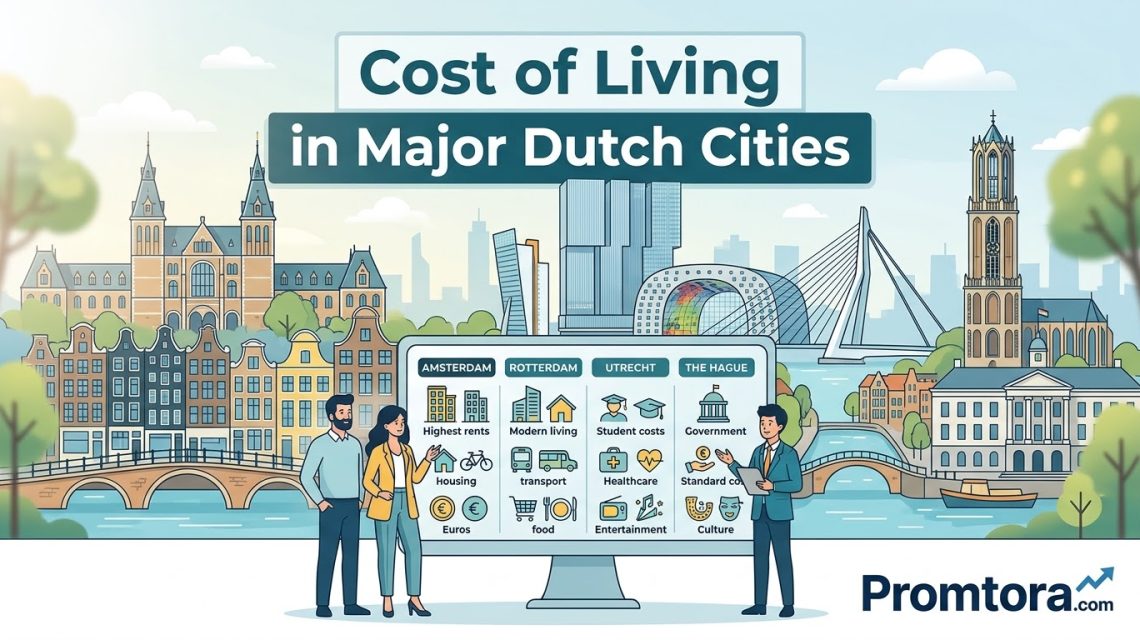
Cost of Living in Major Dutch Cities
You’ve probably heard the same line a dozen times: “The Netherlands is expensive, but Amsterdam is another level.” It’s true enough that people treat it like gospel. What gets lost is how uneven the picture really is once you step outside the canal belt.
I still remember the first time a friend who’d just signed a lease in Rotterdam showed me the numbers side by side with what I was paying in Amsterdam. Same size one-bedroom, similar commute times into the Randstad job market, yet the difference was enough to cover a decent holiday every year. That gap hasn’t closed in 2026. If anything, the housing shortage has made the differences between the big cities sharper.
What actually drives the cost
Rent remains the single biggest variable. Everything else — groceries, health insurance, public transport, a beer on a Friday night — sits in a much narrower band across the country. According to crowdsourced data updated through October 2026 on Numbeo, a single person’s monthly costs excluding rent land somewhere between roughly €1,000 and €1,200 in most major cities. Once you add housing, the spread widens dramatically.
Recent free-sector rental data (Pararius and Luntero reports through Q3 and August–September 2026) show median asking rents that tell the real story:
- Amsterdam continues to sit at the top. A one-bedroom in or near the centre routinely asks €1,800–€2,500, with many listings pushing higher. Outside the centre you might still pay €1,500–€1,900. Median asking rents for new listings hovered around €1,950–€2,400 depending on the exact month and sample.
- Rotterdam and The Hague offer noticeably more breathing room. One-bedrooms in the centre often fall in the €1,300–€1,800 range; outside the centre you can still find places under €1,400 in many neighbourhoods.
- Utrecht sits in between — closer to Amsterdam on price per square metre in popular areas, but with more options that land in the €1,400–€1,900 bracket for a one-bed.
- Eindhoven remains the relative bargain among the major employment hubs. One-bedrooms commonly start in the €1,100–€1,500 range, reflecting both lower demand pressure and the fact that many tech workers still choose to live a short train ride away.
These are asking prices for free-sector homes. Social and mid-rent housing exist, but waiting lists are long and eligibility rules are strict, especially for newcomers. Foreign workers on the 30% ruling or highly skilled migrant visas often find themselves competing in the open market from day one.
A practical side-by-side look
Here’s a rough monthly picture for a single person living modestly but not frugally in late 2026 (rent based on realistic mid-range one-bedroom, not the absolute cheapest listing):
| City | Typical 1-bed rent | Health insurance | Groceries + basics | Transport (OV + bike) | Utilities + internet | Estimated total |
|---|---|---|---|---|---|---|
| Amsterdam | €1,900–2,400 | ~€155–160 | €300–350 | €100–150 | €180–250 | €2,650–3,300 |
| Utrecht | €1,500–1,900 | ~€155–160 | €280–330 | €90–130 | €170–230 | €2,200–2,750 |
| Rotterdam | €1,350–1,800 | ~€155–160 | €280–330 | €90–130 | €170–230 | €2,050–2,650 |
| The Hague | €1,300–1,700 | ~€155–160 | €280–330 | €90–130 | €170–230 | €2,000–2,550 |
| Eindhoven | €1,150–1,500 | ~€155–160 | €270–320 | €80–120 | €160–220 | €1,850–2,350 |
Numbers move with the exact neighbourhood, whether the place is furnished, and how energy-efficient the building is. Utilities have stabilised somewhat after the energy shocks of earlier years, but older apartments still punish you in winter. Health insurance is mandatory and the average base premium sits around €155–160 a month in 2026; children under 18 are free, and income-related zorgtoeslag can reduce the net cost for lower earners.
What the money actually buys
In Amsterdam the premium buys density, international networks, and the simple convenience of never having to leave the city for most things. It also buys intense competition for every decent apartment and a higher chance of ending up in a smaller space than you imagined. Many people who start there eventually move to Haarlem, Amstelveen, or further out once the novelty wears off.
Rotterdam still feels like the underdog of the Randstad. You get more square metres, modern architecture, and a more relaxed pace, while remaining within easy reach of Amsterdam and The Hague by train. The Hague offers green space, the beach at Scheveningen, and a large international community tied to the embassies and courts — useful if your work is in that world. Utrecht’s central location is its superpower; you can reach almost anywhere in the country without changing trains. Eindhoven trades some of that connectivity for space, quieter streets, and salaries that often stretch further because of the ASML and tech ecosystem.
Groceries, dining out, and everyday costs do not diverge as sharply as rent. A mid-range meal for two is typically €70–€90 in all these cities. A monthly public transport pass or regular OV-chipkaart use plus a second-hand bike covers most needs; car ownership is expensive everywhere once you factor in parking, insurance, and the dense network of one-way streets and bike lanes.
A few realities that don’t show up in the averages
These figures are averages and mid-range estimates. Plenty of people live on less by sharing, living further out, or accepting older housing stock. Plenty of others spend more because they want a modern apartment, a balcony, or a neighbourhood that feels safe after dark. Foreign workers sometimes face higher effective costs because they cannot access certain subsidies or because landlords prefer tenants with Dutch permanent contracts. Students and young graduates often start with rooms rather than full apartments — Amsterdam rooms still command €900–€1,100 in many cases.
Inflation has cooled from the peaks of 2022–2023, but housing has not. CBS data shows continued pressure on rents and a modest rise in overall purchasing power in 2025 driven more by wage growth than by falling prices. The gap between the big Randstad cities and the rest of the country remains one of the defining features of Dutch living costs.
If you’re weighing a move or a job offer, the useful question is rarely “Is the Netherlands expensive?” It is “Which city actually matches the life I want and the money I will have left after rent?” Amsterdam will always feel like the centre of the action. For a growing number of people, the smarter financial and lifestyle choice sits one or two train stops away.