What Is the Minimum Basic Salary in the Netherlands in 2026/2027?
If you are considering a job in the Netherlands, planning to relocate, hiring staff, or simply trying to understand the Dutch labour market, one of the most practical questions is the legal minimum wage. The system is clear once you know the rules, but it differs from the way many other countries set their minimum pay.
Since 1 January 2024 the Netherlands has used a pure hourly minimum wage.
There is no longer a fixed monthly, weekly or daily statutory minimum. Every employee aged 15 and older is entitled to a specific gross amount for each hour worked. This rate is reviewed and adjusted twice a year — on 1 January and 1 July — so that it keeps pace with the general development of wages in the Dutch economy.
This article explains the exact figures for 2026, what is already known about 2027, how the monthly equivalent is calculated, the role of holiday allowance, the special rules for young workers, and the practical implications for both employees and employers. It also places the Dutch minimum wage in a broader European context and looks at how collective agreements often raise the floor in specific sectors.
VIEW ALSO : Is Prosus a good company to work for?
Official Minimum Wage Rates for 2026
The Dutch government publishes the statutory gross hourly rates in the Government Gazette (Staatscourant). The figures that apply throughout 2026 are as follows:
| Period | 21 years and older | 20 years | 19 years | 18 years | 17 years | 16 years | 15 years |
|---|---|---|---|---|---|---|---|
| 1 January – 30 June 2026 | €14.71 | €11.77 | €8.83 | €7.36 | €5.81 | €5.07 | €4.41 |
| 1 July – 31 December 2026 | €14.99 | €11.99 | €8.99 | €7.50 | €5.92 | €5.17 | €4.50 |
The adult rate (21 years and older) rose by 1.90% on 1 July 2026, from €14.71 to €14.99. The youth rates moved by the same percentage because they are calculated as fixed percentages of the adult minimum.
These percentages are:
- 20 years → 80%
- 19 years → 60%
- 18 years → 50%
- 17 years → 39.5%
- 16 years → 34.5%
- 15 years → 30%
Special lower rates still apply in 2026 for certain students following a work-based vocational pathway (beroepsbegeleidende leerweg or BBL) aged 18 to 20. Those rates will disappear from 1 January 2027.
How the Monthly Amount Is Calculated
Because the legal minimum is hourly, the amount someone receives each month depends entirely on the number of hours worked. There is no single “monthly minimum wage” figure that applies to everyone.
A simple way to estimate the gross monthly pay is:
Hourly rate × contractual hours per week × 52 ÷ 12
Using the rates that apply from 1 July 2026, the approximate gross monthly figures for full-time work (excluding holiday allowance) are:
- 36-hour week: €2,338
- 38-hour week: €2,468
- 40-hour week: €2,598
Many collective agreements and company policies still use a 36-hour or 38-hour full-time week, so the lower monthly figures are relevant for a large part of the workforce. Part-time employees simply receive the hourly rate multiplied by the hours they actually work.
It is important to remember that these calculations produce gross amounts. Income tax, national insurance contributions and any pension deductions are taken off before the employee receives the net salary.
Holiday Allowance – The Extra 8%
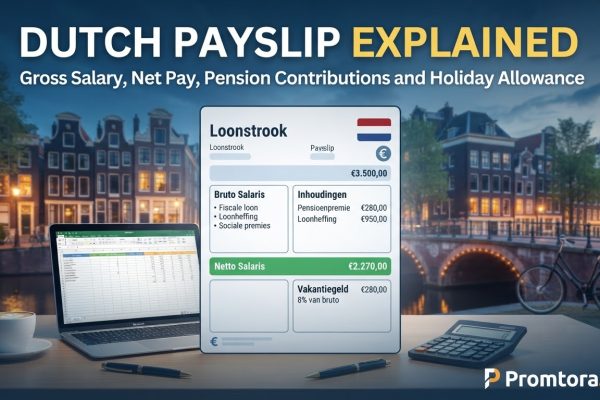
Dutch law requires employers to pay a holiday allowance (vakantiebijslag) of at least 8% of the gross salary. This payment is separate from the statutory minimum wage and does not count toward meeting the minimum.
Most employers pay the holiday allowance once a year, usually in May or June. Some choose to spread it across the twelve months. In either case it is an additional entitlement on top of the hourly minimum.
For someone earning exactly the minimum on a 40-hour week from July 2026, the 8% holiday allowance adds roughly €208 per month on average, or about €2,500 over a full year.
What Is Already Known About 2027
As of late October 2026 the exact adult minimum hourly rate for 1 January 2027 has not yet been published. The Ministry of Social Affairs and Employment normally releases the new figures in October or November. The adjustment is based on the average percentage change in contractual wages across the private, subsidised and public sectors.
Two important changes are already confirmed for 2027:
- The youth minimum wage percentages will increase. From 1 January 2027 the new scale will be:
- 20 years → 87.5%
- 19 years → 75%
- 18 years → 62.5%
- 17 years → 50%
- 16 years → 40%
- 15 years remains 30%
- The lower special BBL rates for vocational students aged 18–20 will be abolished. These young workers will then fall under the regular (higher) youth minimum percentages.
These changes form part of a broader policy effort to improve the financial position of young workers at the start of their careers.
Collective Agreements Often Set a Higher Floor
The statutory minimum is only the legal baseline. In many sectors a collective labour agreement (CAO) applies. CAOs routinely set higher wage scales, especially for jobs that require specific skills or experience. Hospitality, retail, cleaning, logistics, healthcare, construction and metalworking all have well-established CAOs that lift pay above the national minimum.
When a CAO applies, the employer must follow the higher rates. An individual employment contract cannot undercut a CAO. For this reason many people working in the Netherlands earn noticeably more than the statutory minimum even in entry-level roles.
Practical Implications for Employees
If you are starting a job or moving to the Netherlands, the statutory minimum gives you a clear safety net. Every hour must be paid at least at the applicable rate for your age. This includes overtime hours unless a CAO provides a higher overtime rate.
Young workers should pay particular attention to the age-related percentages. Turning 21 brings a significant jump because the full adult rate then applies. The planned increases in youth percentages from 2027 will reduce the gap for 16- to 20-year-olds.
It is also wise to check whether a CAO covers your sector. The difference between the statutory minimum and the CAO rate can be substantial in some industries.
Practical Implications for Employers
Employers must ensure that every employee aged 15 and older receives at least the correct hourly minimum. Records must be kept so that payment of the minimum can be demonstrated if the Labour Inspectorate asks. Recent legislative changes have strengthened enforcement and increased the risk of fines for underpayment.
From 22 October 2026 employers are no longer allowed to deduct rent from the minimum wage in certain situations, closing a loophole that had been used in some sectors. Other technical rules continue to evolve, so employers are advised to stay up to date via the official government channels.
How the Dutch Minimum Wage Compares in Europe
The Dutch statutory minimum ranks among the higher ones in the European Union when measured on an hourly basis. Countries such as Luxembourg, Ireland and Germany also have relatively high minima, while many southern and eastern European member states set lower floors. The twice-yearly indexation mechanism helps the Dutch rate keep pace with wage growth more quickly than systems that adjust only once a year.
For people relocating from lower-wage countries the Dutch minimum can represent a noticeable improvement in basic earnings. At the same time, the cost of living — particularly housing in the Randstad region (Amsterdam, Rotterdam, The Hague and Utrecht) — means that many households aim for salaries well above the legal minimum in order to live comfortably.
Net Pay and Cost-of-Living Considerations
The figures quoted throughout this article are gross. Net income depends on the employee’s tax credits, social-security position and whether they have student status, a 30% ruling (for certain highly skilled migrants), or other specific circumstances.
Housing costs remain the largest expense for most people in the Netherlands. Rent in the major cities has risen sharply in recent years, so even a full-time minimum-wage job can leave limited room for other spending if accommodation is expensive. Shared housing, living outside the largest cities, or securing a role that pays above the minimum are common strategies.
Recent Policy Direction
Successive Dutch governments have treated the minimum wage as an important instrument for protecting lower-paid workers. The shift to a pure hourly system in 2024 simplified the rules and removed anomalies that had existed under the old monthly system. The decision to raise youth percentages from 2027 continues that direction by improving the position of younger workers.
At the same time the authorities have made clear that enforcement will remain active. Underpayment, whether intentional or through administrative error, carries increasing financial and reputational risk for employers.
Final Overview
In 2026 the minimum basic salary in the Netherlands is €14.71 gross per hour from January to June and €14.99 from July to December for anyone aged 21 or older. Younger workers receive fixed percentages of that adult rate. There is no fixed monthly minimum; pay is calculated strictly on hours worked. An additional 8% holiday allowance is mandatory and sits on top of the minimum.
The adult rate for 2027 has not yet been announced, but higher youth percentages and the removal of the lower BBL rates are already confirmed. Collective agreements in many sectors set higher floors, so the statutory minimum is often only the starting point.
For anyone taking a job, changing employer, or moving to the Netherlands, the official hourly rates provide a clear and enforceable baseline. Checking the applicable CAO and understanding how hours and holiday allowance are handled will give a more complete picture of actual earnings.
The most reliable source for the latest figures remains the official websites of the Rijksoverheid and Business.gov.nl. Once the January 2027 rates are published they will appear there first.
Frequently Asked Questions
1. Is there still a fixed monthly minimum wage in the Netherlands?
No. Since 1 January 2024 the statutory minimum has been set exclusively as an hourly rate. The amount an employee receives each month is simply the hourly minimum multiplied by the number of hours worked in that month.
2. What is the minimum wage for a 21-year-old in the second half of 2026?
From 1 July 2026 the rate is €14.99 gross per hour. On a 40-hour week this produces approximately €2,598 gross per month before the 8% holiday allowance is added.
3. When will the exact minimum wage figures for 2027 be known?
The government normally publishes the new rates in October or November for the following 1 January. As of late October 2026 the adult hourly rate for 2027 has not yet been released. The higher youth percentages, however, are already decided.
4. Does the statutory minimum include holiday pay?
No. The mandatory 8% holiday allowance is paid on top of the minimum wage. It does not count toward meeting the legal minimum and must be provided separately.
5. Can an employer and employee agree on a wage below the statutory minimum?
No. The statutory minimum is mandatory for every employee aged 15 and older. Any contractual agreement to pay less is invalid. Where a collective agreement (CAO) applies, the higher CAO rates become the effective minimum and cannot be undercut either.