High-Demand Professions and Their Pay in the Dutch Market
A friend of mine who works in recruitment in Utrecht told me last month that she has stopped counting the number of times a client says “we’ll take almost anyone with the right papers.” The client is usually in healthcare or construction. The tone is half joke, half resignation. The Dutch labour market is still tight in 2026, even if the wild post-pandemic scramble has eased a little. Unemployment sits around 4 percent and open vacancies remain high. For people with the right skills, that tightness shows up as faster interviews, better offers, and in some cases pay that would have looked ambitious five years ago.
Not every shortage job is a high-paying one. Some of the most stubborn gaps sit in care work and skilled trades where the money is decent but not spectacular. Other shortages — especially in software, semiconductors and certain engineering roles — come with salaries that put people comfortably into the upper half of Dutch earners. The difference depends on how specialised the skill is, how long it takes to train someone, and whether the work can be done in English or still requires solid Dutch.
Where the pressure is strongest
UWV, the Dutch public employment service, still lists the same broad clusters year after year: healthcare, construction and installation technology, transport and logistics, engineering, and ICT. In 2026 the agency added a few more specific roles to its “promising professions” list — bricklayers, veterinary assistants, budget consultants, facility managers. The underlying story has not changed much. An ageing population keeps demand for nurses and care staff high. The energy transition and new housing targets keep electricians, installers and construction workers in short supply. Digitalisation and the semiconductor cluster around Eindhoven keep pulling in software and hardware talent.
CBS data shows ICT occupations and managers still sit near the top of the median hourly wage rankings. Health and welfare roles employ the largest absolute number of people but pay closer to the national middle. Technical occupations fall somewhere in between. What the averages hide is the spread. A junior nurse and a senior software engineer both work in shortage fields; their monthly pay slips look very different.
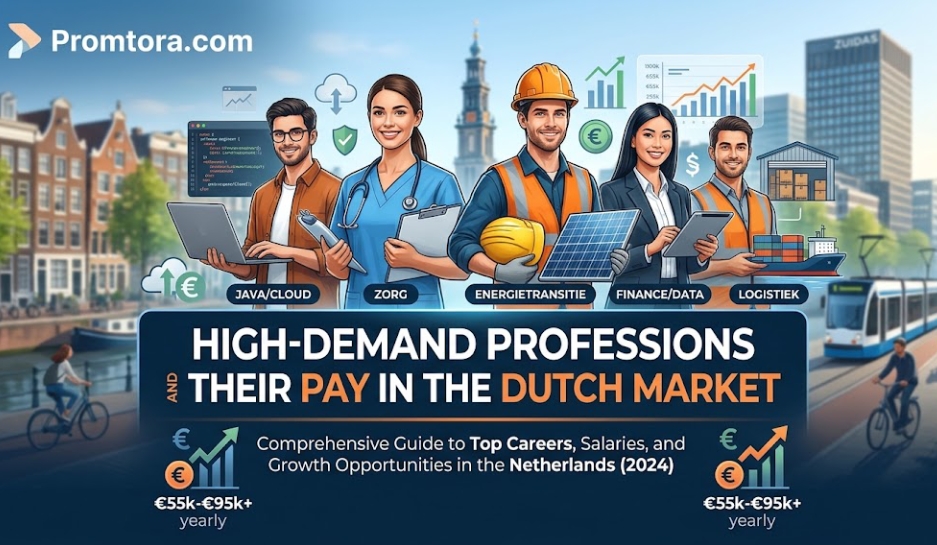
| Profession / Field | Typical gross annual range (2026) | Notes |
|---|---|---|
| Software / backend engineer | €65,000 – €95,000 | Higher at scale-ups and big tech; English often enough |
| DevOps / cloud / cybersecurity | €70,000 – €105,000 | Strong premium for cloud and security specialists |
| Data scientist / AI engineer | €68,000 – €110,000 | Fastest growth area; total comp higher with equity |
| Semiconductor / photonics engineer | €70,000 – €105,000 | Concentrated in Brainport Eindhoven |
| Mechanical / electrical engineer | €62,000 – €95,000 | Energy transition and manufacturing drive demand |
| Financial controller / risk analyst | €62,000 – €92,000 | Steady shortage in mid-sized firms |
| Registered nurse (BIG-registered) | €38,000 – €55,000 | Dutch language usually required; shift allowances extra |
| Medical specialist | €90,000 – €160,000+ | Highest earners; long training path |
| Electrician / installation technician | €38,000 – €55,000 | Energy transition and housing push demand higher |
| Truck / lorry driver (international) | €42,000 – €55,000+ | Recent sharp pay rises; shortage still acute |
Ranges compiled from UWV shortage lists, Robert Half 2026 Salary Guide, CBS occupation data, and market reports from late 2025–2026. Actual offers vary by experience, region, company size and whether the 8 % holiday allowance is included in the quoted figure.
IT and tech: the clearest money story
If you look only at pay, software and data roles dominate the high end of the shortage list. A mid-level software engineer in Amsterdam or Utrecht commonly sits between €70,000 and €90,000 gross. Senior cloud, DevOps or cybersecurity specialists regularly clear €90,000 and sometimes move past €100,000, especially at companies competing with international tech employers. AI and machine-learning roles have seen some of the steepest growth in both demand and pay.
English is often enough in these jobs. Many product and engineering teams at Booking.com, Adyen, ASML’s software side, and the larger scale-ups operate primarily in English. That lowers the barrier for internationals compared with patient-facing healthcare or site-based construction work. The flip side is competition. The same roles attract candidates from across Europe, so the bar for experience and portfolio quality has risen.
What the salary actually buys depends heavily on where you live. In Amsterdam a €80,000 package still leaves a single person or couple watching rent carefully. In Eindhoven, Groningen or parts of Brabant the same money stretches further. Many tech workers now negotiate hybrid or fully remote arrangements precisely to escape the Randstad housing premium.
Healthcare: steady demand, more modest pay
Nurses remain one of the largest absolute shortage groups. A registered nurse with BIG registration typically earns between €38,000 and €55,000 depending on experience, specialisation and shift patterns. Night and weekend allowances can add meaningfully to the take-home figure. Specialist nurses and physician assistants sit higher. Medical specialists — cardiologists, radiologists, surgeons — remain among the highest-paid professionals in the country, with many earning well into six figures once they are fully qualified.
The catch for most international candidates is language and registration. Patient-facing work almost always requires solid Dutch (B2 or higher) and formal recognition of qualifications. That process takes time and filters out many people who would otherwise be interested. Hospitals and care organisations continue to recruit abroad, but the pipeline is slower than for tech roles.
Engineering, construction and the energy transition
The physical side of the economy is just as short of people. Electrical and mechanical engineers, mechatronics specialists, and especially semiconductor process engineers around Eindhoven command strong packages — often €65,000 to €100,000+. Civil and water-management engineers remain in demand because of both climate adaptation projects and the housing shortfall.
Lower down the qualification ladder the picture is different. Bricklayers, electricians, installers of heat pumps and solar systems, and construction site supervisors are desperately needed. Pay has risen, but many of these roles still sit in the €38,000–€55,000 band. The work is physical, the hours can be long, and Dutch is usually required on site. Employers have started offering more training and faster routes into permanent contracts because the alternative is delayed projects.
Transport tells a similar story. International lorry drivers saw one of the sharpest quarterly pay jumps recorded in early 2026. The demographic problem is obvious: the average driver is getting older and fewer young people are entering the profession. Operators are paying more and still struggling to fill seats.
VIEW ALSO : Cost of Living in Major Dutch Cities
What the numbers mean in daily life
A gross salary of €70,000 in the Netherlands typically leaves a single person with roughly €3,800–€4,200 net per month after tax and social contributions, depending on exact circumstances and the 30 % ruling if it applies. That is enough for a comfortable one-bedroom or small two-bedroom flat outside the most expensive Amsterdam postcodes, regular eating out, a car or good public-transport pass, and decent holidays. Inside the canal belt or in the hottest neighbourhoods of Utrecht the same money feels tighter.
At the lower end of the shortage spectrum — a nurse or electrician around €45,000 gross — the lifestyle is more constrained in the Randstad but still workable in many secondary cities. Housing remains the single biggest variable. People who can live outside the most pressured housing markets keep far more of their salary as disposable income.
Benefits matter more than they used to. Many employers in tight fields now compete on hybrid working, extra leave, training budgets, and contribution to commuting or pension rather than pure base salary. In tech the total compensation conversation often includes equity or bonuses that can swing the real number by 10–20 percent.
Who actually gets these jobs
Dutch employers still prefer candidates who already have the right diploma or registration and, where relevant, the language. For tech and many engineering roles the language barrier is lower. For healthcare, teaching and most construction work it remains high. The highly skilled migrant route and the EU Blue Card continue to be the main legal pathways for non-EU talent in the higher-paid shortage occupations. Salary thresholds for 2026 sit at roughly €5,942 gross per month for people over 30 (lower for under-30s and recent graduates).
Regional differences are real. Eindhoven and the surrounding Brainport area punch above their weight for semiconductor and high-tech engineering roles. Amsterdam and Utrecht dominate pure software and fintech. Rotterdam and the logistics corridor need planners, drivers and warehouse specialists. Care shortages exist almost everywhere, but the competition for staff is fiercest in the big cities where housing is hardest.
The market has cooled slightly from the peak of 2022–2023. Vacancies are still high and most occupational groups remain tight, yet employers have become a little more selective again. The people who move fastest are those who can show recent, relevant experience and who are realistic about location and language requirements. Pure credential collecting without practical skills is less effective than it was a few years ago.
For anyone deciding whether to retrain, relocate or simply change jobs inside the Netherlands, the useful question is not “which profession is short-staffed?” Almost every technical and care field still is. The better questions are: how long will the training take, how much Dutch do I need, where am I willing to live, and does the realistic pay after tax and rent actually improve my life? The answers differ for a software engineer eyeing Amsterdam, a nurse considering a move from abroad, and an electrician looking at the energy-transition wave. The shortages are real. The pay is better than it used to be in most of these fields. Whether it is good enough depends on the rest of the equation.